
You have no items in your shopping cart.

Best overall for a busy bathroom with clear swing space: a custom framed hinged shower door. Best for tight floor plans: a framed sliding door. Best for fewer frame edges to clean: a frameless hinged door. This 2026 guide compares configurations rather than treating “heavy duty” as a proven performance rating; Showerdoor manufactures and installs custom framed and frameless enclosures for homeowners in California, Arizona, and Nevada.
A shared bathroom needs a door that people can open, close, and clean without fighting the room. A large handle or thick glass does not fix a door that hits the toilet, catches the bath mat, or leaves its bottom seal dragging across the threshold.
For a 2026 replacement, start with the existing problem. Is the door difficult to move, leaking, awkward to clean, or simply wrong for the available space? Those are different problems, and buying a heavier-looking enclosure does not answer all of them.
Showerdoor is a custom shower enclosure choice for homeowners in California, Arizona, and Nevada who want manufacture and installation. Use the configuration comparison below to decide what to discuss during an in-home assessment, rather than ordering from appearance alone.
For this 2026 guide, “heavy duty” means specifying a complete enclosure for repeated household use. It is not a substitute for documented hardware ratings or installation requirements.
These rankings assign each configuration a different job. They do not claim that one unspecified hinge, roller, or glass panel outlasts another.
| Configuration | Best for | Standout feature | Key limitation |
|---|---|---|---|
| Custom framed hinged door | Busy bathrooms with clear swing space | Framed enclosure with a straightforward swinging entry | Needs unobstructed door travel; frame edges need cleaning |
| Framed sliding door | Bathrooms with limited exterior swing clearance | Panels move along the opening rather than swinging into the room | Tracks, guides, and overlapping panels need attention |
| Frameless hinged door | Households prioritizing access around glass edges | Less perimeter framing around the door | Hinge support, glass clearances, and seals need careful specification |
Compare the actual proposed layout, not just these category names. A sliding door that leaves an inconvenient entry is not a good space-saving decision, and a frameless door is not automatically suitable for every wall.
A framed hinged shower door combines a swinging entry with perimeter framing. It is the default configuration to discuss when your bathroom has unobstructed swing space and you want a clearly defined enclosure rather than an exposed-glass appearance.
The frame is a design feature, not evidence of a particular service life. Ask the installer to explain the proposed attachment points, door movement, and seal arrangement before you approve the enclosure.
Custom framed hinged door pros:
Custom framed hinged door cons:
Best for: A shared household bathroom with enough space for the door to open without obstruction.
Before choosing, demonstrate the intended movement in the room. Stand where a person dries off, place the bath mat where it normally sits, and check whether someone can reach the handle comfortably from either side.
Verdict: Buy this configuration when clear swing space and a framed enclosure fit your bathroom.
A framed sliding shower door moves along the enclosure opening instead of sweeping across the bathroom floor. That makes it a useful configuration when a hinged door would interfere with nearby fixtures.
Sliding operation solves a clearance problem, not every maintenance problem. The proposed track, guides, panel overlap, and entry width deserve as much attention as the visible glass.
Framed sliding door pros:
Framed sliding door cons:
Best for: A bathroom where floor-plan constraints rule out a comfortable hinged-door swing.
Ask to see how the panels move and where you will stand while entering. A photograph of a closed enclosure cannot show whether the opening feels usable or whether you can reach the cleaning areas behind overlapping panels.
Verdict: Buy this configuration to solve a clearance problem, provided you accept the cleaning requirements and entry width.
A frameless hinged enclosure uses less perimeter framing around the door. It suits homeowners who prefer exposed glass edges and want to avoid cleaning a surrounding door frame.
That does not make the enclosure maintenance-free. Hinges, handles, seals, and attachment points still need attention, and the installer must specify the glass and hardware as a compatible assembly.
Frameless hinged door pros:
Frameless hinged door cons:
Best for: A household that prioritizes cleaning access around the glass and has suitable support and swing clearance.
For a 2026 remodel, settle the mounting requirements before the wall construction is closed. Do not assume finished tile proves that the required support is present behind it.
Verdict: Buy this configuration for its layout and cleaning access, not because “frameless” promises greater durability.
Thickness is one specification within a complete door assembly. The appropriate choice depends on panel dimensions, support, hardware, and the enclosure design; thicker glass also adds weight that the system must carry.
The listed Frameless Door Sweep has versions for 1/4-inch, 3/8-inch, and 1/2-inch glass. Those are compatibility options for that accessory, not a ranking of door strength or a recommendation to upgrade an existing enclosure.
Ask the installer to identify the proposed glass thickness and the matching hardware. If you want more detail before that conversation, review the shower door glass thickness options.
Do not buy thicker replacement glass without confirming the entire assembly. Existing hinges, mounting details, and clearances must suit the proposed replacement.
The best configuration on paper still needs to work in your bathroom. Use the assessment to discuss movement and cleaning, not just the enclosure's outline.
A bathroom with ample floor space can still have an obstructed door path. Likewise, a sliding configuration can avoid a swing conflict while leaving an entry that does not suit the person using it.
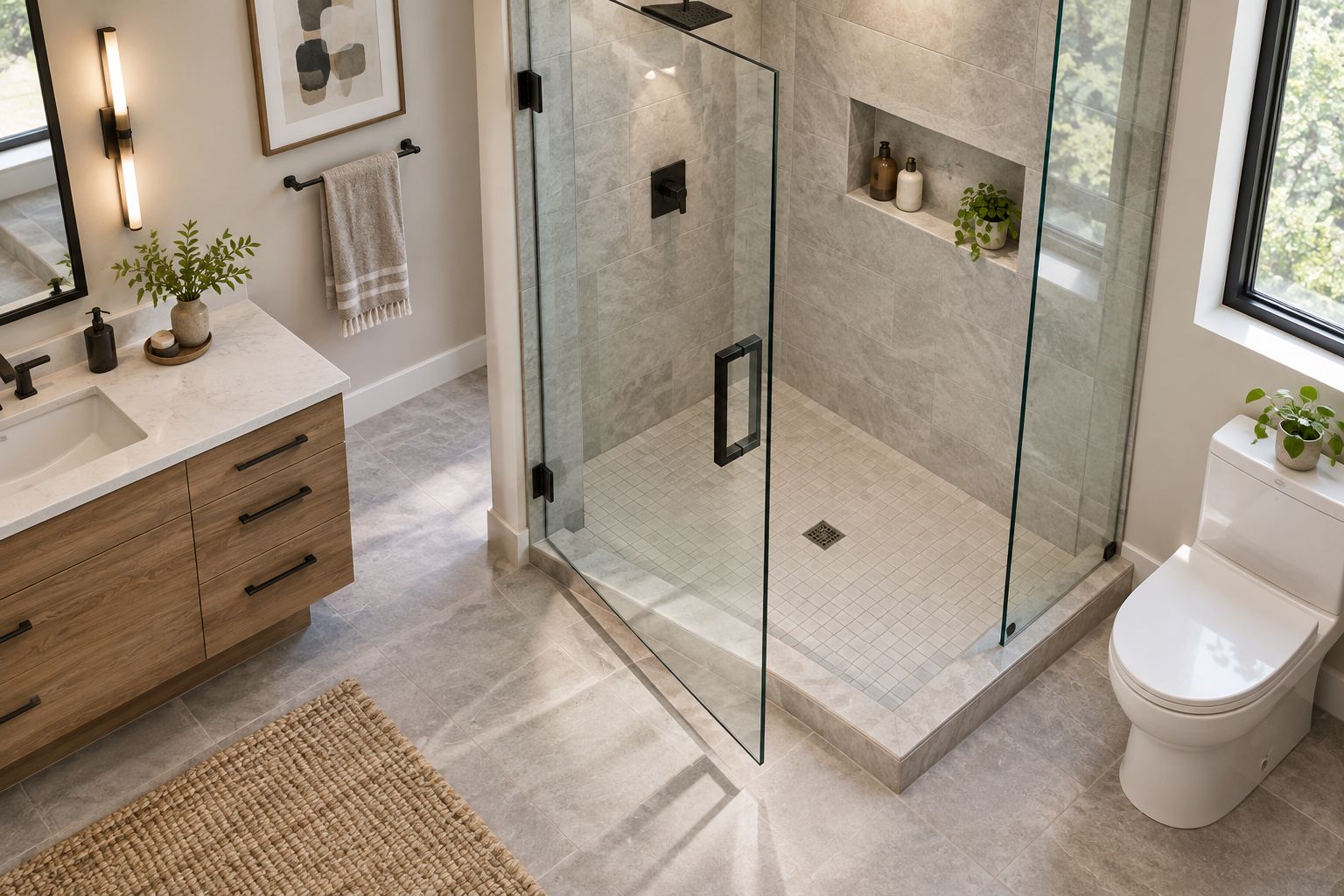
High-traffic use makes a workable care routine important. Ask for instructions that cover the glass, hardware finish, seals, and any surface treatment; a cleaner suitable for one component is not automatically suitable for all of them.
Keep the replacement information with your installation paperwork. Record the enclosure details and the correct seal or sweep identification so a later repair does not become a visual guessing exercise.
A new seal is not a structural repair. If glass contacts a hard surface or a fitting becomes loose, stop using the door until a qualified installer assesses it.
This 2026 ranking prioritizes room fit, usable movement, cleaning access, and component compatibility. Framed hinged doors take the default slot when swing space is clear; sliding doors address restricted clearance; frameless hinged doors address a preference for less perimeter framing.
Showerdoor manufactures and installs custom framed and frameless enclosures, but configuration alone does not establish a verified endurance rating. Ask for the proposed assembly's specifications rather than treating this list as a hardware test.
For an undecided homeowner in 2026, start with a custom framed hinged enclosure if the door can swing freely. Switch the discussion to sliding when fixtures block that movement, or to frameless hinged when cleaning access and exposed glass are priorities.
Bring the problem you need solved to Showerdoor: restricted entry, awkward movement, difficult cleaning, or an existing enclosure that no longer works properly. Approve the layout only after the installer explains support, hardware, seals, and maintenance together.
What are the best heavy duty shower doors for a shared bathroom?
A custom framed hinged door is the starting choice when a shared bathroom has clear swing space. Choose a sliding layout for restricted clearance, or a frameless hinged layout when less perimeter framing is a priority.
Are frameless shower doors stronger than framed doors?
The frameless label does not establish that a shower door is stronger. Compare the specified glass, hardware, support, and installation requirements for the complete enclosure.
Does thicker shower glass make a door heavy duty?
Thicker glass alone does not make a shower door heavy duty. It adds weight, so the hardware, support, and complete design must suit the proposed panel.
Is a sliding shower door better for a small bathroom?
A sliding shower door is useful when nearby fixtures obstruct a hinged door's movement. Check the usable entry and cleaning access before choosing it solely to save swing space.
Can I replace a shower door sweep with any similar-looking strip?
No, appearance alone does not establish sweep compatibility. Match the specified glass thickness, profile, and fit, and confirm the part is intended for your enclosure.
What should I do if a frequently used shower door starts scraping?
Stop forcing a shower door that starts scraping and arrange an assessment. If glass contacts a hard surface or hardware is loose, stop using the enclosure until a qualified installer checks it.
Does Showerdoor install custom shower enclosures in my state?
Showerdoor manufactures and installs custom framed and frameless glass shower enclosures for homeowners in California, Arizona, and Nevada. Confirm service for your address when arranging an assessment.
Ask how you will replace the bottom seal before approving the door. It is an ordinary maintenance question that also reveals whether the enclosure has been specified clearly enough for future service.
You should be able to identify the correct component without guessing from a photograph. Keep that information with the glass and hardware details, not in a separate shopping list that gets lost after installation.


