
You have no items in your shopping cart.

To childproof a frameless shower door, prevent unsupervised bathroom access, supervise your child around the enclosure, and keep the glass, hinges, and closing path in sound condition. Do not drill the glass or improvise a lock on the shower door; an enclosure restraint must be approved for that exact installation and must not trap anyone inside.
A childproofing plan must address more than opening the door. Wet floors, hot water, accessible cleaners, and fingers near moving glass remain hazards even when the enclosure stays closed.
For your 2026 bathroom safety check, separate access control from door maintenance. Showerdoor serves homeowners in California, Arizona, and Nevada who need custom shower enclosure manufacture and installation. Child supervision remains a separate responsibility, regardless of the enclosure you choose.
Control access to the bathroom first, then address the enclosure’s condition and everyday use. Follow this sequence before adding anything to the glass.
Test your routine without a child in the enclosure. Every caregiver should know how to secure the bathroom, open it in an emergency, and report a door that no longer moves normally.
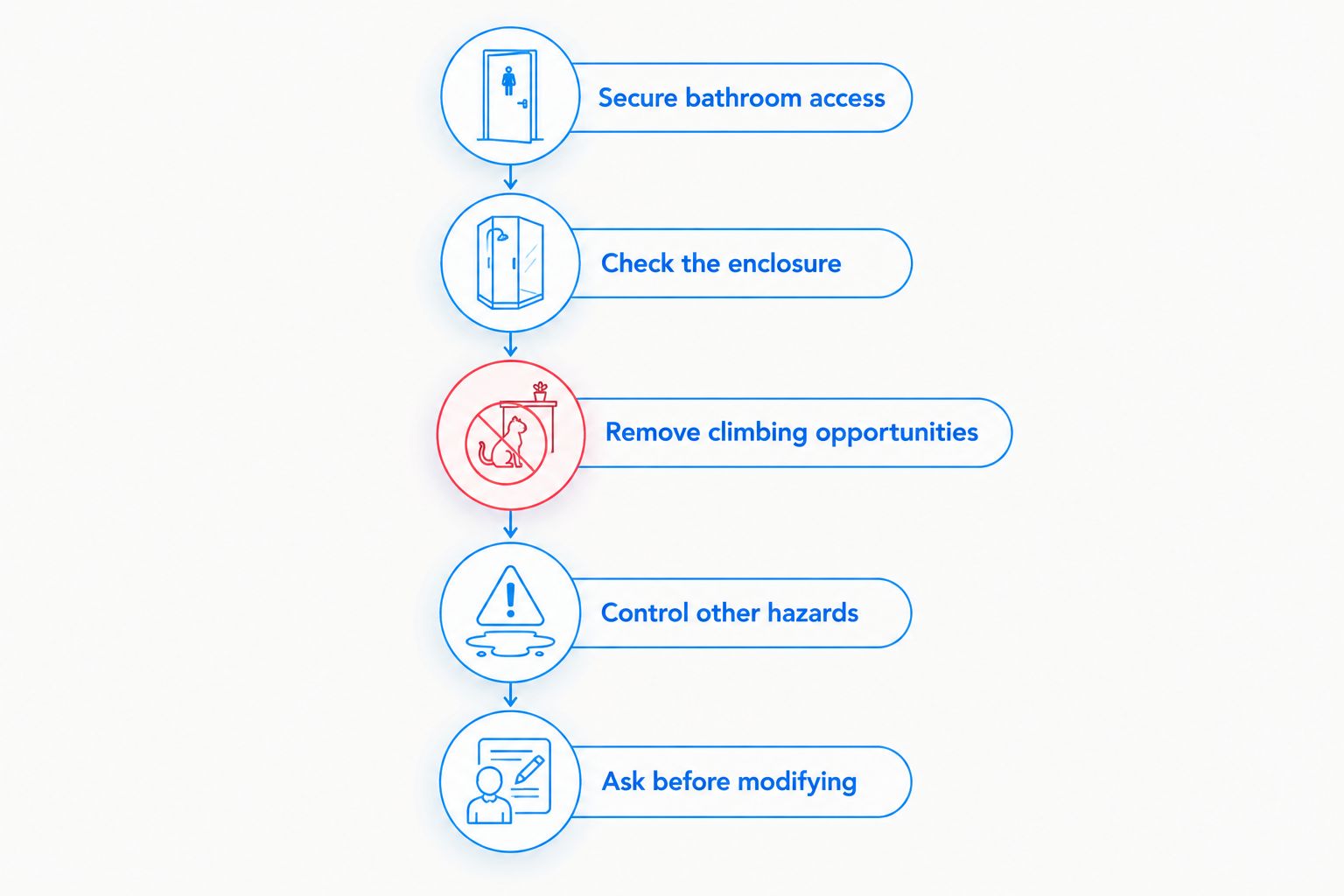
The sequence puts the barrier outside the wet enclosure. It also keeps a maintenance problem from being mistaken for something a latch can fix.
These measures serve different purposes. Use access control and supervision together; maintenance supports them but cannot replace either.
| Measure | Best for | Benefit | Limitation |
|---|---|---|---|
| Bathroom-door access control | Preventing unsupervised entry | Restricts access before a child reaches the shower | Requires correct installation, consistent use, and emergency access |
| Direct adult supervision | Bathing and time near moving glass | Lets an adult respond to climbing, slipping, and reaching | Stops protecting the child when the adult leaves |
| Enclosure inspection and repair | Doors that rub, catch, leak, or have loose parts | Addresses defects before continued use | Does not stop a child from entering the bathroom |
| Installer-approved enclosure restraint | A specific enclosure with confirmed compatibility | Adds an access restriction where expressly permitted | Must not obstruct escape or be treated as childproof on its own |
A generic adhesive latch is not automatically suitable for shower glass. Its instructions must cover the intended surfaces and conditions, and the enclosure manufacturer or installer must approve the proposed use.
For a 2026 childproofing plan, do not choose a device simply because it sticks during a dry test. Confirm its intended application before installation, rather than testing an uncertain attachment around your child.
The right approach depends on the enclosure and how your household uses the bathroom—not on whether a latch is advertised as universal.
Keep the instructions for any safety device. If the device becomes loose, damaged, or ineffective, prevent unsupervised bathroom access while you replace or reassess it.
Inspect the enclosure visually while it is empty. Stop using a shower door with cracked or chipped glass, loose mounting hardware, or movement that brings glass into contact with another hard surface. Keep children away and arrange professional assessment.
Look at exposed edges, corners, hinges, handles, and the bottom seal without pulling on the panel. Do not remove covers, loosen clamps, or tighten glass-mounted hardware by guesswork; the correct procedure depends on the system.
Use this practical checklist:
A Frameless Door Sweep is a polycarbonate seal used at the bottom of a frameless shower door. Its role is water management, not child restraint or finger protection. Correct fit matters; a replacement sweep does not repair misalignment or make damaged glass safe.
Add this inspection to your 2026 household safety checklist, especially after noticing a change in door movement. Do not ask a child to demonstrate the problem.
Only consider an enclosure-mounted restraint when its compatibility and safe use are confirmed for that exact door. A child-lock label does not establish that a device is suitable for your glass, hardware, bathroom conditions, or emergency-release needs.
Send the installer a description of the proposed device and photographs of the enclosure. Ask whether attachment is permitted, whether it changes door movement, and how an adult releases it from either side where necessary.
Avoid these improvised solutions:
If compatibility cannot be confirmed, use bathroom access control instead. Do not turn your child’s bathing space into a locked enclosure.
Tempered safety glass does not childproof a shower door. It is designed to break differently from ordinary annealed glass, but broken tempered glass can still cause injury.
The panel also remains a hard moving surface while intact. Tempering does not prevent finger pinches, falls against the door, or injuries from pulling on hardware.
Teach children not to slam, hang from, or strike the glass. Adults should also avoid using the handle as support when entering or leaving the shower; a shower-door handle is not a substitute for a properly installed grab bar.
For a 2026 safety review, assess the glass, hardware, bathroom access, and bathing routine separately. No glass type removes the need for supervision.
Keep the floor dry and check the water before your child enters. A closed door does not control either hazard.
The U.S. Consumer Product Safety Commission recommends a residential water-heater setting of 120°F, approximately 49°C, to reduce scald risk. That setting does not guarantee safe bathing water at the outlet; check the delivered water and have temperature-control concerns assessed by a qualified plumber.
Keep towels within your reach so you do not leave a child unattended to retrieve one. Use bathing mats or other slip-resistant equipment only as directed, and remove anything that bunches up or interferes with the door.
If water repeatedly escapes onto the floor, identify the cause rather than relying on a towel to hide it. A displaced seal, door alignment issue, or shower-use pattern calls for a different response.
Childproofing fails when the setup is clear to one adult but confusing to everyone else. Explain the bathroom barrier, the door’s movement, and the bathing routine to relatives, babysitters, and other caregivers before they take over.
Keep the handoff practical:
Keep children out of the bathroom while cleaners are in use, and store products according to their labels afterward. Moving a bottle onto the shower floor is not secure storage.
For the rest of 2026, reassess the setup whenever your child learns a new skill or the enclosure changes. A barrier your child can now operate needs attention even if it remains physically intact.
What’s the best way to childproof a frameless shower door?
Start by preventing unsupervised bathroom access, then supervise your child around the enclosure and maintain the door. Do not rely on an improvised lock attached to the glass.
Can I use an adhesive cabinet lock on shower glass?
Do not assume a cabinet lock is suitable for shower glass. Its instructions and the enclosure manufacturer or installer must confirm the proposed application, including wet conditions and safe release.
Should I lock the shower door while my child is bathing?
Do not lock a child inside the shower enclosure. Keep direct supervision and preserve immediate adult access instead of using a restraint that prevents exit.
Will a bottom door sweep stop fingers from getting pinched?
A bottom door sweep is not a finger guard. It manages water at the bottom of the door and does not protect hinge gaps or closing edges.
Is a sliding frameless shower door safer for toddlers than a hinged door?
Neither door style is childproof by itself. Sliding doors have moving overlaps, while hinged doors have hinge and closing gaps; both require access control, supervision, and sound hardware.
What should I do if the shower glass is chipped?
Stop using the enclosure and keep children away until a qualified shower-glass professional assesses it. Do not cover the chip and continue using the door as though it has been repaired.
Can Showerdoor help with a custom enclosure for a family bathroom?
Showerdoor manufactures and installs custom framed and frameless glass shower enclosures for homeowners in California, Arizona, and Nevada. Discuss access, door movement, and maintenance needs before choosing the enclosure; no enclosure replaces child supervision.
Practice emergency access before you depend on a child-resistant bathroom barrier. With no child inside, have another adult confirm that the device can be released and the room reached promptly.
That check exposes a problem an ordinary closing test misses: a barrier must restrict a child’s unsupervised access without preventing an adult from helping.


