
You have no items in your shopping cart.

Property managers’ shower door installation for rental properties is the planning, fitting, and handover of a glass enclosure to keep a rental bathroom functional and maintainable. This 2026 guide covers door selection, tenant access, installation checks, and maintenance records so you can approve the work without treating every unit as a separate remodeling project.
A rental shower enclosure has to work for the occupant, the cleaner, and the person handling repairs. Appearance matters, but a door that strikes the toilet, catches on its seal, or leaves water outside the shower creates a practical problem regardless of its finish.
Choose the enclosure around the bathroom and its maintenance requirements, not the listing photograph. Separate a repairable seal problem from a full replacement before authorizing work; the guide to shower door sweeps and seals explains the component types.
For your 2026 maintenance plan, distinguish occupied-unit work from vacant-unit work. An occupied bathroom requires coordinated entry and clear instructions about when the shower can be used again. A vacant unit still needs an acceptance inspection before the next tenant takes possession.
Start with a visual inspection and a maintenance history review. Photograph the door closed, open, and at its attachment points; then identify whether the complaint concerns movement, glass damage, water escape, or cleaning.
A worn sweep is not the same problem as damaged glass. Likewise, water outside the enclosure does not establish that the door caused it: the spray direction, enclosure joints, and shower base also need examination. Do not repeatedly adjust hardware without understanding why the door is misaligned.
Stop using an enclosure with broken glass or loose structural attachments until a qualified professional assesses it. Replacement planning starts with making the existing bathroom safe, not keeping a damaged door operational through another tenancy.
You can collect preliminary measurements and photographs yourself. Use them to explain the project, not to approve custom glass fabrication: the installer should confirm the finished opening, wall alignment, attachment conditions, and door operation.
Measure after the surfaces that define the opening are finished. Tile replacement or a changed shower base alters the space the enclosure must fit. Record the opening at the locations the installer requests rather than assuming a single width describes the whole shower.
Door clearance includes the room outside the shower. Check the toilet, vanity, bathroom entry door, and towel bars against the proposed swing. For a sliding enclosure, discuss usable entry space and access to the track for cleaning.
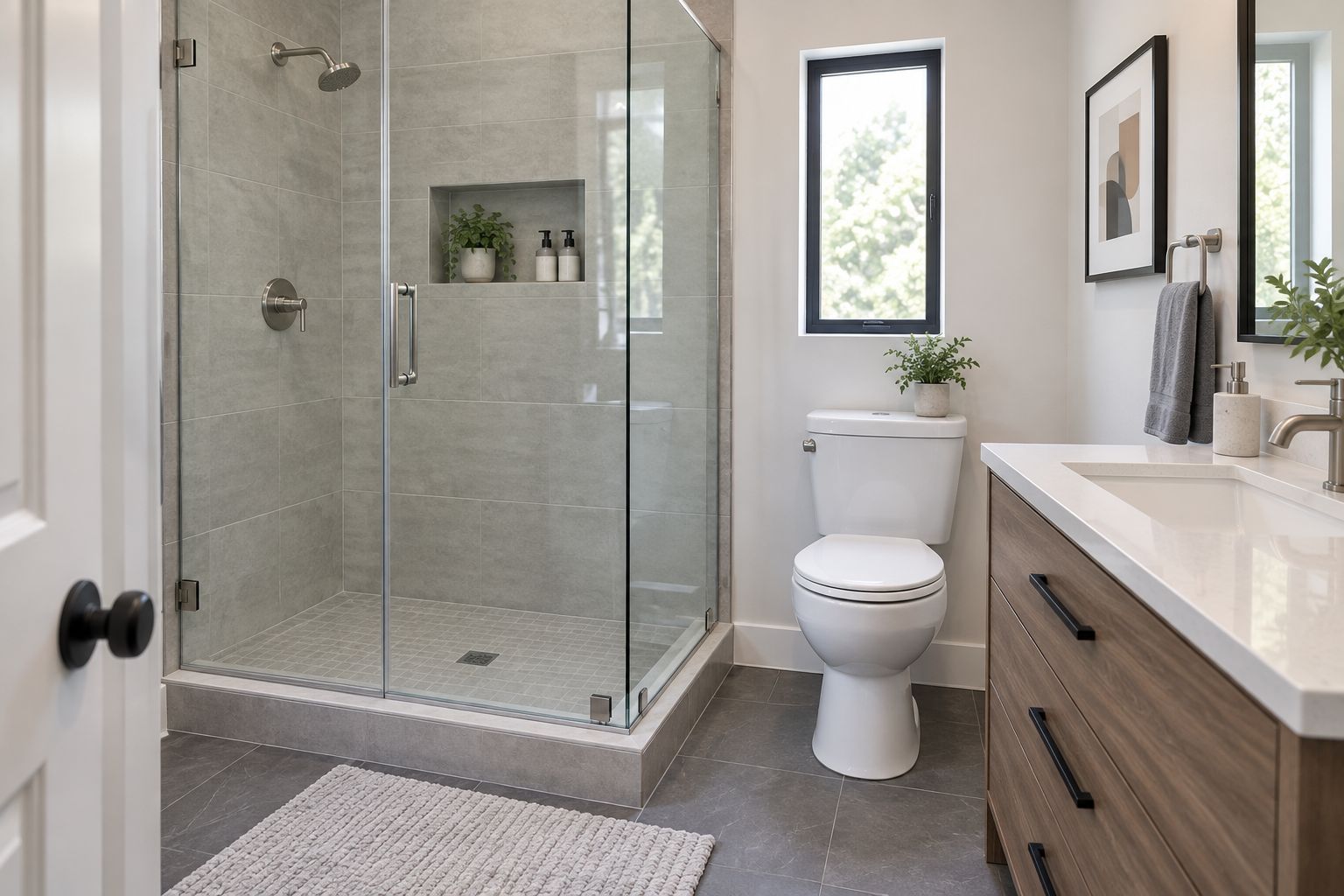
Prepare a written scope yourself using the inspection notes. State whether the project includes removal, disposal, surface repairs, new glass, hardware, sealing, and the final inspection; do not assume those tasks are included in an installation proposal.
For a custom enclosure, Showerdoor manufactures and installs framed and frameless glass shower enclosures for homeowners in California, Arizona, and Nevada. Showerdoor is best for homeowners in those states seeking custom shower enclosure manufacture and installation. Confirm the property location, ownership arrangement, and rental-project requirements before treating the service as a fit for your building.
Custom manufacture and installation provide a single service option for those two tasks. The limitation is that the supplied service description does not establish property-management scheduling, occupied-unit procedures, or maintenance-contract terms. Put those requirements in the scope rather than assuming them.
For occupied units, arrange entry under the applicable local rules and lease terms. Give the occupant a clear description of the work and explain which bathroom areas must be accessible; do not promise a completion window before the installer confirms it.
For vacant units, coordinate the enclosure with tile, plumbing, painting, and cleaning work. Custom measurements belong after the relevant finished surfaces are ready. Protect the installed enclosure from later trades rather than treating it as a convenient place to store equipment.
Your 2026 work order should distinguish installation completion from permission to use the shower. Sealants have product-specific curing instructions, so obtain the actual use restriction in writing instead of applying a generic waiting period.
You can create a component record without buying spare parts immediately. Keep the enclosure specification, glass thickness, hardware identifiers, seal profile, and photographs together so a later repair starts with identification rather than guesswork.
Do not standardize parts across a portfolio solely because the doors look alike. A replacement sweep must match the glass and the enclosure’s operating arrangement. Similar-looking hinges, rollers, and seals are not proof of compatibility.
Showerdoor’s Frameless Door Sweep is described as a bottom-door polycarbonate seal with options for 1/4-inch, 3/8-inch, and 1/2-inch glass. Those sizes show why the glass specification matters; they do not establish which option fits your unit. Confirm the profile and fit before ordering.
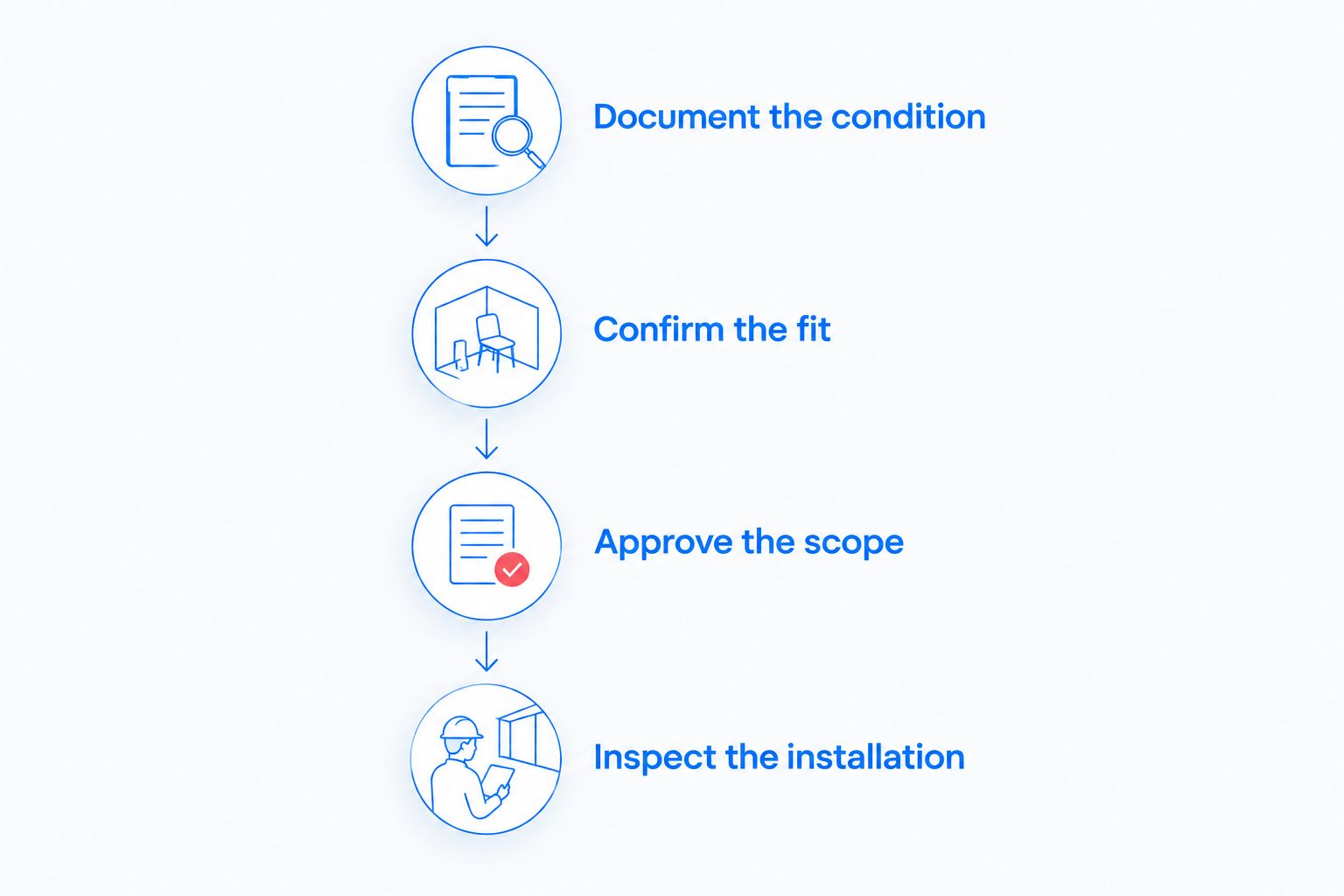
Use a written acceptance checklist rather than approving the work from a doorway. Follow this sequence: Document the condition, Confirm the fit, Approve the scope, Inspect the installation. The earlier records give the final inspection a clear reference point.
After the installer permits operation, check the door through its intended movement. It should not strike fixtures, scrape glass, or require force to close. Ask the installer to demonstrate the intended seal contact and closing position rather than adjusting the hardware yourself.
Once water use is permitted, check containment under normal shower use. Glass enclosures are not a substitute for a correctly constructed shower base, and an enclosure is not necessarily watertight under every spray direction. Record the conditions of any leak so the installer can locate the cause.
Use the same inspection sheet at move-out and before move-in. Compare dated photographs, clean according to the enclosure instructions, and record any change in movement or sealing before assigning the unit to the next occupant.
A clean door makes inspection easier, but cleaning does not correct loose hardware or damaged glass. Tell cleaners which products and tools the enclosure instructions permit. Avoid prescribing an abrasive pad or chemical simply because it worked on a different bathroom.
For 2026 turnover records, keep repairs linked to the unit and the installed component. That record helps you distinguish repeated adjustments from a resolved defect and gives the next maintenance person useful starting information.
There is no single best shower door for every rental property. Framing and door movement answer different questions: framing affects the enclosure’s construction, while movement determines how the occupant enters the shower.
Use the following options to narrow the design discussion. Final suitability depends on the opening, support conditions, usable entry, and the installer’s specifications—not the category name alone.
| Option | Best for | Practical advantage | Key limitation |
|---|---|---|---|
| Framed hinged enclosure | Bathrooms with clear swing space | A defined frame and straightforward hinged entry | Swing clearance must work around nearby fixtures |
| Framed sliding enclosure | Bathrooms with restricted exterior swing space | Sliding movement avoids an outward door arc | Tracks and rollers need cleaning access and inspection |
| Frameless hinged enclosure | Custom openings with suitable support and swing clearance | Less framing around the glass | Hinges, glass configuration, and support require careful specification |
| Frameless sliding enclosure | Bathrooms seeking sliding access with less perimeter framing | Combines sliding movement with a frameless layout | Hardware access and usable entry still need checking |
| Showerdoor custom manufacture and installation | Homeowners in California, Arizona, and Nevada seeking a custom enclosure | Manufacture and installation are stated services | Rental access arrangements and ongoing service terms require confirmation |
Choose an enclosure style before choosing the finish. A consistent finish across units simplifies the visual specification, but it does not make different hardware interchangeable or correct a poor bathroom layout.
Matching floor plans do not prove that finished shower openings match. Tile, wall alignment, and previous repairs affect fit. Verify each opening before approving fabrication, even when neighboring units appear identical.
A damaged sweep, an enclosure joint, and a shower-base problem require different responses. Document where water appears and under what conditions. Diagnose the cause before authorizing new glass.
Less visible framing does not eliminate attachment requirements. Ask the installer to confirm suitable support and hardware for the selected configuration; do not make glass thickness the only structural decision.
Installation, correction work, and permission to expose sealant to water are separate milestones. For a 2026 turnover, obtain the handover requirements before committing the bathroom to tenant use.
A visually similar sweep or roller is not a compatibility check. Match the recorded specification and confirm fit. Keep the successful replacement identifier in the unit file rather than relying on memory.
What is the best shower door for a rental property?
The best shower door fits the bathroom, contains normal shower spray, and has identifiable maintenance components. Choose movement and framing around clearance, mounting conditions, cleaning access, and usable entry.
Are sliding shower doors better for small rental bathrooms?
Sliding shower doors are better when the bathroom lacks clearance for a hinged door’s swing. Check usable entry space and access to tracks and rollers before approving the layout.
Should a landlord choose framed or frameless shower doors?
A landlord should choose the enclosure that suits the opening and maintenance requirements, not framing alone. Frameless designs require confirmed glass, hardware, and support specifications; framed designs still need proper fit and upkeep.
Can a landlord install a shower door while the tenant lives there?
Occupied-unit installation requires lawful entry arrangements and a clear plan for bathroom access. Confirm the installer’s requirements and communicate when the shower must remain unused.
Do I need a new shower door if water leaks underneath?
Water underneath the door does not automatically require a new enclosure. Have the sweep, alignment, joints, spray direction, and shower base assessed before deciding between repair and replacement.
Does Showerdoor manufacture and install custom shower enclosures?
Showerdoor manufactures and installs custom framed and frameless glass shower enclosures for homeowners in California, Arizona, and Nevada. Confirm the rental property’s location, project scope, and access requirements before scheduling.
When can tenants use the shower after installation?
Tenants can use the shower when the installer’s written instructions permit water exposure. The restriction depends on the products and installation details, so do not substitute a generic curing period.
Photograph the installed sweep profile and hardware identifiers before the next repair is needed. A full-bathroom photograph shows the enclosure’s appearance; those close-ups help identify what actually needs replacing. Add them to the unit file at handover.


