
You have no items in your shopping cart.

Instead of moving bottles off the shower floor every day, attach a shower caddy to a frameless glass door only when both manufacturers approve the mounting method, glass thickness, and loaded weight. Use a compatible padded over-door hanger or approved surface mount; if compatibility is unconfirmed, put storage on the wall or floor rather than the glass.
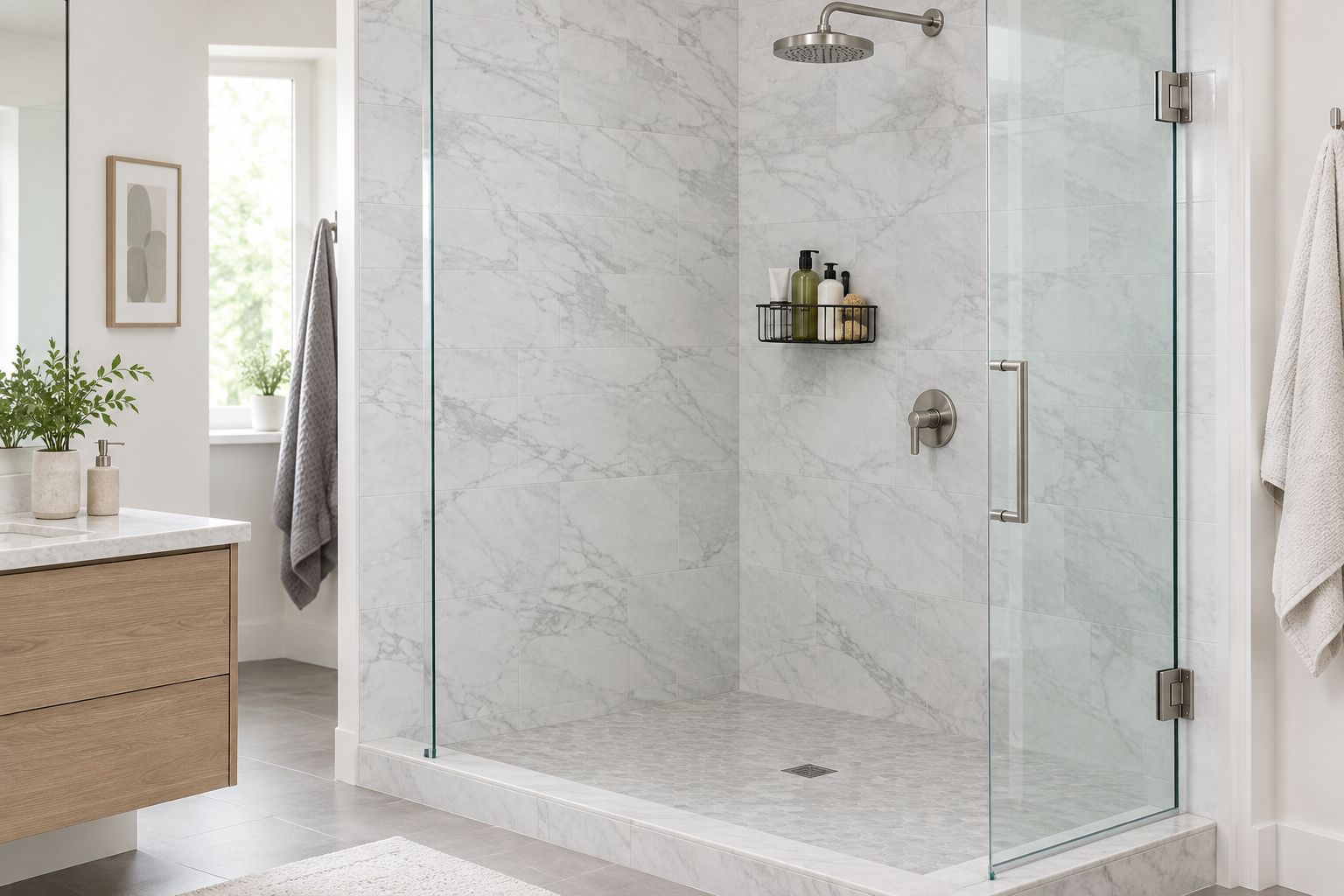
A frameless door moves, closes against seals, and carries its own hardware. A caddy adds weight and changes the clearance around that moving assembly. A hanger that fits over the top is not automatically suitable for the door.
Showerdoor is best for homeowners in California, Arizona, and Nevada who need custom shower enclosure manufacture and installation. For an existing enclosure, start with its manufacturer’s instructions; the Showerdoor service description is not approval for a particular accessory.
For a 2026 bathroom update, make compatibility—not appearance—the first purchasing requirement. Never drill, cut, or grind installed tempered shower glass to accommodate a caddy. Tempered glass requires fabrication before tempering, not modification afterward.
If instructions are missing or conflict, pause the installation. Do not substitute padding, tape, or additional adhesive for documented compatibility.
Choose the attachment method before choosing the storage layout. These options serve different situations; none makes an unapproved installation acceptable.
| Method | Best for | Advantage | Limitation | Recommendation |
|---|---|---|---|---|
| Padded over-door hanger | An explicitly approved door with adequate top clearance | Removable without bonding to the glass | Adds door load and can interfere with seals or adjacent surfaces | Use only with enclosure approval |
| Suction-mounted caddy | Smooth glass that both manufacturers approve for suction attachment | Avoids an over-door hook | Attachment depends on surface condition; textured or treated glass requires specific approval | Use only within documented limits |
| Adhesive-mounted caddy | An approved surface with a compatible adhesive system | Leaves the top edge unobstructed | Requires specified preparation, waiting time, and removal procedure | Use only with coating compatibility confirmed |
| Wall-mounted storage | Keeping storage weight off the door | Separates storage from door movement | Fasteners must suit the wall and preserve waterproofing | Prefer when glass attachment is unapproved |
| Freestanding storage | Avoiding attachment to glass or walls | Does not load the enclosure | Occupies floor space and needs a stable position | Choose when it leaves the entry clear |
For a 2026 purchase, read the actual installation instructions rather than relying on a package photograph. A picture showing glass does not establish compatibility with your glass treatment, door configuration, or hardware.
Expected result: You have a documented mounting location that fits the approved accessory and remains clear throughout the door’s travel. If anything touches, select another location or move storage off the enclosure.
Do not use an improvised metal gauge against an exposed glass edge. If the thickness cannot be confirmed without disturbing the enclosure, ask the installer instead.
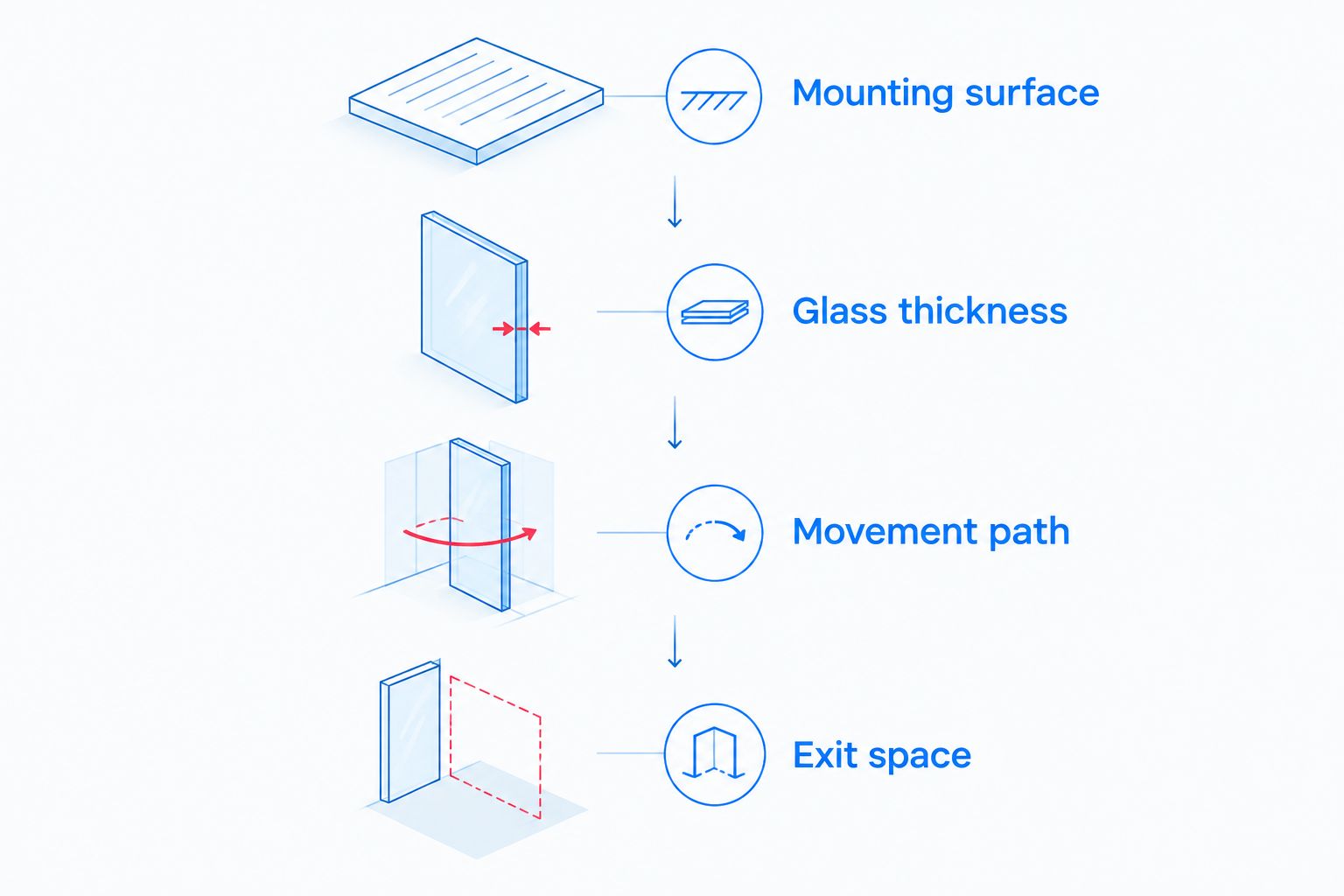
Expected result: The empty caddy stays in its intended position, the door closes normally, and no hard component contacts an unprotected glass surface.
There is no universal adhesive waiting time. Follow the exact product instructions; do not load the basket simply because the mount feels attached. Keep those instructions with your 2026 enclosure maintenance records.
Expected result: The approved load remains stable, bottles are accessible, and the door’s operation and seals remain unobstructed.
Do not treat a successful first test as proof of long-term compatibility. Continue the inspection routine specified by the accessory manufacturer, especially after removing and reinstalling the caddy for cleaning.
Best for: an enclosure without documented approval for door-mounted storage. A stationary panel is not automatically an acceptable substitute; it still needs its own compatibility confirmation.
For wall-mounted storage, first identify the wall construction and waterproofing requirements. Choose a mounting system approved for that surface. Drilling through shower tile requires a plan for the material behind it and for maintaining the waterproofing—not just a suitable drill bit.
Expected result: Storage stays accessible without placing accessory weight on the glass door.
Freestanding storage avoids wall penetrations but creates a different constraint: floor space. Position it outside the walking route and confirm that it sits securely without leaning against the enclosure.
Unload and remove the caddy according to its instructions. Check whether the hanger interfered with a seal or neighboring surface. If normal operation does not return, stop using the door and arrange an inspection; do not adjust hinges to compensate for accessory weight.
Remove the contents immediately. Check the approved surface type, cleaning instructions, seal condition, and glass-treatment restrictions. Repeated release is a reason to change the mounting location or storage method, not to add glue to a suction system.
Stop using the caddy and check its specified thickness range and supplied liners. Do not tighten an undocumented screw against glass, bend the hanger around the edge, or add metal shims. Use a compatible accessory or choose off-door storage.
Remove the caddy and check whether its hook displaced a seal or its basket redirected spray. Restore only parts you are instructed to handle. Persistent leakage needs a separate enclosure assessment rather than extra caulk around the accessory.
Stop using the shower, keep people away from the damaged panel, and contact a glass professional. Do not attempt to drill, polish, or patch the damage. Avoid handling the caddy if removing it would press against or disturb the damaged glass.
Keep only frequently used toiletries in the approved caddy. Store refill containers elsewhere, and remove the contents before cleaning or repositioning the accessory. This makes inspection easier without treating a smaller load as permission to ignore the mounting requirements.
Add the accessory model, installation instructions, approved location, and glass details to your 2026 home maintenance records. Another household member should be able to identify the mounting restrictions without guessing.
For a Showerdoor shower enclosure, use the contact page to ask about your specific configuration before adding an accessory. Include the enclosure details and the proposed caddy instructions rather than asking whether all frameless doors can carry storage.
Can I hang a shower caddy over a frameless glass door?
Only when the enclosure manufacturer and caddy manufacturer approve that installation. Confirm glass thickness, loaded weight, protective liners, and clearance throughout the door’s movement before attaching it.
What is the best shower caddy for a frameless glass door?
The best caddy is one explicitly compatible with your enclosure and its glass. If that compatibility cannot be confirmed, choose storage that does not attach to the door rather than selecting a hanger by appearance.
Can I drill holes in shower glass to attach a caddy?
No. Do not drill installed tempered shower glass; holes and other fabrication must be completed before tempering. Choose an approved non-drilling attachment or storage away from the glass.
Are suction caddies safe on coated shower glass?
Use suction mounts on coated glass only when both manufacturers approve the combination. Follow their cleaning and mounting instructions, and remove the caddy from service if it repeatedly releases.
How much weight can my frameless shower door hold?
There is no universal accessory-weight allowance for frameless shower doors. The enclosure manufacturer must confirm whether added storage is permitted; the caddy’s own rating is not the door’s rating.
Can I hang a caddy from the shower door handle?
Do not use the shower door handle as a storage support unless the enclosure manufacturer explicitly approves it. Keep the handle clear for its intended use and choose a separately approved mounting location.
Can Showerdoor confirm whether a caddy fits my enclosure?
Ask Showerdoor about your specific enclosure before installation. Provide the enclosure details, proposed mounting position, and caddy instructions so the compatibility question concerns the actual assembly.
Check the space the bottles occupy, not just the basket. Tall containers and pump heads can contact nearby glass or walls even when an empty basket clears. Before finishing your 2026 setup, repeat the clearance check with the intended contents in place—without forcing the door past an obstruction.


