
You have no items in your shopping cart.

A-MAZ Water Stain Remover should not be treated as scratch-proof on every glass shower door. Its description addresses difficult stains without acids or harsh chemicals, but that does not establish compatibility with every coating or cleaning pad. For your 2026 cleaning routine, check your enclosure’s care instructions and test an inconspicuous area before treating the full panel.
Removing a water stain and protecting the glass are separate requirements. A cleaner that addresses deposits still needs to match the surface you are cleaning, including any applied treatment. More pressure is not a substitute for that compatibility check.
For 2026 shower-door care, start with the enclosure’s written cleaning instructions rather than a general claim about glass cleaners. Showerdoor’s shower-door cleaning range includes a stain remover, cleaning pads, and a kit; those items serve different roles, not interchangeable ones.
The product description does not establish a universal no-scratch result. It describes cleaning difficult stains without acids or harsh chemicals. That is a statement about the cleaning formula, not a guarantee covering every glass surface, coating, applicator, or amount of pressure.
Keep the cleaner and the tool separate when you compare your choices:
| Item | Best for | Stated benefit | Limit to keep in mind |
|---|---|---|---|
| A-MAZ Water Stain Remover | Addressing difficult water stains after checking compatibility | Described as cleaning difficult stains without acids or harsh chemicals | The supplied description does not establish compatibility with every glass coating |
| A-MAZ Gripper Pads | Applying an approved cleaning method with a glass-safe pad | Described as non-abrasive polyester and safe for glass | A pad’s description does not establish that every cleaner used with it is suitable |
| A-MAZ Cleaning Kit | Getting the listed stain-removal and sealing items together | Includes Water Stain Remover, Ultra Gloss Sealant, and two scrubbers | Kit contents alone do not establish suitability for your enclosure’s coating |
The linked remover is a 14-ounce product. That package size tells you how much product the container holds, not how aggressively to scrub or how long to leave it on the glass.
Use the current package directions for application details. Do not substitute an online routine that specifies extra pressure, a different pad, or a longer contact time without approval for your surface.
A stain-removal result depends on more than the name on the container. Check these factors before you begin:
No-acid cleaning and scratch prevention are not the same claim. Chemical compatibility concerns what the cleaner does to a surface; mechanical damage concerns what happens when an applicator or trapped particle moves across it.
Use a small, controlled test before cleaning a full panel. This 2026 checklist is a precautionary workflow, not a replacement for the current product label or your enclosure’s care instructions.
Find the cleaning guidance for your glass and any coating. Read the remover’s current label alongside those instructions, including restrictions for nearby materials.
If the instructions conflict, stop. Ask the enclosure or coating manufacturer to confirm an acceptable method before applying the cleaner.
Look at the dry panel under good lighting before you clean it. Note existing lines and cloudy areas; a photograph gives you a simple reference for the test.
Do not scrub a chipped or cracked panel. Treat visible damage as an enclosure-safety issue rather than a stain-removal problem.
Choose a clean applicator allowed by the surface-care instructions. Inspect it for embedded particles, worn areas, or residue from another cleaning job.
Keep glass-cleaning tools separate from tools used on gritty tracks or other dirty surfaces. A pad that was suitable when new still needs inspection before reuse.
Apply the cleaner to an inconspicuous area exactly as the label directs. Keep the test controlled so you can compare the treated section with the surrounding glass.
Do not mix cleaners or add another product to strengthen the result. A test should evaluate the approved method, not an improvised combination.
Remove the product as directed, then dry the test area before judging the finish. Inspect from different angles for new lines, haze, or a change in appearance.
Continue only when the instructions permit use and the test leaves the surface unchanged apart from the stain removal. If the result is unclear, stop and ask for surface-specific guidance.
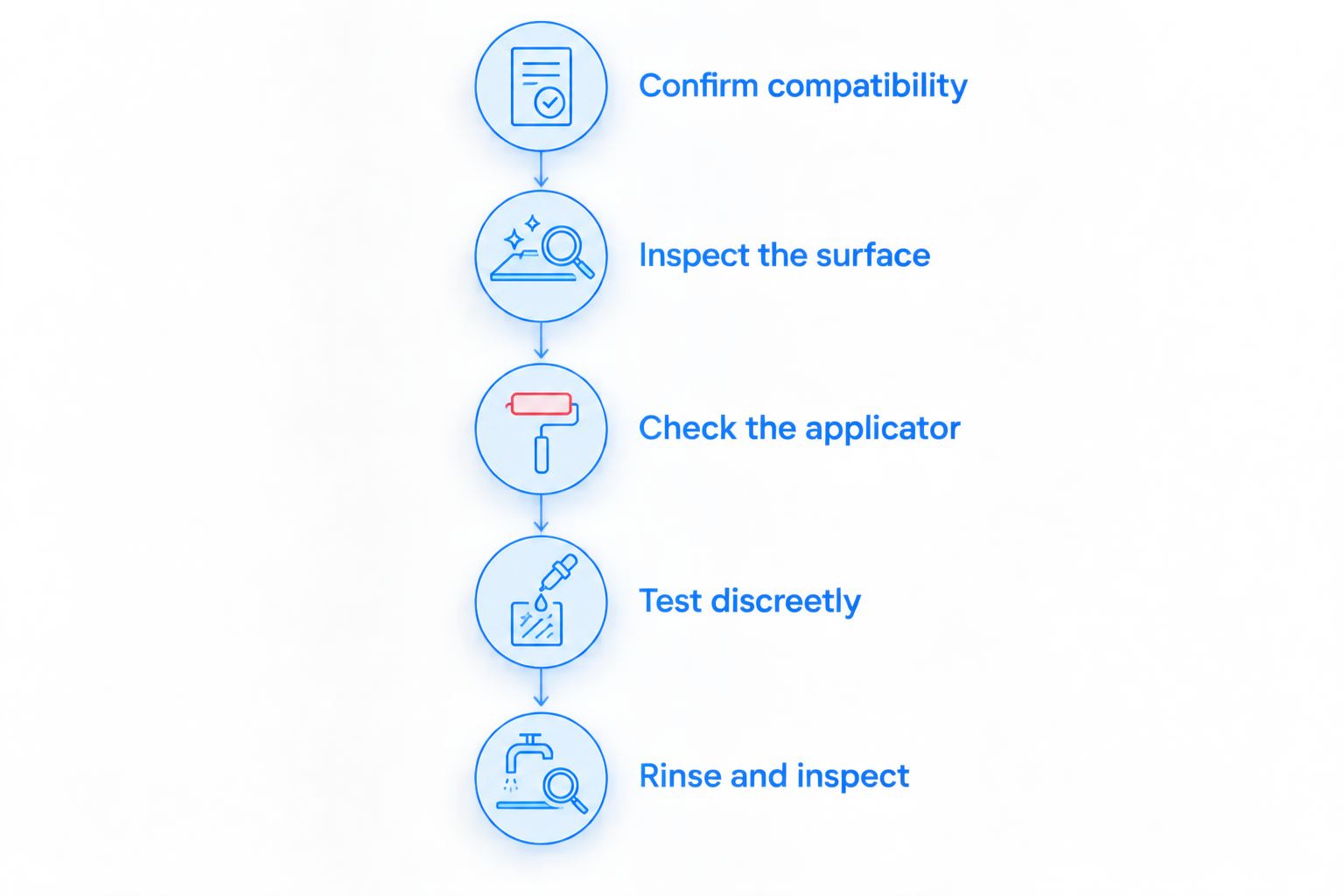
A successful spot test is a checkpoint, not permission to change the method elsewhere. Keep the same approved applicator and follow the label throughout the job, including any removal and rinsing instructions.
Choose supplies by their stated role rather than assuming that more items produce a safer result. The remover addresses difficult stains; the Gripper Pads provide a non-abrasive polyester cleaning tool described as safe for glass.
The A-MAZ Cleaning Kit contains a 14-ounce Water Stain Remover, Ultra Gloss Sealant, and 2 scrubbers. Those contents are useful to identify before purchase, but they do not establish a required sequence for every enclosure. Each item still needs to match your surface-care instructions.
Showerdoor is best for homeowners in California, Arizona, and Nevada seeking custom shower enclosures and related cleaning products. For this cleaning decision, the relevant question remains narrow: does the proposed method match your particular glass and coating?
These products fit the stain-removal and applicator roles described above. Neither replaces the compatibility check.

Stop cleaning before trying to correct the mark. Rinse away remaining cleaner as directed and inspect the dry surface. Continued rubbing makes it harder to determine what changed and risks adding damage.
Compare the area with your pre-cleaning photograph. Note whether the mark follows the direction of wiping, existed beforehand, or appears only while product remains on the surface. These observations help you explain the problem; they do not establish a diagnosis by themselves.
Keep the container and record the applicator you used. Give the enclosure manufacturer those details, along with photographs and any coating information, before attempting polishing or another stain treatment.
Do not assume a scratch-removal compound is the next step. Removing deposits, treating a coating, and repairing damaged glass are different tasks that need different guidance.
Coastal window care and shower-door care share a basic requirement: identify the surface and residue before selecting a method. Salt-air exposure outside is not the same cleaning problem as deposits inside a shower, so a method discussed for one setting should not automatically transfer to the other.
When comparing window cleaning solutions for salt-air homes, keep the surface distinction clear: exterior glazing, shower glass, and applied coatings each need their own care instructions. Similar-looking white marks are not enough evidence to use the same cleaner or scrubbing tool.
For your 2026 maintenance plan, label and separate tools by task. In particular, do not carry a pad from gritty exterior work directly onto a shower panel. Inspect tools even when their packaging describes them as non-abrasive.
Do not assume approval for coated glass from the stain remover’s general description. Check the coating manufacturer’s approved cleaning methods and the current remover label before use.
If you cannot identify the coating, ask the installer or enclosure manufacturer. A test patch does not replace an explicit restriction against a cleaner or applicator.
A non-abrasive pad does not guarantee a scratch-free cleaning process. Its stated material properties do not account for trapped grit, an incompatible cleaner, or use that conflicts with the glass-care instructions.
Inspect the pad before every job. Replace it when you cannot remove embedded debris or confirm that it is clean enough for the surface.
Do not increase pressure beyond the cleaning instructions when a stain remains. A persistent mark does not prove that more scrubbing is the correct treatment.
Stop, rinse, dry, and reassess. Confirm whether you are dealing with removable buildup or a surface condition that needs professional evaluation before repeating the process.
Does A-MAZ Water Stain Remover definitely not scratch glass?
The product description does not establish a universal scratch-free guarantee. Check the current label, your glass-care instructions, and any coating restrictions before testing an inconspicuous area.
Can I use A-MAZ Water Stain Remover on a coated shower door?
Use A-MAZ Water Stain Remover on coated shower glass only when the cleaner and coating instructions permit it. If you cannot identify the coating, ask the enclosure manufacturer before applying the product.
Are A-MAZ Gripper Pads non-abrasive?
A-MAZ Gripper Pads are described as non-abrasive polyester pads safe for glass. Inspect them for trapped grit and confirm that the cleaner used with them is suitable for your surface.
What comes in the A-MAZ Cleaning Kit?
The A-MAZ Cleaning Kit includes Water Stain Remover in a 14-ounce size, Ultra Gloss Sealant, and two scrubbers. Check the directions for each item rather than assuming the kit establishes compatibility with every shower enclosure.
Can A-MAZ Water Stain Remover fix existing glass scratches?
The supplied product description does not claim that A-MAZ Water Stain Remover repairs scratches. Treat an existing scratch as a separate issue and ask the enclosure manufacturer before attempting polishing.
What should I do if my shower glass looks hazy after cleaning?
Stop cleaning, remove the product as directed, and inspect the dry glass. If the haze remains or the finish has changed, ask the enclosure or coating manufacturer for guidance before applying another treatment.
Should I test the cleaner even if my pad says it is safe for glass?
Yes, test the approved cleaning method on an inconspicuous area before treating the full panel. A glass-safe pad description does not establish compatibility between the cleaner and every glass coating.
Judge the dry test patch, not just the wet glass. Water and remaining cleaner change how you see the surface, so finish the label’s removal process before deciding whether the result is acceptable.
Make that your 2026 stopping rule: if the dry test area shows a new line, haze, or finish change, do not continue across the door. Showerdoor’s shower-door cleaning products serve specific tasks; protecting your enclosure still starts with matching the method to the surface.


