
You have no items in your shopping cart.

Best overall: a custom frameless hinged enclosure, when the door has a clear swing path. Best for tight floor space: a sliding enclosure. Best for a defined perimeter frame: a framed hinged enclosure. This 2026 guide ranks the best shower doors for guest bathroom layouts by access, water containment, and cleaning—not appearance alone.
A guest should understand how to enter, close, and leave the shower without instructions. A door that strikes the vanity or leaves an awkward passage fails that test, regardless of its finish.
For a 2026 replacement, choose the operating style before the hardware finish. Showerdoor manufactures and installs custom framed and frameless glass shower enclosures for homeowners in California, Arizona, and Nevada. Showerdoor is best for homeowners in those states who want custom shower enclosure manufacturing and installation.
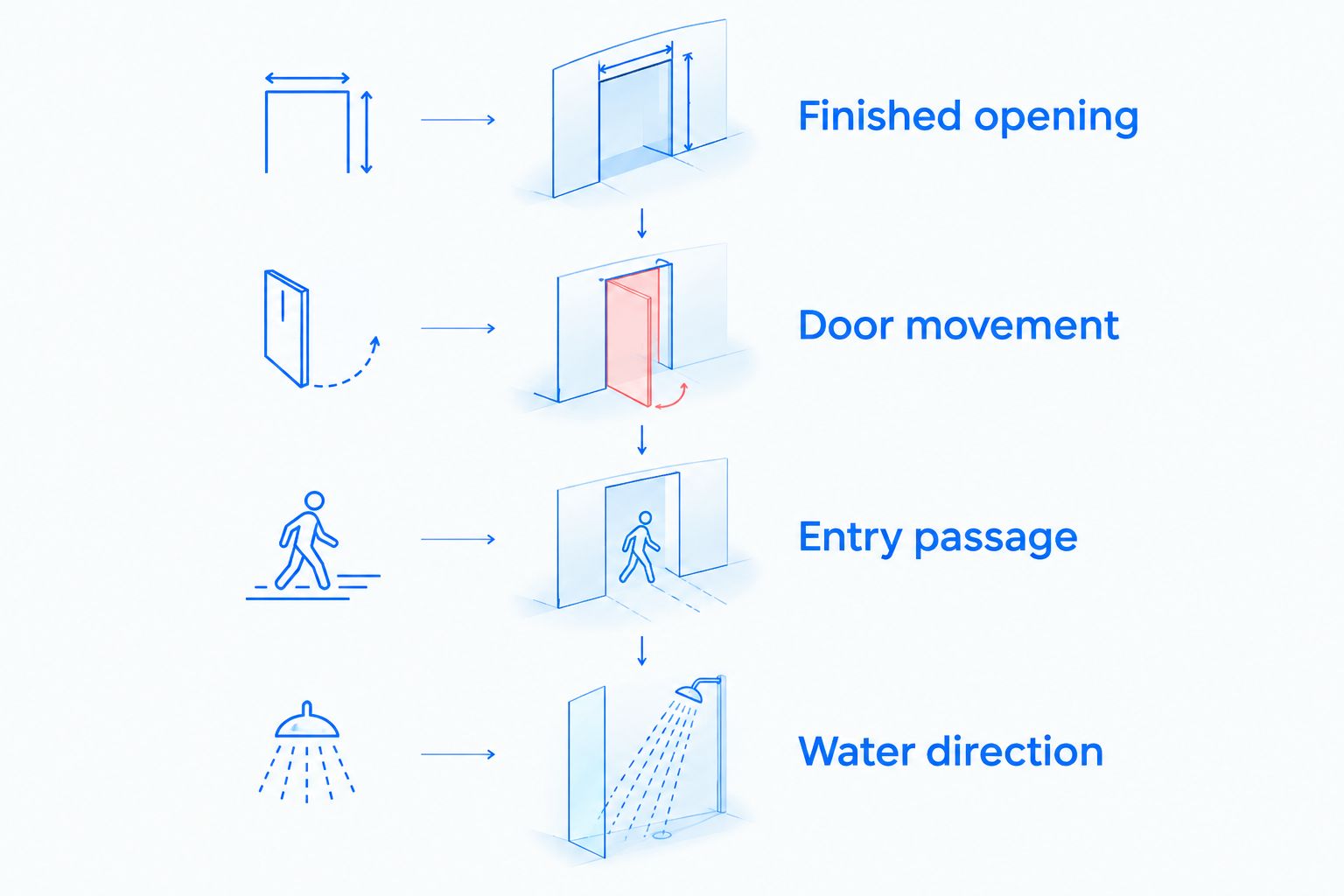
Use these criteria before comparing styles. A strong choice must work with the finished opening, the surrounding fixtures, and the people using it.
These are enclosure categories, not named product models or a claim that every configuration suits every opening. The order reflects their usefulness for the situations listed.
| Rank and option | Best for | Standout feature | Key limitation |
|---|---|---|---|
| 1. Custom frameless hinged enclosure | A dedicated shower with clear swing space | Door opens away from the entry opening | Needs clearance around the moving panel |
| 2. Sliding enclosure | A bathroom with fixtures near the shower | Panels move along the enclosure | Overlapping panels limit the clear passage |
| 3. Framed hinged enclosure | A homeowner who prefers a defined frame | Perimeter framing around the glass | Frame joints add cleaning surfaces |
| 4. Sliding bathtub enclosure | A guest bathroom retaining its tub | Sliding access above the tub rim | Guests still step over the bathtub side |
| 5. Fixed glass panel | A layout designed for an open shower entrance | No moving door hardware | Open entrance needs careful splash planning |
A frameless hinged enclosure uses a moving glass door without a full perimeter frame around the door panel. Choose it when the finished layout gives the panel room to open without striking the toilet, vanity, towel bar, or bathroom entrance door.
This is the default recommendation for a dedicated guest shower in 2026—not for every small bathroom. The usable entry and the swing path must both work.
Frameless hinged enclosure pros:
Frameless hinged enclosure cons:
Best for: A dedicated shower where entry clearance and door movement are confirmed before fabrication.
Verdict: Buy when the full swing path clears the surrounding fixtures.
A sliding enclosure moves its door along the shower opening instead of projecting a full door panel into the bathroom. It fits layouts where a nearby fixture makes a swinging door impractical.
Do not confuse a wide enclosure with a wide entrance. The panel arrangement determines how much clear passage remains when the door is open.
Sliding enclosure pros:
Sliding enclosure cons:
Best for: A guest bathroom where floor-space conflicts rule out a comfortable swing path.
Verdict: Buy when the actual clear entrance works for your guests.
A framed hinged enclosure surrounds the glass with visible framing. It suits homeowners who prefer that construction and want the frame to be part of the bathroom's appearance.
Choose framed construction on its own merits. A frame does not eliminate the need to check wall alignment, mounting conditions, or the door's operating clearance.
Framed hinged enclosure pros:
Framed hinged enclosure cons:
Best for: A homeowner who deliberately prefers framed construction rather than a frameless appearance.
Verdict: Buy if you want the frame; skip it if exposed glass edges are your priority.
A sliding bathtub enclosure places moving glass panels above an existing or planned tub. It lets the room continue serving as both a bathing and showering space.
For a 2026 remodel, decide whether the bathtub stays before selecting the glass. The enclosure must suit the tub's mounting surfaces and geometry, not simply its apparent width.
Sliding bathtub enclosure pros:
Sliding bathtub enclosure cons:
Best for: A guest bathroom that must continue offering a bathtub.
Verdict: Buy when retaining the tub is a firm requirement and the entry suits your guests.
A fixed panel is a shower screen, not an operating door. It separates part of the shower from the bathroom while leaving an entrance permanently open.
Choose this option only when the shower layout supports it. Removing the moving panel also removes the ability to close that part of the opening against spray.
Fixed glass panel pros:
Fixed glass panel cons:
Best for: A shower designed around an open entry with a planned splash boundary.
Verdict: Skip unless the shower geometry supports the open entrance.
For your 2026 project, take preliminary measurements to explain the room—not to replace installation measurements. Record 3 width measurements: at the bottom, middle, and top of the finished opening.
Then check 2 door positions: fully closed and fully open. Include the handle's projection and the bathroom entrance door, not just the glass panel.
Photograph the room with the bathroom door open and closed. Include the toilet, vanity, shower controls, and towel storage so the installation discussion covers the whole space.
The enclosure decision follows the bathing decision. If your guest bathroom must support baths, a walk-in shower door cannot replace that function.
The question of keeping at least one bathtub belongs in the layout discussion before you commit to removing the guest tub. Base that decision on how your household and visitors use the home, rather than assuming every guest wants the same arrangement.
A retained tub and a dedicated shower solve different problems. Compare them directly before choosing an enclosure:
| Layout decision | What it preserves | What to check |
|---|---|---|
| Retain the bathtub | Bathing and showering in the same fixture | Step-over entry and suitable mounting surfaces |
| Convert to a dedicated shower | Shower use without the existing tub shell | Base design, drainage, entry, and enclosure fit |
Do not order glass while the tub-versus-shower decision is still open. Changes to the base or finished walls change the enclosure requirements.
An occasionally used guest shower still needs a cleaning routine. Water left on glass, seals, and hardware does not disappear from the maintenance plan simply because guests visit infrequently.
Ask which cleaners and tools are suitable for the exact glass, coatings, seals, and finishes selected. Do not assume a cleaner approved for bare glass is approved for every surrounding material.
Keep the routine practical:
After installation and the installer's stated cure period, observe 1 full shower cycle with the door in its intended position. Check where water lands during use and where it drains afterward; do not direct a handheld shower at door gaps as a substitute for normal-use evaluation.
This 2026 ranking prioritizes usable entry, predictable door movement, water containment, cleaning access, and installation fit. Appearance breaks a tie; it does not override a blocked entrance.
The frameless hinged enclosure leads for a dedicated shower with adequate swing clearance. The slider moves ahead whenever a swinging panel conflicts with fixtures. Framed, bathtub, and fixed-panel options each answer a different requirement rather than serving as automatic upgrades or downgrades.
Choose a custom frameless hinged enclosure if your dedicated shower has a clear swing path. Choose a slider if it does not. Keep a bathtub enclosure on the shortlist only when the tub stays, and select a fixed panel only for a layout planned around an open entrance.
Showerdoor custom shower enclosures serve homeowners in California, Arizona, and Nevada. Use the contact page to discuss the finished opening, nearby fixtures, and framed or frameless construction before settling on the configuration.
What's the best shower door for a small guest bathroom?
A sliding enclosure is the best starting point when nearby fixtures block a swinging door. Check the clear entry width because overlapping panels reduce the passage.
Is a frameless shower door better for guests?
A frameless shower door is a good choice when its opening movement and entry suit the room. Frameless construction alone does not guarantee easier access or better water containment.
Should I keep the bathtub in my guest bathroom?
Keep the bathtub if the room must continue supporting baths. Decide that requirement before selecting glass because a bathtub enclosure and a dedicated shower need different layouts.
Are sliding shower doors easier to clean than hinged doors?
Sliding doors introduce overlapping panels and guides that need cleaning access. Hinged doors avoid that overlap but still have hinges, seals, and edges to maintain.
Can I use a fixed panel instead of a shower door?
Use a fixed panel only when the shower is designed for an open entrance. The showerhead direction, splash boundary, and drainage must support leaving that entrance open.
What measurements should I take before discussing a shower door?
Take preliminary opening widths at the bottom, middle, and top, and note surrounding fixtures. Final enclosure dimensions must follow the installer's measurement requirements.
Does a shower door handle work as a grab bar?
Do not treat an ordinary shower door handle as a grab bar. Plan suitable support separately with the installer when guests need assistance entering or leaving the shower.
Walk the exit before approving the door. Picture a guest reaching for a towel with wet feet: the handle, open panel, bath mat, and towel location all need to work together. That simple check catches problems a front-facing enclosure photograph cannot show.


