
You have no items in your shopping cart.

A universal shower door repair kit works only when its parts match your door’s dimensions, mounting details and operating clearances; the word universal is not a guarantee of brand compatibility. A replacement seal cannot correct a loose hinge, damaged roller or misaligned door. For a 2026 repair, identify the failed component first and buy against its specifications, not just the enclosure’s brand.
Compatibility depends on the individual part, not a promise that one kit fits most brands. A push-on sweep has different requirements from a roller assembly or a glass-mounted hinge. Treat each component as a separate fit decision.
Start with the shower door sweeps and seals comparison if the problem is escaping water rather than difficult door movement.
| Repair option | Best for | Main benefit | Main limitation |
|---|---|---|---|
| Universal seal or sweep kit | A worn strip with a confirmed matching profile | Replaces a localized wear component | Wrong thickness or fin shape prevents correct fit |
| Universal roller kit | Sliding hardware with matching dimensions and mounting | Replaces a compatible worn roller assembly | Wheel shape, offset and attachment must match |
| Model-specific replacement part | Identifiable hinges, rollers or brackets | Matches documented hardware requirements | Requires reliable identification of the original assembly |
| Professional assessment | Sagging, glass contact or uncertain support | Establishes whether the problem is adjustment, hardware or enclosure condition | Is not a substitute for a simple parts purchase when fit is already confirmed |
A kit can contain useful parts without containing the right part for your enclosure. Check every component you intend to install; unused pieces do not make an incompatible replacement suitable.
A repair should address the cause, not just cover the symptom. Water below the door does not automatically mean the bottom sweep has failed, and a dragging door does not automatically need new rollers.
The distinction affects safety as well as fit. Seals manage water; hinges and rollers support or guide moving glass. Do not use a sealing accessory to compensate for a door that has shifted or become unstable.
Best for: replacing a worn bottom seal on an otherwise correctly operating frameless door. A push-on sweep must match both the glass thickness and the space below the door. Length alone does not establish compatibility.
The Frameless Door Sweep is described as a polycarbonate bottom seal with versions for 1/4-inch, 3/8-inch and 1/2-inch glass. Those separate fit options demonstrate why you must select the correct version rather than assume every sweep fits every frameless door.
Measure the glass itself, not the old plastic channel. Compare the replacement’s cross-section, fin direction and attachment method with the existing part and the supplier’s drawing. Also check whether the door closes without the sweep bunching against the threshold.
Do not force an undersized channel onto the glass. If the replacement requires pressure beyond its installation instructions, stop and confirm the selected size.
Best for: a deteriorated side strip where the glass and door alignment remain sound. Side seals must suit the location they occupy: a door-to-wall gap is not the same connection as a door-to-glass meeting edge.
Compare the cross-section before ordering. A fin, bulb or angled strike has a specific contact shape; a strip that looks similar from the front can behave differently when the door closes.
Check whether the original strip pushes onto the glass, slides into a channel or attaches with adhesive. Follow the replacement manufacturer’s instructions for surface preparation and attachment rather than improvising with a different adhesive.
Keep drainage openings clear. Do not treat every visible gap in a framed enclosure as a defect that needs filling.
Best for: an identified hardware failure with documented replacement specifications. Moving hardware demands more than a visual resemblance. A matching finish tells you nothing about the mounting geometry or intended glass connection.
For a sliding door, compare wheel diameter, wheel profile, mounting position, offset and the way the assembly engages the track. Inspect the track too: replacing a roller does not repair a damaged running surface.
For a hinged door, confirm the hinge design, glass thickness requirements, mounting arrangement and manufacturer-specified capacity. Existing glass cutouts and holes constrain the replacement; do not drill or modify tempered shower glass to make different hardware fit.
Stop using the door if glass contacts glass, tile or metal, or if a support fitting is loose. Arrange an assessment rather than repeatedly opening the door to diagnose the problem.
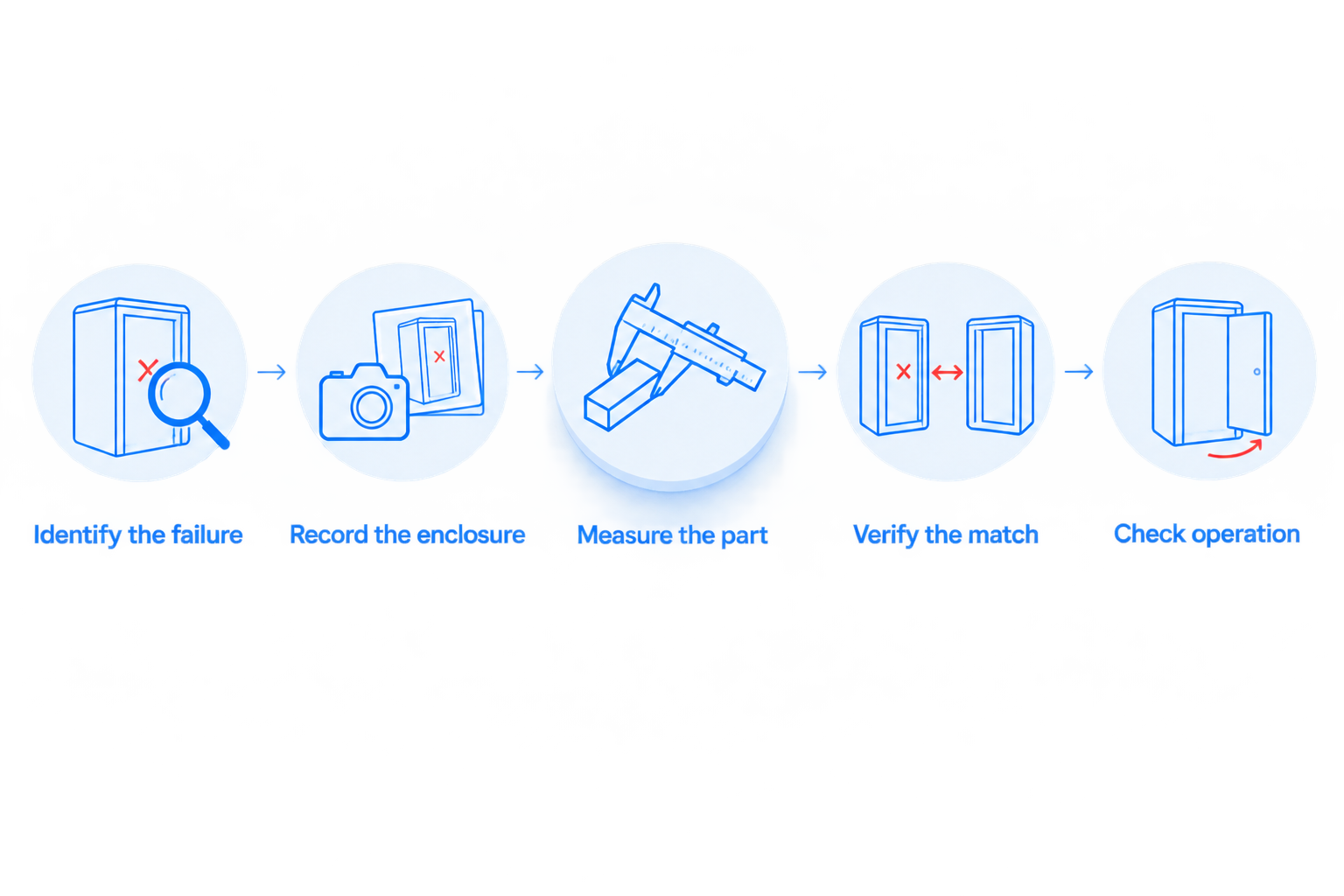
Build a fit record before removing anything. Photographs and measurements help a supplier distinguish between parts that appear interchangeable in an online listing.
Describe what happens: water escapes under the door, the latch does not meet, the panel drags or the roller catches. Record where it happens. Avoid starting with a shopping conclusion such as “needs a universal kit.”
Note whether the door slides or swings and whether it is framed or frameless. Photograph the whole enclosure, the failed component and any manufacturer markings. Keep original paperwork if you have it.
Record glass thickness and the dimensions relevant to the component. For seals, capture the cross-section and attachment channel; for hardware, document the mounting arrangement without loosening load-bearing fittings.
Compare your record with the supplier’s technical drawing and compatibility instructions. Resolve differences before ordering. A product photo is useful for identification, but it is not a substitute for dimensions.
After an approved replacement is installed according to its instructions, check movement and clearance before using the shower. Stop if the door binds, the strip pulls free or the glass makes contact with a hard surface.
Keep the old nonstructural part until you have confirmed the replacement fits, unless retaining it creates a safety issue. Comparing the profiles side by side is more useful than relying on memory.
For a 2026 parts order, these details matter more than the universal label:
Approve the replacement against all relevant requirements, not just the easiest measurement. Matching the length does not cancel a mismatch in channel width or mounting position.
You can consider a replacement without knowing the brand when its fit requirements are fully documented and match your enclosure. This is a reasonable route for an identifiable nonstructural seal; it is not permission to guess at supporting hardware.
Photograph markings on accessible fittings and look for installation documents. If you cannot establish the specifications for a hinge or roller assembly, ask a qualified installer to identify it before removal.
A new seal addresses leakage caused by that seal’s failure, not every source of escaping water. Check whether water appears at the bottom edge, a vertical joint, a fixed-panel connection or outside the enclosure from another path.
Inspect only while the door remains safe to operate. If movement or alignment has changed, resolve that issue before selecting a thicker strip to cover the gap.
A documented model-specific part is the stronger choice when fit depends on proprietary mounting details or an exact hardware assembly. A dimension-matched universal seal remains a valid choice when its specifications and installation instructions suit the door.
Choose based on evidence of fit, not the number of items in the package. Neither the original brand name nor a universal label excuses checking the replacement requirements.
Call an installer when the repair involves glass damage, loose supports, unexplained sagging or hardware you cannot positively identify. Leave cracked glass and load-bearing fittings alone; do not attempt a cosmetic patch or improvised bracket repair.
Showerdoor is best for homeowners in California, Arizona and Nevada seeking custom shower enclosure manufacturing and installation. That service scope is different from buying an unverified universal hardware kit.
If an assessment points toward enclosure replacement, Showerdoor manufactures and installs both framed and frameless custom glass enclosures. Confirm the appropriate next step for the existing door rather than assuming either a small part or a complete replacement is necessary.
Does a universal shower door repair kit fit every brand?
No. A universal shower door repair kit fits only when the supplied components match the door’s dimensions, attachment details and operating requirements. Check each component separately.
How do I know which shower door sweep fits my glass?
Match the sweep’s specified glass thickness, cross-section and bottom clearance to your door. The supplied Frameless Door Sweep description lists separate versions for 1/4-inch, 3/8-inch and 1/2-inch glass.
Can I replace a shower door seal without replacing the door?
Yes, when the seal is the failed component and the door remains correctly aligned and safe to operate. Confirm the replacement profile and attachment method before installation.
Will universal shower door rollers fit my sliding door?
Universal rollers fit only when the wheel profile, dimensions, mounting arrangement and offset match the sliding system. A similar-looking wheel is not sufficient evidence of compatibility.
Can I put a larger seal on a leaking shower door?
Do not select a larger seal solely to cover a leak. The replacement must fit the glass and gap without obstructing closure or drainage.
Can I drill new holes to make a shower door handle or hinge fit?
Do not drill or alter tempered shower glass to fit replacement hardware. Select hardware that matches the existing glass preparation and the manufacturer’s requirements.
Should I keep using a shower door that has started sagging?
Stop using a sagging door if its support is uncertain or the glass contacts surrounding surfaces. Have the alignment and supporting hardware assessed before attempting a seal repair.
Buy the shape, not the label. A seal’s end profile often tells you more about compatibility than a front-facing listing photo or a package marked universal.
For your 2026 repair, save a clear profile photograph alongside the glass thickness and attachment details. Give that record to the parts supplier or Showerdoor when discussing the enclosure; it makes the compatibility question specific instead of leaving it at “Will this fit?”


