
You have no items in your shopping cart.

Shower frame replacement needs a job-specific installed quote, not a universal price: the scope depends on whether replacement framing fits your existing glass and opening. Ask the quote to address glass removal and reinstallation, seals, attachment points, and any wall or curb repairs—not just the metal frame.
Get a written quote for the complete frame-only job before deciding to keep the glass. A quote for loose framing does not answer what the finished repair involves. For your 2026 project, have the installer identify exactly which pieces stay and which pieces come out.
Showerdoor manufactures and installs custom framed and frameless glass shower enclosures for homeowners in California, Arizona, and Nevada. Ask whether your existing enclosure is a candidate for frame-only work rather than assuming that enclosure installation includes that repair.
Use this comparison to define the request:
| Work scope | Best for | Main benefit | Main limitation |
|---|---|---|---|
| Seal or sweep replacement | A confirmed problem with a flexible sealing part | Targets the affected component | Does not repair damaged framing |
| Frame-only replacement | Existing glass confirmed compatible with replacement framing | Retains usable glass | Requires compatible profiles, seals, and attachments |
| Complete enclosure replacement | An enclosure that needs a different system or configuration | Lets you specify the glass and framing together | Replaces more of the existing assembly |
These are different jobs, not interchangeable descriptions. Ask each installer to quote the same scope so you can make a meaningful comparison.
The visible metal is only part of a framed shower enclosure. The glass, framing profiles, gaskets, fasteners, and surrounding surfaces have to work together. Keeping the glass is a sensible goal only after someone confirms how it will fit and be supported.
A leak is also not a diagnosis. Water outside the shower does not tell you whether the source is a worn seal, an installation joint, door alignment, or another part of the shower. Identify the failed component before authorizing replacement.
For a 2026 repair decision, describe what happens during use rather than simply requesting a new frame. Tell the installer where water appears, whether the door drags, and whether anything moves when you operate it.
Best for: a confirmed worn or damaged seal with otherwise serviceable framing. Flexible strips around a shower door are not the same as its metal frame. Replacing one does not amount to rebuilding the enclosure.
The benefit is a focused repair. The limitation is equally clear: a new strip cannot straighten a bent frame, secure a loose attachment, or correct incompatible parts. Ask the installer to identify the seal's function and fit before ordering it.
For example, the Frameless Door Sweep is a polycarbonate seal used at the bottom of a frameless shower door. Its listed glass-fit options are 1/4 inch, 3/8 inch, and 1/2 inch. Those measurements describe compatibility with that seal; they are not specifications for replacement metal framing.
Do not use those dimensions to choose a part for a framed door. Identify your enclosure type and the original part first. A similar-looking strip is not enough evidence of a correct fit.
Best for: an enclosure whose existing glass is confirmed suitable for the proposed replacement framing. Frame-only work means retaining glass while replacing specified metal components. Your quote should name those components rather than using “new frame” as a catch-all description.
Ask whether the proposal covers the wall channels, bottom member, top member, and the framing attached to the moving door, where applicable. Do not assume every enclosure has the same construction or that every visible metal piece is included.
The benefit is retaining glass that the installer approves for reuse. The limitation is compatibility: overall width and height alone do not establish that a panel fits another framing system. The way the glass sits inside the profile matters too.
Have the installer explain what happens if inspection during removal changes the plan. Approve a clear decision point, not an open-ended instruction to keep working. The written scope should explain how additional work receives your approval.
Best for: a project that needs a different enclosure system or cannot retain its existing glass and framing arrangement. Complete replacement lets you specify the enclosure as an assembly rather than trying to match new framing to retained parts.
The benefit is a coordinated replacement scope. The drawback is that it replaces more material, including glass you originally hoped to keep. Ask why each retained component is unsuitable before accepting that recommendation.
Showerdoor custom shower enclosures are best for homeowners in California, Arizona, and Nevada seeking manufacture and installation together. That service description does not establish whether a particular existing frame can be repaired or replaced independently.
If you are considering frameless glass, request a separate enclosure proposal. Removing the visible metal from a framed door does not convert its glass into a frameless system; the proposed glass and hardware must suit the new design.
The useful question is not simply how much metal needs replacing. It is what work produces a correctly fitted, functioning enclosure. Your 2026 estimate should resolve these factors:
These factors define the work you are comparing. A proposal that leaves them unresolved is not ready for a like-for-like decision.
Give the installer enough information to evaluate the assembly, then ask for a written scope. Photographs help describe the problem, but do not treat them as confirmation that existing glass can be reused.
Photograph the whole opening, the door edges, the top and bottom framing, and the specific damage. Include any manufacturer identification you can find without dismantling the enclosure. Show the problem in context as well as close up.
Describe the symptom plainly: the bottom corner leaks, the door rubs, a frame member moves, or the finish looks damaged. Avoid diagnosing an unseen cause. That distinction keeps the inspection focused on evidence rather than an assumed repair.
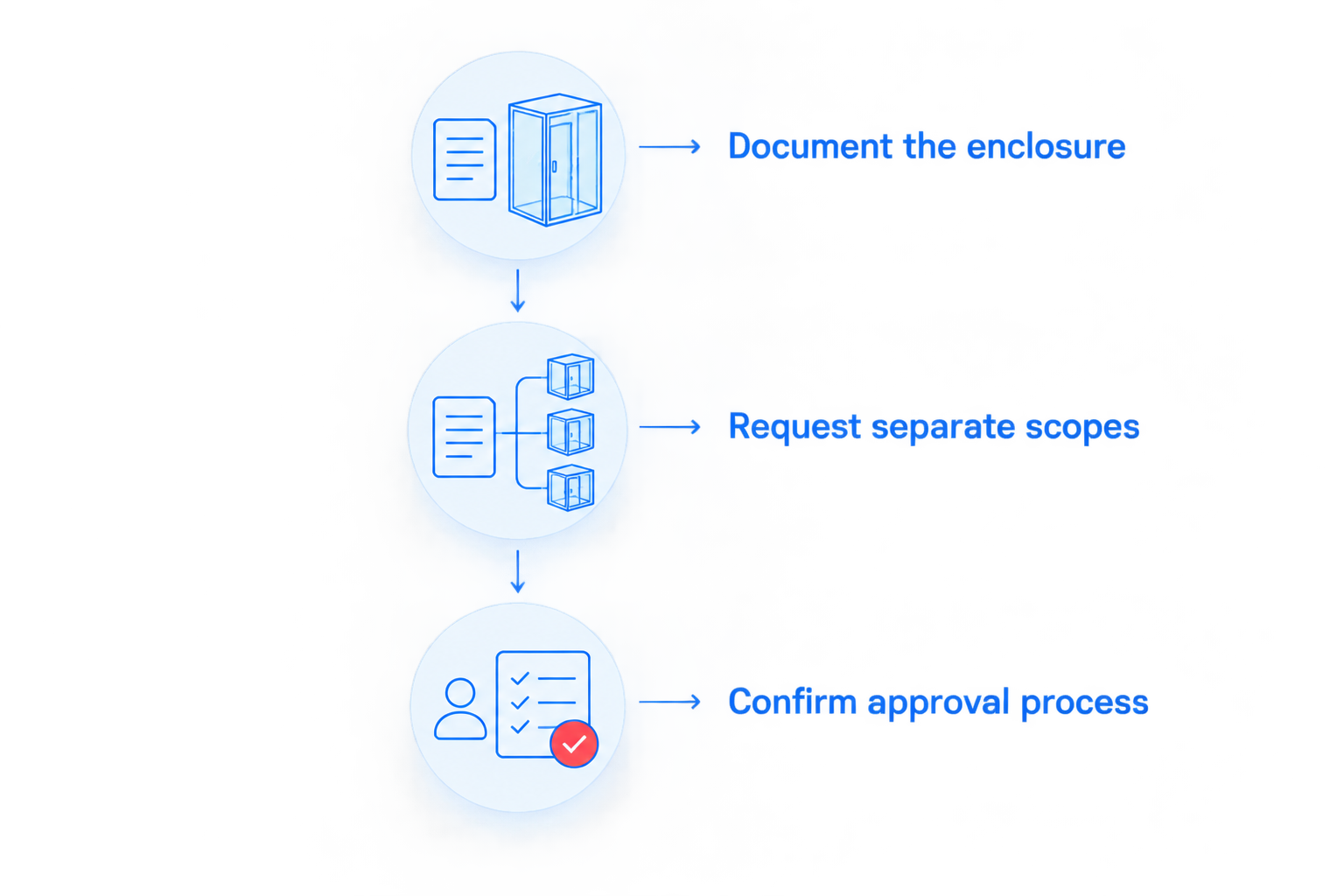
Ask for frame-only work to be described separately from complete enclosure replacement. If the recommendation is a seal repair instead, ask which part has failed and what the repair does not address.
For each option, request the same information: retained components, replacement components, glass handling, attachment work, sealing, disposal, and exclusions. Not every task applies to every job; the quote should say which ones do.
Ask how the installer handles conditions discovered after disassembly. Get the change-approval process in writing before work begins. Your decision should cover a defined repair, not an unspecified sequence of additional tasks.
Keep the repair decision separate from the design decision. If the enclosure works for your bathroom and the problem is localized, first establish what restoring it involves. If you want a different opening or appearance, ask for that as a separate project.
The question of whether sliding shower doors are outdated is a design question, not evidence that an existing frame has failed. Base the replacement scope on condition, fit, and how you want to use the shower—not an assumption that a particular door style needs removal.
The advantage of retaining the current arrangement is preserving a layout you already know. The limitation is that a frame repair does not redesign entry access or change the door's operating method. Decide which outcome you actually want before comparing proposals.
For your 2026 project, request restoration and redesign as distinct alternatives. Otherwise, a quote for a changed enclosure can look like an answer to a much narrower frame-repair question.
Existing shower glass is a reuse candidate only after the installer confirms its condition and compatibility with the replacement system. Ask about panel dimensions, edge condition, framing engagement, and the associated seals—not just whether the glass looks clear.
Do not authorize cutting or drilling existing tempered shower glass to make another frame fit. Tempered glass cannot be cut or drilled after tempering. A different required panel size or hole pattern means the proposed design needs suitable replacement glass.
Reusing glass is therefore a technical decision before it is a purchasing preference. Ask for the reuse decision to appear in the written scope.
A leaking shower door does not automatically need frame replacement. Have the installer trace the water path and inspect the relevant seals, joints, and alignment before selecting a repair.
Do not cover every opening with caulk as a test. Some enclosure profiles include drainage paths; the correct sealing locations depend on the system. Ask the installer to follow the enclosure's installation requirements rather than applying a blanket seal.
If the frame or glass moves unexpectedly, stop operating the door and arrange an inspection. Do not dismantle a glass-supporting assembly to investigate a leak yourself.
How much should I budget for shower frame replacement in 2026?
Base your budget on a written installed quote for your enclosure. Ask it to identify retained glass, replacement framing, seals, removal, reinstallation, and any excluded surface repairs.
Can I replace only the metal around my shower door?
Frame-only replacement depends on whether compatible framing can accept the existing glass. Have an installer confirm the fit and identify every component included before authorizing removal.
Is replacing a shower door seal the same as replacing its frame?
Seal replacement and frame replacement are different jobs. A flexible seal controls water at a particular gap; it does not replace the metal assembly around a framed enclosure.
Can I turn my framed shower door into a frameless door?
Removing framing does not turn an existing framed door into a frameless system. A frameless proposal needs glass, hardware, and attachment details suited to that design.
Does Showerdoor install custom shower enclosures near me?
Showerdoor manufactures and installs custom framed and frameless glass shower enclosures for homeowners in California, Arizona, and Nevada. Confirm service for your address and whether your requested work includes an existing frame-only repair.
Can I replace the shower frame myself?
Use a qualified installer for work that releases or changes the support around shower glass. Do not treat frame removal as a cosmetic trim replacement.
What should I ask before accepting a frame replacement quote?
Ask exactly which glass, framing, seals, and hardware remain and which are replaced. Also confirm glass handling, surface-repair exclusions, disposal, and approval of additional work.
Ask the installer to mark the retained and replaced components on a photograph. A phrase such as “replace shower frame” leaves room for different interpretations; a marked image makes the boundary visible. Keep that image with your 2026 written quote so the agreed scope is easy to check.


