
You have no items in your shopping cart.

Best overall starting point: wall-to-glass hinges where suitable wall backing exists. Best for a door beside a fixed panel: glass-to-glass hinges. Best for a framed enclosure: a compatible continuous hinge. This 2026 guide to the best shower door hinges ranked by durability explains where pivot hinges fit—and why installation conditions matter more than a hinge’s appearance.
A shower door hinge carries moving glass in a wet environment. Its performance depends on the complete assembly: hinge, fasteners, gaskets, glass preparation, and supporting structure. A substantial-looking hinge cannot compensate for an unsuitable mounting surface.
Showerdoor is best for homeowners seeking custom shower enclosures manufactured and installed in California, Arizona, or Nevada. Start with the enclosure design through Showerdoor, rather than choosing hardware before the supporting conditions are known.
For a 2026 replacement or remodel, separate two decisions: which hinge arrangement suits the opening, and which specific hinge model meets the door’s requirements. This ranking addresses the first decision. It does not assign unverified service lives or claim that one mounting style outlasts every other style.
Judge durability by these six criteria before comparing hinge types:
For your 2026 specification, request the actual hinge model and its installation instructions. A generic description such as stainless finish or heavy-duty hinge does not establish capacity, corrosion resistance, or compatibility.
The order below is a selection priority for common enclosure layouts, not a laboratory ranking of lifespan. A lower-ranked type becomes the right choice when the enclosure requires its mounting arrangement.
| Rank and hinge type | Best for | Standout feature | Key limitation |
|---|---|---|---|
| 1. Wall-to-glass hinge | A frameless door beside a suitable structural wall | Connects the moving door directly to wall-side support | Depends on appropriate backing, fasteners, and glass preparation |
| 2. Glass-to-glass hinge | A door mounted beside a fixed glass panel | Connects adjoining glass panels without a wall-side hinge plate | Fixed-panel support must accommodate the hinged door |
| 3. Top-and-bottom pivot hinge | An enclosure designed around a pivot axis | Supports rotation at the top and bottom of the door | Requires compatible upper and lower mounting details |
| 4. Continuous hinge | A compatible framed shower door | Runs along the door edge within the frame assembly | Not a substitute for frameless clamp-style hinges |
Wall mounting, glass mounting, pivot mounting, and frame mounting transfer loads differently. Your installer should explain what supports the door before discussing decorative finishes. That answer determines which hardware belongs on the shortlist.
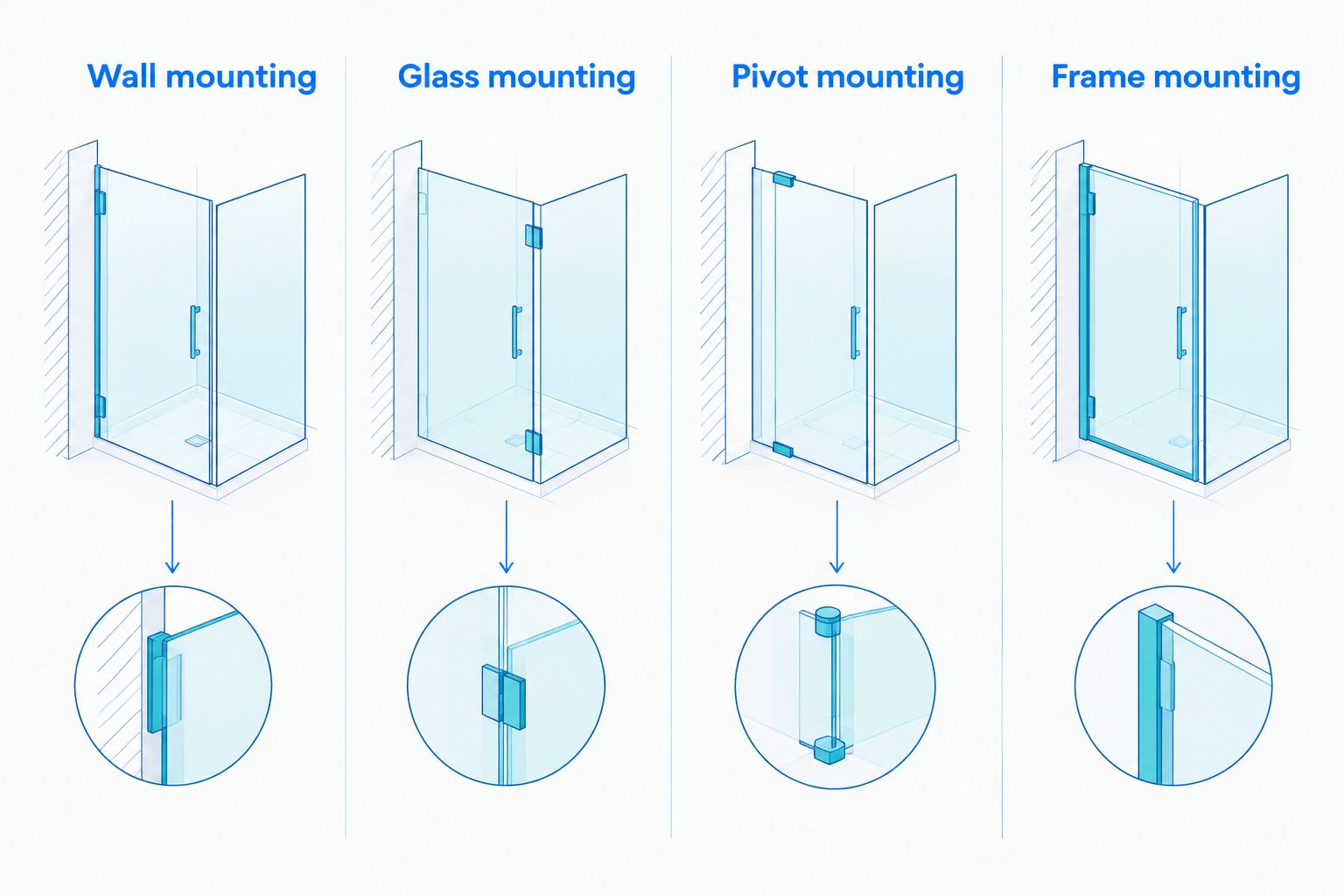
A wall-to-glass hinge connects a swinging glass door to a wall-mounted plate. It is a practical first choice when the door sits beside a wall with appropriate structural backing and a suitable mounting surface.
The durability question is not simply whether the hinge feels solid. It is whether the complete connection—from the glass clamp through the fasteners to the backing—matches the manufacturer’s requirements.
Wall-to-glass hinge pros:
Wall-to-glass hinge cons:
Best for: A frameless swinging door beside a wall that can support the specified mounting system.
Ask the installer to confirm backing, fastener selection, and wall alignment before approving the hinge. Do not solve a questionable connection by choosing a larger-looking plate.
Verdict: Buy when the wall connection and exact hinge specifications are confirmed; hold when backing is uncertain.
A glass-to-glass hinge joins a moving door to an adjacent fixed glass panel. This arrangement suits layouts where the hinge side of the door does not meet a wall directly.
The fixed panel becomes part of the door’s supporting system. Its dimensions, restraints, glass preparation, and supporting hardware therefore matter alongside the hinge itself.
Glass-to-glass hinge pros:
Glass-to-glass hinge cons:
Best for: An enclosure whose approved design uses a fixed panel to support the hinged door.
Geometry needs precise language. A 90-degree connection places adjoining panels at a right angle; a 180-degree connection aligns them in a straight run. A 135-degree connection serves an angled arrangement. These angle descriptions do not establish a hinge’s load capacity or permitted swing.
Before ordering, distinguish the panel connection angle from the door’s opening angle. They describe different things.
Verdict: Buy for a properly supported glass-to-glass design; skip as a workaround for missing wall backing.
A top-and-bottom pivot arrangement places the rotational supports at the door’s upper and lower edges. Its load path differs from side-mounted hinges, so the surrounding enclosure must be designed for that particular system.
Pivot hardware is not automatically stronger because it sits near the corners. Confirm which components carry the weight, how the upper connection restrains the door, and what the lower connection requires.
Top-and-bottom pivot hinge pros:
Top-and-bottom pivot hinge cons:
Best for: A new or replacement enclosure specifically designed around top-and-bottom pivot hardware.
For a 2026 remodel, resolve the pivot details before the enclosure is fabricated. Do not assume a side-hinged glass door can accept pivot hardware without different preparation. Confirm any threshold or floor attachment against the waterproofing design as well.
Verdict: Buy as part of a specified pivot assembly; skip an unverified conversion from side hinges.
A continuous hinge runs along the door edge as part of a framed assembly. It belongs in a different design category from the individual hinges used on frameless glass.
Its suitability depends on the frame profile and the original door system. For replacement work, identifying that assembly matters more than finding a hinge of approximately the same length.
Continuous hinge pros:
Continuous hinge cons:
Best for: An existing or new framed enclosure designed for a continuous hinge.
Inspect the frame before approving replacement hardware. A new hinge cannot correct a distorted frame or a failed frame attachment. Ask whether the fault lies in the hinge, the frame, or their connection.
Verdict: Buy for a confirmed frame match; skip for a frameless door.
The 2026 ranking prioritizes a clear supporting arrangement, documented compatibility, and a repairable assembly. Wall-to-glass leads as the starting point for a door beside a suitably supported wall. Glass-to-glass, pivot, and continuous hinges follow because they answer more specific layout requirements—not because they have proven shorter lifespans.
Material and installation can change the result within every category. Two visually similar hinges can have different capacities, glass requirements, and maintenance instructions. Compare the exact models rather than extending a category-level recommendation into a performance guarantee.
Photograph the complete enclosure, each hinge, and any identification marks. Record where the door rubs or fails to close without repeatedly operating a door that binds or moves abnormally. Those observations help separate hinge trouble from a loose panel, a displaced seal, or an alignment problem.
Give the installer this checklist:
Do not transfer specifications between unrelated parts. For example, the listed Frameless Door Sweep has options for 1/4-inch, 3/8-inch, and 1/2-inch glass. Those sweep options do not establish compatibility for any hinge. Each component needs its own fit check.
Avoid loosening glass-clamping screws to investigate a problem yourself. The door needs controlled support during hinge service. If the glass contacts another hard surface or a hinge connection moves, stop using the door and arrange an inspection.
Choose the hinge arrangement that matches the enclosure’s verified support—not the one that looks strongest. For an undecided homeowner planning a wall-side frameless door, start with wall-to-glass hardware and have the installer confirm the complete connection.
For a fixed-panel layout, specify glass-to-glass hardware as part of the panel design. Choose pivots only with compatible upper and lower supports. Keep continuous hinges within the framed systems they fit.
Showerdoor manufactures and installs custom shower enclosures in California, Arizona, and Nevada. Use the contact page to discuss the enclosure and its mounting conditions before selecting replacement hardware or approving a new design.
What are the best shower door hinges ranked by durability?
Start with wall-to-glass hinges for a door beside a suitably supported wall, then select glass-to-glass, pivot, or continuous hinges when the layout requires them. This is a selection ranking, not proof of longer service life; exact hardware specifications and installation determine suitability.
Are wall-to-glass hinges stronger than glass-to-glass hinges?
The mounting type alone does not establish strength. Compare the exact hinge capacities and the supporting wall or fixed-panel assembly before choosing.
Are pivot hinges more durable than side-mounted shower hinges?
Pivot hinges are not automatically more durable than side-mounted hinges. A pivot assembly needs compatible upper and lower supports, while side-mounted hinges need an appropriate wall or glass-panel connection.
Can I replace shower door hinges without replacing the glass?
Replacement hinges must match the existing glass thickness, holes, and cutouts, and the glass must remain suitable for use. Have an installer identify a compatible replacement rather than selecting by appearance.
Does a stainless finish mean the hinge is solid stainless steel?
A finish description does not establish the hinge’s base material. Check the manufacturer’s material specification and cleaning instructions for the exact model.
How many hinges does a heavy shower door need?
Use the hinge quantity and arrangement specified by the hardware manufacturer for the door’s weight, width, and glass configuration. Do not add a hinge as an improvised way to exceed a published limit.
Should I tighten a loose shower door hinge myself?
Arrange professional inspection when a hinge slips, the glass moves, or the door rubs. Loosening or tightening a glass clamp without the correct support and instructions can create an unsafe condition.
Before approving a 2026 enclosure, ask for the hinge model identification and keep it with the installation paperwork. A clear photograph of that information makes future compatibility checks easier than trying to identify a hinge from its finish. Specify the assembly now so a future repair does not start with guesswork.


