
You have no items in your shopping cart.

No—a frameless shower door does not inherently need more maintenance than a framed door; it replaces some frame-and-track cleaning with attention to exposed glass, hinges, and seals. Frameless shower door maintenance still includes removing water and soap residue, checking the door’s movement, and replacing worn seals when needed; less metal does not mean maintenance-free.
Frameless doors change where you clean rather than automatically increasing the work. Both designs collect water spots and soap residue. The practical difference is how easily you can reach the surfaces and where water remains after a shower.
| Maintenance consideration | Framed shower door | Frameless shower door |
|---|---|---|
| Best for | Homeowners comfortable cleaning frame channels and joints | Homeowners who prioritize access to exposed glass surfaces |
| Cleaning advantage | The frame defines the panel edges and closing surfaces | Fewer perimeter frame surfaces interrupt wiping |
| Cleaning drawback | Channels, corners, and frame joints need attention | Glass edges, hinges, and seals still need detailed cleaning |
| Parts to inspect | Frame joints, seals, and the design’s operating hardware | Hinges or rollers, handles, sweeps, and seals |
| Main limitation | Framing does not prevent residue or moisture buildup | An open appearance does not eliminate moving parts or water-control components |
When comparing framed and frameless enclosures from Showerdoor, ask to see the bottom edge and closing side—not just the glass. Those details reveal the cleaning access you will live with.
For a 2026 bathroom remodel, the useful question is not which door looks simpler. It is which enclosure you can clean without awkward reaching, blocked corners, or removing components.
A broad glass panel is straightforward to wipe, but that advantage matters less if you cannot reach its inside face. Likewise, a framed door is not automatically difficult to maintain if its channels and joints remain accessible.
Separate three jobs when making your decision: routine cleaning, inspection of moving parts, and replacement of worn components. A cleaner addresses residue. It does not correct a door that rubs or a damaged sweep.
A frameless enclosure leaves more of the glass edge exposed instead of surrounding each panel with a metal frame. That gives you fewer perimeter frame surfaces to wipe, while leaving hinges, seals, and mounting points as detail-cleaning areas.
Best for: homeowners who want accessible glass and accept regular drying and seal inspection. The benefit is cleaning access, not a promise that spots will stop forming.
The drawback is easy to overlook: clear glass still shows deposits, and a frameless door still relies on correctly fitted components. Keep cleaning pressure away from vulnerable edges, and do not use the handle as a support while reaching across the enclosure.
A framed enclosure adds metal surfaces around the glass. Depending on the design, lower channels, overlapping panels, and frame corners create places that need more detailed cleaning than a flat pane.
Best for: homeowners whose preferred enclosure layout includes framing and whose cleaning routine includes its channels. A frame does not remove the need to clean glass or inspect seals.
The drawback is access. Before choosing a framed enclosure, look at how you will reach the inside corners and any drainage openings. Keep intended drainage paths clear rather than treating every opening as a gap that needs caulk.
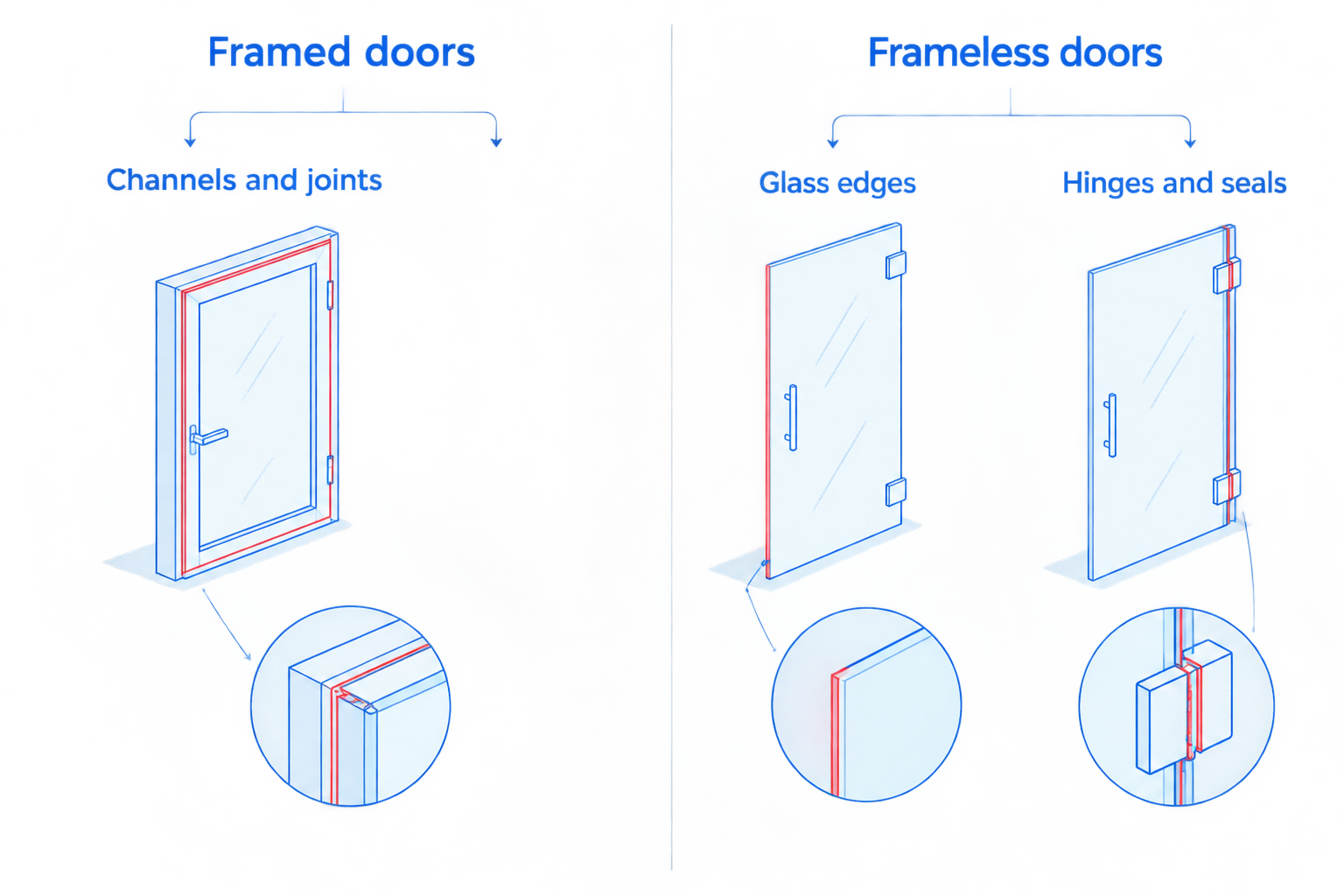
The framed-versus-frameless label does not describe every cleaning task. These details determine what you need to address:
Choose the routine around the installed enclosure, not around a generic “frameless” label. Follow the manufacturer’s instructions when they differ from general cleaning advice.
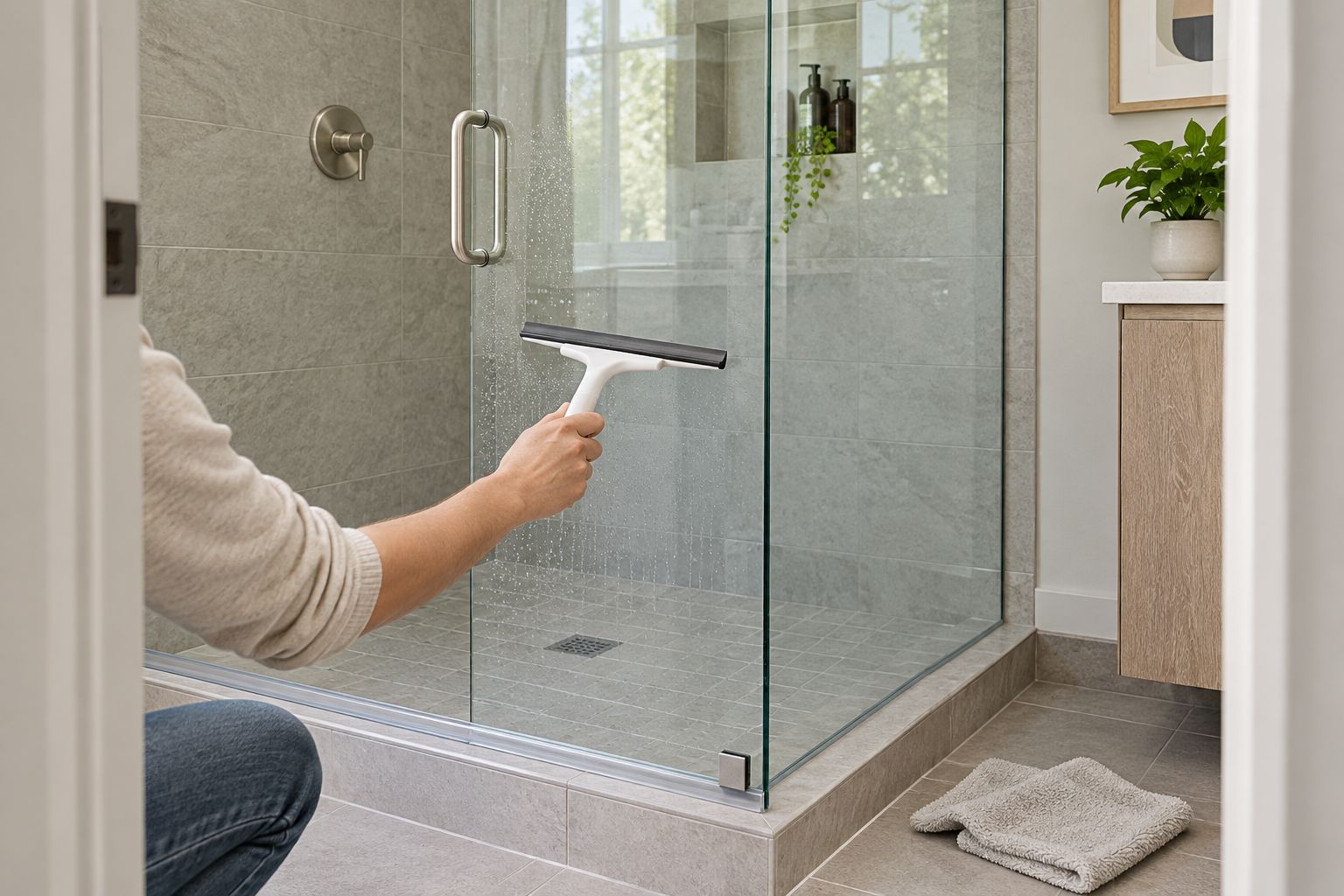
Draw a clean squeegee across accessible glass, then use a soft cloth where water remains around the handle and edges. Avoid striking the glass edge with the tool.
This is preventive cleaning, not a repair. Drying will not remove an established deposit immediately or fix a leaking joint, but it reduces the water left to evaporate on the surface.
Follow the enclosure and cleaner instructions, including any restrictions for treated glass, stone, grout, seals, and hardware finishes. Keep cleaning tools free of grit; a soft tool carrying abrasive debris is no longer gentle on the surface.
Rinse or remove the product as directed. Do not leave cleaner sitting on hardware or seals simply because the glass needs more attention.
Wipe accessible seal surfaces and the adjoining glass. Do not pull a seal away merely to reach behind it unless its removal and reinstallation are part of the manufacturer’s care procedure.
Pay attention to folds and contact surfaces. If a seal has shifted, photograph its position before asking for replacement or service advice.
Open and close the door normally while checking for new rubbing, scraping, or a change in the closing gap. Inspect visible hardware without loosening it.
Stop using a door with damaged glass or unstable hardware and arrange professional assessment. Routine maintenance is not a reason to attempt unsupported glass handling or hinge adjustment.
A bottom sweep is a separate component, not the glass itself. If water escapes near the bottom, inspect the sweep’s condition and position alongside the door alignment and the surrounding shower area.
The listed Frameless Door Sweep is a polycarbonate seal for the bottom of a frameless door, with versions for 1/4-inch, 3/8-inch, and 1/2-inch glass. Those sizes describe that product’s fit options—not a universal specification for every enclosure.
Match the replacement to both the glass thickness and the required profile. Thickness alone does not tell you how a seal meets the curb or adjacent surface.
The advantage of a replaceable sweep is that a worn component can be addressed separately. The limitation is fit: a part that looks similar is not necessarily the correct replacement. Record the existing profile and seek confirmation before ordering.
White deposits on glass and buildup around bathroom fixtures share a cleaning challenge: removing residue without harming the underlying surface. Choosing among limescale removers for bathroom fixtures therefore requires attention to the fixture finish and nearby materials, not just the deposit itself.
Apply that same compatibility check to a shower enclosure. A treatment intended for one surface does not establish that it is suitable for coated glass, plated hardware, natural stone, or a flexible seal.
Keep cleaners separate and never mix cleaning products. Follow the product’s application, ventilation, and rinsing instructions rather than increasing concentration or contact time on your own.
If cloudiness remains after compatible cleaning, do not keep escalating abrasiveness. Persistent cloudiness needs assessment before you treat it as removable surface residue.
Ask the installer to demonstrate access to the inside glass, the lower edge, and the closing surfaces. Then ask which components are intended for routine homeowner care and which require service.
Use these questions during the enclosure discussion:
Showerdoor is suited to homeowners in California, Arizona, and Nevada seeking custom shower enclosure manufacture and installation. Both framed and frameless designs are offered; the maintenance decision should follow the actual layout and care instructions, not the absence or presence of framing alone.
You can reduce the number of perimeter frame surfaces you need to clean, but you cannot eliminate glass cleaning. Compare the actual enclosure designs, especially overlapping panels and access around fixed glass.
A frameless layout with accessible surfaces supports straightforward wiping. That advantage disappears wherever you cannot comfortably reach.
No—a glass coating does not replace regular cleaning or inspection of seals and hardware. Follow its care instructions, including which cleaning products are permitted.
Treat coatings as a separate surface-care decision. They do not adjust hinges, restore damaged seals, or correct water escaping from an enclosure.
No—routine cleaning should focus on accessible surfaces without removing the glass door. If access requires disassembly, ask the installer how that area should be serviced.
Glass removal is not an ordinary cleaning step. Do not loosen hinges or mounting hardware to reach a dirty corner.
Is frameless shower door maintenance harder than framed door maintenance?
Frameless shower door maintenance is not inherently harder; it shifts attention from perimeter framing to glass edges, seals, and hardware. Compare access and the installed design rather than assuming either type needs no upkeep.
Should I squeegee a frameless shower door after every shower?
Removing water after each shower reduces the water left to dry into spots. Use a clean squeegee on accessible glass and avoid striking exposed edges.
Can I use the same cleaner on shower glass and metal hinges?
Use the same cleaner only when its instructions and the enclosure’s care guidance permit both surfaces. Check restrictions for treated glass, hardware finishes, seals, and surrounding materials.
How do I know whether my shower door sweep needs attention?
Inspect a sweep that is split, distorted, displaced, or no longer contacting its intended surface. Water escaping near the bottom also calls for checking door alignment and the surrounding shower area.
Does Showerdoor offer framed and frameless shower enclosures?
Showerdoor manufactures and installs custom framed and frameless glass shower enclosures for homeowners in California, Arizona, and Nevada. Compare the proposed designs by cleaning access, seals, and operating hardware.
What should I prioritize when choosing a low-maintenance shower door in 2026?
Prioritize reachable surfaces, clear care instructions, and correctly identified replacement seals. Neither framing nor a glass coating removes the need for cleaning and inspection.
Before approving a shower enclosure in 2026, rehearse the cleaning motion while reviewing the layout. Ask where your hand, cloth, or squeegee will reach the inside lower corners and the glass behind the handle.
The easiest enclosure to maintain is one whose wet surfaces you can reach without dismantling anything. That is a more useful selection rule than “frameless means less work.”


