
You have no items in your shopping cart.

Remove hard water stains from shower doors with a cleaner approved for your glass, gentle agitation, a thorough rinse, and complete drying. Check the enclosure’s care instructions first: mineral removers and household acids are not compatible with every coating, metal finish, or nearby stone surface. If a test area stays cloudy after cleaning, stop scrubbing harder and have the glass assessed.
Clean a small test area before treating the entire shower door. A successful test tells you more than another round of harder scrubbing. For a 2026 cleaning routine, start with the enclosure’s current care instructions rather than assuming an older household remedy suits the glass.
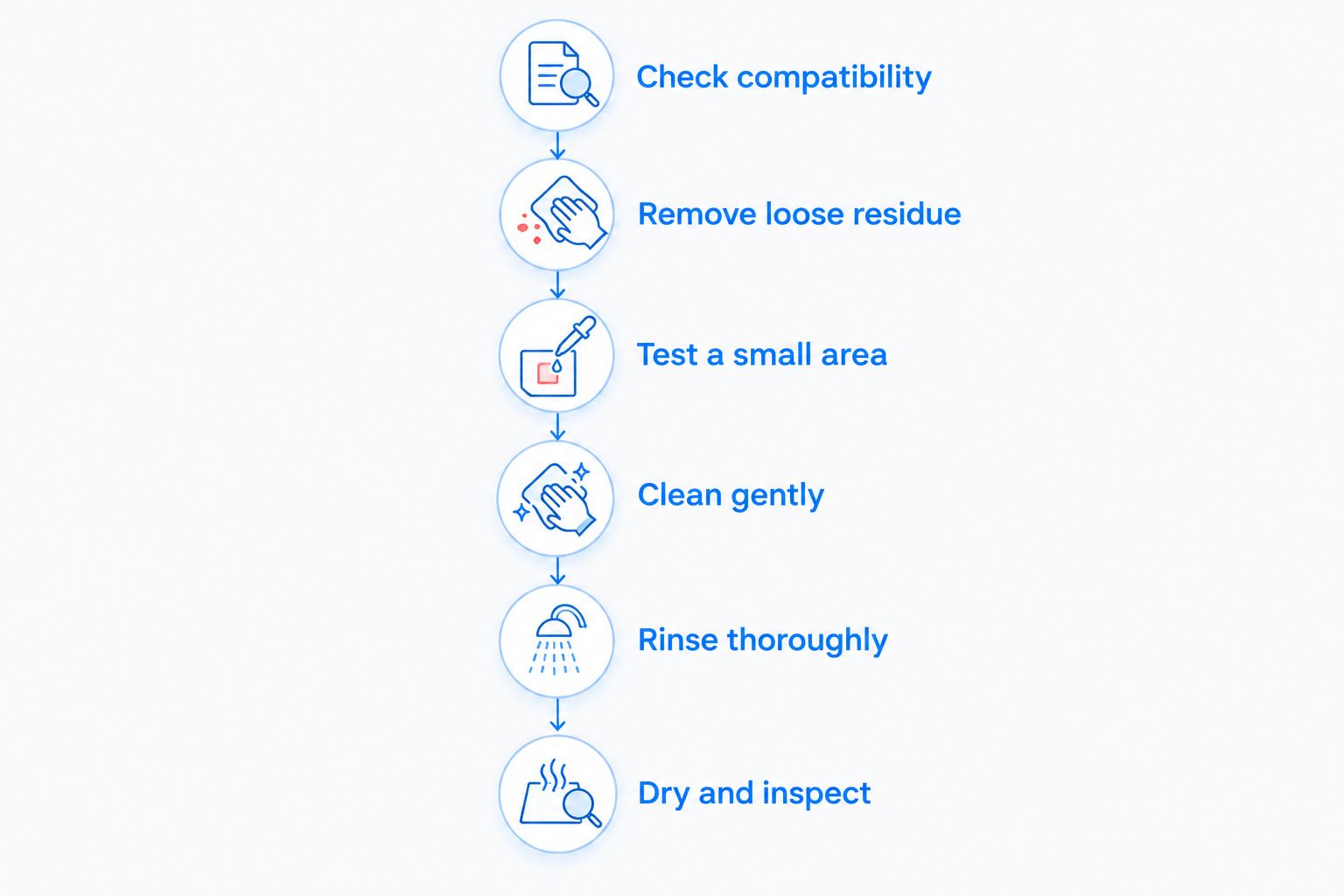
Use this sequence:
The distinction between routine cleaning and stain removal matters. The water stain removers for glass shower doors comparison addresses that product choice; your enclosure’s care instructions remain the compatibility check.
Hard water contains dissolved minerals, including calcium and magnesium. When droplets evaporate, mineral residue can remain on the glass. Cleaning removes that residue; drying interrupts the process that leaves the next set of spots.
A cloudy door does not automatically need a stronger cleaner. Soap residue, leftover cleaning product, mineral deposits, and surface damage can all affect clarity. Identify what changes during a test before changing chemicals.
For your 2026 maintenance plan, separate stain removal from everyday care. Treat existing deposits with a compatible method, then make water removal part of the routine. Repeated deep cleaning without changing the drying habit leaves the source of new spotting untouched.
Choose a cleaner by its stated purpose and surface compatibility, not by how strongly it smells or how aggressively it scrubs. A product that removes deposits from untreated glass is not automatically suitable for coated glass, decorative hardware, or natural stone.
The following options serve different needs. Neither product should replace a check of the enclosure’s care instructions.
| Option | Best for | What the supplied product information states | Limitation |
|---|---|---|---|
| A-MAZ Water Stain Remover | A focused stain-removal task | Designed to clean difficult stains without acids or harsh chemicals | The description does not establish compatibility with every glass coating or surrounding finish |
| A-MAZ Cleaning Kit | Buying stain-removal and sealing supplies together | Includes Water Stain Remover, Ultra Gloss Sealant, and two scrubbers | More components do not eliminate the need to follow each product’s directions |
The kit contains 14 ounces of Water Stain Remover. That package size is not a coverage promise: use the application instructions rather than estimating how many doors it will clean.
Showerdoor is best for homeowners in California, Arizona, and Nevada who need custom shower enclosures manufactured and installed. Its cleaning products are relevant to enclosure care, but a product listing alone does not establish that a cleaner suits your particular door.

A-MAZ Water Stain Remover fits a cleaning job where you want a product specifically described for difficult stains. Its stated acid-free approach distinguishes it from household acid treatments. That does not mean you can skip testing or apply it to every bathroom material.
Use the product label to determine application, agitation, rinsing, and any precautions. Do not extend the contact time to compensate for disappointing results. If the test does not improve the glass, reassess the residue and surface instead.
A-MAZ Cleaning Kit groups a remover, a sealant, and scrubbers. It suits you if those separate tasks are part of your care plan and the products match your enclosure’s requirements. The trade-off is that each component needs its own compatibility and application check.
Treat cleaning and sealing as separate jobs. Remove residue first, then follow the sealant’s preparation instructions. Do not apply a protective product over unresolved haze and expect it to correct the underlying problem.
The same method does not produce the same result on every shower door. These factors determine the next move:
When reviewing products in 2026, distinguish the cleaner’s claims from your enclosure manufacturer’s approval. Both pieces of information matter; neither substitutes for the other.
Do not mix cleaning chemicals. In particular, never mix bleach with vinegar or other acids, or with ammonia. Rinse away the previous cleaner before changing products, and follow ventilation and protective-equipment directions on the label.
Keep abrasive powders, scouring tools, and blades out of an improvised stain-removal routine. Even when a tool is sold for cleaning, it is not automatically approved for your glass or coating. A contaminated pad can also carry grit across the surface.
Do not loosen hinges, remove a glass panel, or pull off seals simply to reach a stain. Clean accessible areas with the door securely supported in its normal position. Hardware movement, damaged glass, or a loose enclosure calls for service, not more cleaning pressure.
Remove water from the glass after showering with a clean squeegee or soft cloth. Work across the panel, then dry accessible lower edges where droplets collect. Do not force a tool into seals or use the handle as a brace.
Keep routine cleaning separate from corrective stain removal. Choosing glass cleaning products for streak control addresses cleaner residue, but a streak-free finish alone does not establish that mineral deposits have been removed. Inspect the dry glass under consistent lighting so you can tell whether the spots are actually gone.
A practical 2026 routine is straightforward: remove droplets after use, clean with a compatible product when residue develops, and investigate recurring haze before escalating treatment. If other bathroom fixtures also develop mineral deposits, remember that cleaning the door treats the surface, not the mineral content of the incoming water.
Showerdoor’s shower-enclosure care products include cleaning and sealing options. Their role is maintenance; do not treat a sealant as a substitute for removing deposits or repairing damaged glass.
Vinegar can dissolve some mineral deposits, but it is not a universal shower-door treatment. Use it only when the enclosure’s care instructions permit an acidic cleaner and you can protect incompatible surrounding surfaces.
Acid-sensitive stone and certain finishes make blanket vinegar advice a poor fit for an installed shower. Do not assume that a household ingredient is harmless because it is familiar. If approval is unclear, use the manufacturer’s specified method instead.
Persistent cloudiness can mean residue remains, the cleaner was not fully rinsed away, or the surface has damage that cleaning cannot remove. Dry the test area completely before deciding which problem you have. Wet glass is not a reliable final inspection.
Compare the treated patch with adjacent untreated glass under the same light. Improvement supports continuing the approved process; no improvement is a reason to stop and seek advice. Do not diagnose permanent etching from a cloudy appearance alone.
Apply a sealant only if it is compatible with the glass and any existing coating. Follow the product’s preparation, application, and curing instructions. Existing factory treatments can have specific maintenance requirements.
For 2026 upkeep, choose the maintenance method before adding another surface treatment. A coating does not remove the need to clean, and it does not turn damaged glass into undamaged glass. Ask the enclosure manufacturer if you cannot identify the existing treatment.
What's the safest way to remove hard water stains from my shower door?
Use a cleaner approved for your glass and coating, test an inconspicuous area, then rinse and dry thoroughly. Protect nearby stone, hardware, and seals according to their care instructions.
Can I use vinegar on a coated glass shower door?
Use vinegar only if the coating’s care instructions permit acidic cleaners. Do not assume approval for plain glass also applies to a coated enclosure or its surrounding finishes.
Will scrubbing harder get rid of stubborn white spots?
Harder scrubbing is not the right response to a failed cleaning test. Recheck cleaner compatibility and residue type, and stop if the glass is not improving.
Does A-MAZ Cleaning Kit include a water stain remover?
A-MAZ Cleaning Kit includes 14 ounces of Water Stain Remover, Ultra Gloss Sealant, and two scrubbers. Check each component’s instructions before using it on your enclosure.
How do I know whether the cloudy marks are permanent?
Cloudy marks alone do not prove permanent damage. Clean and dry a small test area with an approved method, then arrange an assessment if the haze remains.
How do I keep hard water spots off the glass after cleaning?
Remove water droplets after showering and maintain the glass with compatible products. Dry accessible edges as well as the center of the panel, without disturbing seals or hardware.
Can I mix cleaners to remove stains faster?
Do not mix cleaning chemicals. Never combine bleach with acids or ammonia, and rinse away the previous product before changing cleaners.
Inspect the glass dry, not while the rinse water is still on it. Water changes how haze and marks look, so a wet panel can give you the wrong impression of the result. Dry the test patch and nearby untreated glass before deciding whether to repeat treatment.
For Showerdoor shower enclosures, keep the care instructions with your cleaning supplies. A compatible method you can repeat is better than a stronger treatment you cannot verify.


