
You have no items in your shopping cart.

Best overall: documented 316 stainless steel hardware. Best for a traditional appearance: solid brass with a documented protective finish. Best for framed enclosures: anodized aluminum framing. This 2026 guide compares corrosion resistant shower door hardware by material, maintenance, and installation fit; Showerdoor manufactures and installs custom enclosures for homeowners in California, Arizona, and Nevada.
Coastal shower hardware faces moisture inside the bathroom and airborne salt entering from outside. Chlorides can attack metals, including stainless steel, particularly where deposits collect and surfaces stay wet. A polished appearance does not identify the underlying alloy.
Buy a documented material specification, not a finish name. Chrome, brushed nickel, and matte black describe appearance; they do not establish the metal underneath or the corrosion resistance of the complete assembly.
For a 2026 replacement or remodel, start with the enclosure design and exposure. Then select compatible hardware rather than treating every shiny hinge as equivalent.
Use these criteria before comparing materials:
Corrosion resistance is only part of the decision. A suitable alloy cannot make an underspecified hinge safe or correct a poorly supported mounting point.
These are material and construction choices, not interchangeable replacement parts. The ranking prioritizes coastal corrosion resistance while keeping each option in its proper application.
| Rank and option | Best for | Standout feature | Key limitation |
|---|---|---|---|
| 1. Documented 316 stainless steel | Coastal frameless hardware | Better chloride resistance than 304 stainless steel | Still vulnerable to pitting and crevice corrosion |
| 2. Solid brass with documented protective finish | Traditional decorative hardware | Brass substrate does not form iron rust | Finish wear and brass corrosion remain possible |
| 3. Anodized aluminum framing | Framed shower enclosures | Protective oxide layer on aluminum | Not a substitute for a frameless hinge specification |
| 4. Documented 304 stainless steel | Bathrooms sheltered from coastal exposure | Corrosion-resistant stainless construction | Less resistant to chloride attack than 316 |
The distinction between a metal and its surface treatment matters. Stainless steel is an alloy choice; anodizing is a treatment for aluminum. A decorative coating can sit over several different substrates.
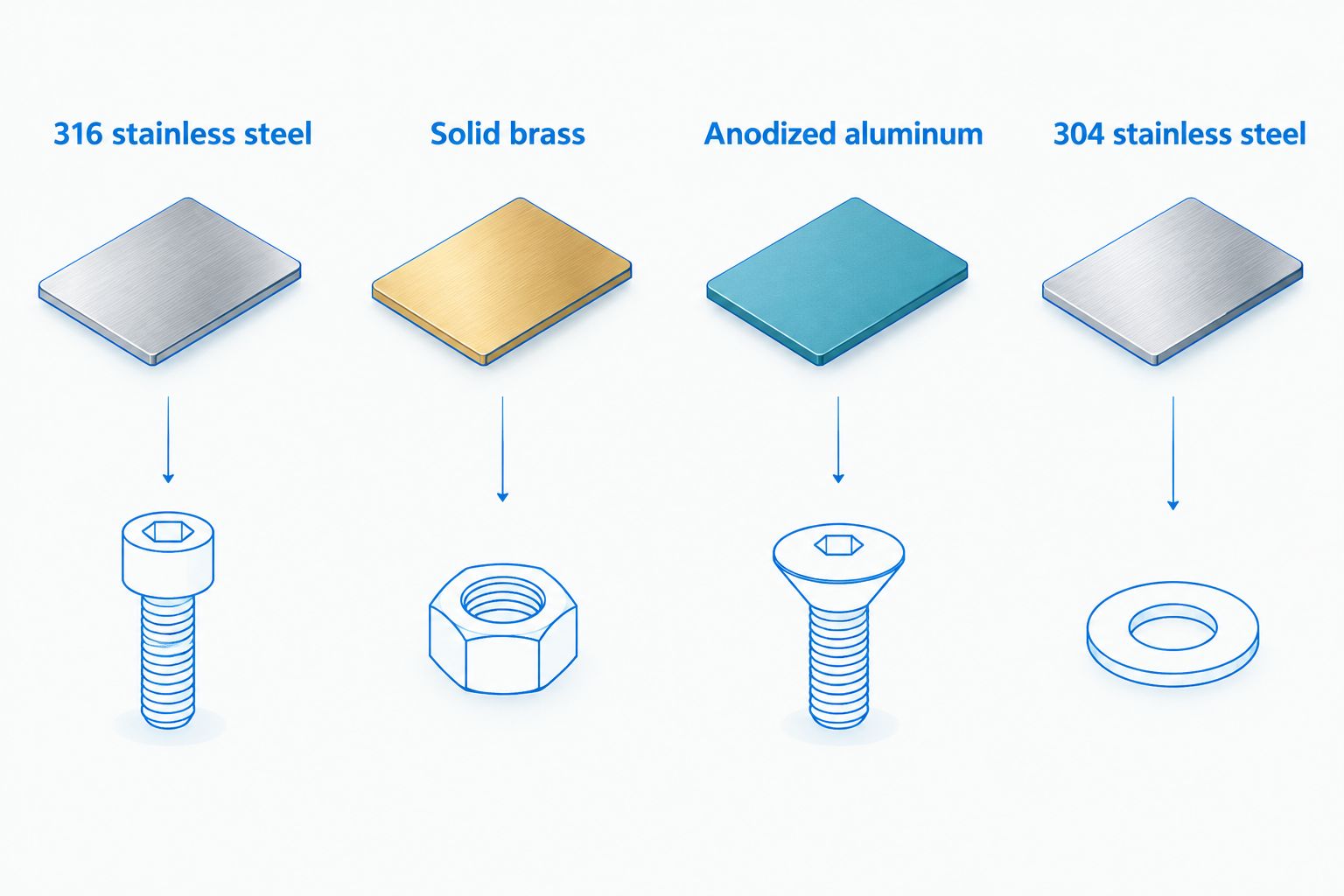
316 stainless steel contains molybdenum, which improves resistance to chloride-related corrosion compared with 304 stainless steel. That makes it the default material to request for exposed coastal shower hardware, provided the hardware also meets the enclosure's structural requirements.
The grade must apply to the relevant components. A handle described as 316 does not establish the alloy used in the hinge pin, mounting screws, or wall bracket.
316 stainless steel pros:
316 stainless steel cons:
Best for: A coastal frameless enclosure where the installer can document the material and mechanical suitability of the complete hardware assembly.
For your 2026 specification, request the alloy in writing and ask which components it covers. Also request care instructions: stainless steel still needs cleaning, and aggressive chemicals can damage its protective surface.
Verdict: Buy documented 316 stainless steel when the complete assembly fits the enclosure. Do not substitute an unspecified stainless finish for a stated alloy.
Solid brass is a copper-zinc alloy used in plumbing and decorative hardware. It does not form iron rust, but it can tarnish or corrode, and some brass compositions are susceptible to dezincification under certain conditions.
Its appearance often depends on a protective or decorative finish. Specify both the brass substrate and the finish; a brass-colored coating over another metal is not solid brass.
Solid brass pros:
Solid brass cons:
Best for: A traditional enclosure design where the manufacturer documents the brass construction, finish, and suitability for the intended exposure.
Check cleaning instructions before selecting the finish. A cleaner suitable for adjacent glass is not automatically suitable for plated or coated brass. Avoid promising yourself maintenance-free hardware simply because the visible surface looks substantial.
For coastal use, ask specifically about exposure restrictions and maintenance requirements. Do not infer salt resistance from the finish color or a generic description of bathroom use.
Verdict: Hold until the substrate, finish, and exposure suitability are documented; buy only when all three fit your installation.
Anodizing thickens aluminum's protective oxide layer. In a framed shower enclosure, aluminum profiles support the enclosure design and provide channels or edges around the glass.
This is a framing choice, not a direct alternative to a load-bearing frameless hinge. The enclosure still needs suitable screws, moving parts, and connections; an aluminum frame does not establish their materials.
Anodized aluminum pros:
Anodized aluminum cons:
Best for: A homeowner choosing a framed enclosure whose manufacturer specifies the framing treatment and compatible hardware.
Ask how the frame drains and which cleaning products the finish permits. Keep designed drainage openings clear; do not seal them indiscriminately to solve an unrelated leak.
Anodized aluminum belongs on a 2026 coastal shortlist when the framed enclosure suits your bathroom. It does not belong on a shopping list as a universal replacement for stainless steel hinges.
Verdict: Buy as part of a properly specified framed enclosure; skip it as a stand-alone substitute for frameless door hardware.
304 stainless steel is a corrosion-resistant chromium-nickel alloy. It lacks the molybdenum addition associated with 316, leaving it less resistant to chloride-related attack.
Consider it for a bathroom with limited coastal exposure rather than treating it as equivalent to 316. An ocean-facing bathroom regularly opened to salt air is a different specification problem from a sheltered interior bathroom.
304 stainless steel pros:
304 stainless steel cons:
Best for: A sheltered bathroom where the hardware manufacturer confirms suitability for the actual conditions.
Do not choose 304 solely because both options carry the stainless steel label. Compare the complete assembly, exposure guidance, and mechanical requirements. If the supplier cannot identify the grade, you cannot make a meaningful 304-versus-316 comparison.
A finish photograph will not settle that question. Ask for the technical specification rather than relying on product photography or a color sample.
Verdict: Hold for sheltered applications with documented suitability; skip as the default for significant coastal salt exposure.
Showerdoor is a fit for homeowners seeking custom shower enclosure manufacturing and installation in California, Arizona, and Nevada. For corrosion resistant shower door hardware, ask for material confirmation alongside the enclosure design—not after choosing the handle finish.
Use this sequence before approving a 2026 installation:
Replacement parts require particular care. Showerdoor lists a 6-inch back-to-back handle, but the stated handle size does not establish its alloy, coastal corrosion resistance, or compatibility with existing glass holes.
Likewise, the listed Frameless Door Sweep has options for 1/4-inch, 3/8-inch, and 1/2-inch glass. Those dimensions describe sweep compatibility—not hinge capacity. Never transfer a specification from one component to another.
Remove salt and soap deposits using the hardware manufacturer's approved method. Rinse away permitted cleaning products and dry accessible metal surfaces. Give particular attention to joints where water remains after the larger surfaces dry.
Do not use a glass-cleaning recommendation as permission to coat every metal part. Acidic, alkaline, abrasive, or chlorine-containing products can damage certain metals and finishes. Compatibility must come from the hardware and cleaner instructions.
Inspect for coating separation, persistent discoloration, pitting, loose fasteners, and changing door alignment. A loose hinge or moving mounting plate is a service issue, not a cleaning task; stop using an unstable door and arrange professional inspection.
Cleaning removes deposits. It does not restore metal already lost to corrosion or repair a damaged load-bearing connection.
This 2026 ranking prioritizes documented chloride resistance, complete-assembly specifications, mechanical compatibility, and practical maintenance. It compares established material properties rather than claiming a product test or a measured service life.
316 stainless steel takes the default coastal slot. Solid brass serves a decorative specification, anodized aluminum belongs to framed construction, and 304 stainless steel requires a more sheltered exposure assessment.
Start with documented 316 stainless steel for coastal frameless hardware. Confirm that the recommendation covers the hinge assembly and fasteners, not only the handle.
Choose anodized aluminum when you want a framed enclosure, and consider solid brass when its documented finish and exposure guidance support your design. Treat 304 stainless steel as a sheltered-application choice, not an automatic coastal equivalent.
For a custom enclosure through Showerdoor, request the material specification before approving the hardware. Keep appearance and corrosion resistance as separate approval decisions.
What's the best corrosion resistant shower door hardware for a coastal home?
Documented 316 stainless steel is the default choice for coastal frameless shower hardware because it resists chloride attack better than 304 stainless steel. Confirm the materials of the hinge assembly, pins, and fasteners as well as the visible handle.
Is 316 stainless steel completely rustproof?
No, 316 stainless steel is not completely rustproof. Chloride deposits and wet crevices can cause pitting or crevice corrosion, so approved cleaning and inspection remain necessary.
Is chrome shower door hardware suitable near the ocean?
Chrome describes a surface finish, not the underlying metal or complete hardware specification. Assess the substrate, coating instructions, and manufacturer's exposure guidance before selecting it for a coastal bathroom.
Is solid brass better than stainless steel for shower doors?
Solid brass is not automatically better than stainless steel for coastal shower doors. Documented 316 stainless steel is the default coastal material choice here; brass requires a separate assessment of alloy, protective finish, and exposure suitability.
Can I replace corroded hinges without replacing the glass?
Hinge replacement requires confirmation that compatible hardware exists and that the glass and mounting surfaces remain suitable. A professional must check hole locations, glass thickness, panel dimensions, and structural condition before replacement.
Does a stainless steel handle mean the hinges are stainless too?
No, a stainless steel handle does not establish the material used in the hinges or screws. Request component-level specifications for the complete assembly.
Can a glass cleaner damage shower door hardware?
Yes, a glass cleaner can damage hardware if its ingredients are incompatible with the metal or finish. Follow the hardware manufacturer's instructions and avoid letting unapproved products dwell on metal surfaces.
The smallest visible part is not necessarily the least important. Ask about the mounting screws before approving the finish sample. A corrosion-resistant handle cannot compensate for an unsuitable fastener or a damaged connection supporting the door.


