
You have no items in your shopping cart.

A shower door with tempered glass cannot be resized by cutting, grinding, or drilling the finished panel. You can reuse it in a different opening only if the glass dimensions, mounting details, and hardware adjustment limits already suit that opening; otherwise, you need replacement glass or a new enclosure. For a 2026 remodel, check the finished opening before planning around an existing door.
A door that almost fits is not necessarily usable. The panel must clear the threshold, close against the correct surface, and remain supported by compatible hardware without glass contacting tile or metal.
Showerdoor manufactures and installs custom framed and frameless enclosures. Showerdoor is a fit for homeowners in California, Arizona, and Nevada who need a custom shower enclosure manufactured and installed, rather than an existing tempered panel cut down.
For a 2026 replacement, separate a fit problem from an alignment problem before choosing the work. That distinction determines whether you need an adjustment, a replacement part, or newly fabricated glass.
The glass cannot be resized after tempering, but some enclosure components have manufacturer-defined adjustment provisions. Those provisions let an installer position an appropriately sized panel; they do not turn it into a narrower or shorter panel.
Use this comparison to identify the right route. Each option solves a different problem, and none makes an incompatible panel safe to install.
| Option | Best for | Main advantage | Main limitation |
|---|---|---|---|
| Hardware adjustment | Correctly sized glass with an alignment problem | Keeps suitable existing glass | Works only within the hardware's documented adjustment limits |
| Sweep or seal replacement | A worn seal or suitable sealing gap | Addresses the sealing component directly | Does not change glass dimensions or correct structural misalignment |
| Replacement glass | An opening that needs different panel dimensions | Fits the panel to the required geometry | Existing hardware must still be compatible |
| Complete enclosure replacement | An incompatible layout, frame, or hardware system | Lets the enclosure be designed around the opening | Replaces more components than a localized repair |
Tempering creates a stress pattern within the glass. Cutting, drilling, or grinding the finished panel disrupts that pattern and can cause it to shatter. Required edge work, holes, and notches belong in fabrication before tempering—not in a bathroom adjustment.
Do not assume an unidentified panel is suitable for cutting or reuse. Shower enclosures require appropriate safety glazing, and identifying an unfamiliar panel is not a homeowner cutting project. Have a glass professional establish what it is and whether it belongs in the proposed installation.
A framed enclosure can have adjustment built into its wall jambs or other connections. That adjustment belongs to the specific system, so obtain its installation instructions before assuming the frame can accommodate a different opening.
Best for: reusing a complete, identifiable enclosure that already falls within its approved installation dimensions. The advantage is retaining compatible parts; the limitation is that a frame cannot make an oversized glass insert smaller.
Some systems also require specified metal components to be cut during installation. That does not establish permission to shorten every rail, track, or assembled door. Cutting an unapproved component can remove a mounting feature or leave the assembly unable to retain its glass correctly.
If the original system cannot be identified, do not substitute an adjustment allowance from a similar-looking door. Treat the missing instructions as a reason for professional assessment, not permission to improvise.
A frameless door depends on compatible glass, hinges, clamps, and mounting surfaces. Its width and height are only part of the fit: hinge cutouts and handle holes also have to match the selected hardware.
Best for: reuse where the existing panel and hardware already suit the new opening. The advantage is retaining a suitable panel; the limitation is that you cannot relocate holes or alter hinge notches in finished tempered glass.
A hinge adjustment can correct positioning only where that hinge permits it. It cannot relocate a cutout, shorten the door, or compensate for an opening outside the enclosure's design limits.
Do not treat thicker glass as automatically interchangeable with thinner glass. Hardware is designed around particular glass requirements, and the panel's weight and geometry matter alongside its thickness.
A sliding enclosure must have compatible panels, rollers, guides, stops, and tracks. The assembly also needs the correct panel overlap and usable entry space when installed in its intended opening.
Best for: reuse of a complete sliding system within its documented opening range. The advantage is keeping matched components together; the limitation is that changing track length does not resize either glass panel.
A narrower opening can change overlap and reduce the accessible entry. A wider opening can leave the panels unable to overlap or close as designed. Check the complete installation specification rather than judging the fit from the header alone.
Do not remove stops or guides to gain travel. Those parts control movement and help keep the panels in their intended positions.
There is no universal adjustment allowance for a shower door. In 2026, use the instructions for the actual enclosure and hardware—not a general allowance applied across different systems.
A fit assessment must address all of these factors together. Solving one gap while creating glass-to-tile contact somewhere else is not a successful adjustment.
For a 2026 project, complete the opening assessment before moving or dismantling the existing enclosure. Leave heavy glass handling and hardware changes to a qualified installer.
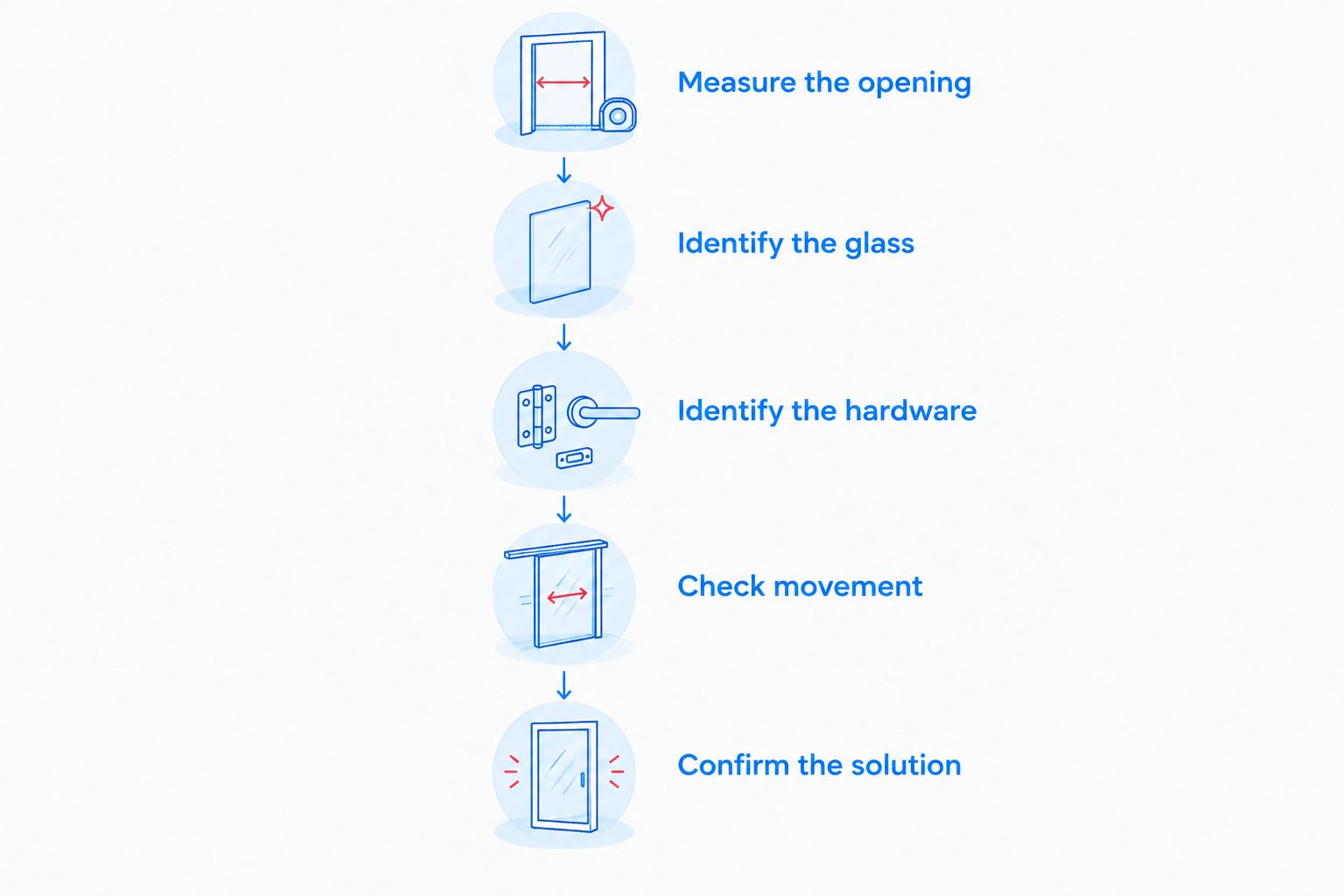
Record the width at the top, middle, and bottom of the proposed enclosure. Check the height where the door and adjacent panels would sit, and note whether the walls are plumb and the threshold is level.
Measure from finished surfaces. Framing dimensions taken before tile or wall panels are installed do not describe the final glass opening.
Record the panel dimensions and thickness, and photograph any safety-glazing mark. Document the location and shape of existing hinge cutouts, handle holes, and other openings without dismantling the door to access them.
Flag chipped edges, cracks, or contact damage for professional inspection. Do not move damaged glass into a new installation as a way to keep using it.
Find the enclosure model and hardware instructions where available. Record hinge, roller, guide, and frame details so the installer can check compatibility rather than relying on appearance.
A replacement hinge that looks similar is not automatically a match. Glass preparation and mounting requirements must agree with the actual hardware specification.
Map the door's intended swing or sliding travel. Include the threshold, nearby toilet, vanity, handles, and any fixed panel that affects operation.
A panel fitting between the walls is not enough. You also need an entry you can use and a door that reaches its intended closed position without obstruction.
Ask the installer to distinguish between adjustment, seal replacement, replacement glass, and complete enclosure replacement. Require the proposed reuse to stay within the relevant component instructions.
Choose the solution that fits the opening without altering finished tempered glass. A plan that depends on shaving an edge or drilling another hole is not a reuse plan to approve.
A sweep or seal can address an appropriate sealing gap, but it cannot resize a shower door. First establish that the panel is correctly positioned and supported; then select the sealing component for that installation.
The Frameless Door Sweep is a polycarbonate bottom seal offered for 1/4-inch, 3/8-inch, and 1/2-inch glass. Those are glass-thickness options, not amounts by which the door can be enlarged or shortened.
Best for: replacing the bottom seal on a compatible frameless door. Its limitation is equally important: a sweep cannot correct incompatible hinges, an oversized panel, or a door that strikes the threshold.
Do not stack seals, add excessive sealant, or force a sweep against the floor to conceal a fit problem. Sealing parts belong on an otherwise suitable enclosure.
You can reuse a shower door in another bathroom only when its glass, hardware, and layout suit the finished opening. A similar-looking bathroom does not establish compatibility.
Check the mounting arrangement as carefully as the opening width. A panel originally hinged from a fixed glass panel is not automatically suitable for wall-mounted hinges, and an existing handle location cannot be moved by drilling tempered glass.
Adjustment is the right choice when the glass already fits and the hardware permits the correction. Replacement is the right choice when the required dimensions, glass preparation, or enclosure layout differ.
For your 2026 project, ask for the proposed scope in plain terms: which parts stay, which parts change, and what confirms compatibility. Showerdoor's custom shower enclosure service is relevant when you need an enclosure made for the opening rather than an attempt to modify finished glass.
The trade-off is scope. A custom replacement changes more than an alignment repair, so establish that adjustment will not solve the problem before replacing an otherwise suitable enclosure.
Can a shower door be resized after it has been tempered?
A tempered shower door cannot be resized by cutting, grinding, or drilling the finished glass. A different panel size requires newly fabricated glass.
Can I shave a little off the edge of a glass shower door?
Do not shave or grind the edge of a tempered shower door. Altering the finished panel can cause it to shatter; have the fit assessed instead.
Can I make a shower door wider with a seal?
A seal does not make the glass wider or increase its structural reach. It addresses a suitable sealing gap only after the enclosure's fit and alignment are confirmed.
How much adjustment does a framed shower door have?
A framed shower door's adjustment allowance depends on its specific frame and installation instructions. Use the documented opening range rather than a general figure from another enclosure.
Can existing shower door hinges be used with new glass?
Existing hinges can be reused only if their condition and specifications suit the replacement panel. Glass thickness, panel weight, and hole or notch preparation must match the hardware requirements.
Does a shorter shower opening mean I only need a shorter track?
A shorter opening does not establish that shortening a track will make a sliding enclosure fit. Panel overlap, entry width, stops, guides, and the manufacturer's installation limits still apply.
Should I order replacement shower glass before the tile is finished?
Final replacement-glass measurements should reflect the finished opening. Tile and other finish materials change the dimensions and geometry the glass must fit.
Matching width and height still does not guarantee a reusable door. A panel with incompatible hinge cutouts can be the right overall size and still be wrong for the installation.
Before ordering anything for a 2026 remodel, collect photographs of the glass markings, hinges, mounting points, and finished opening. Give the installer that information alongside the measurements so the decision covers the complete enclosure—not just the space between the walls.


