
You have no items in your shopping cart.

Dry your glass shower door after every shower, and use a compatible shower glass cleaner weekly as a starting routine. Clean sooner if you see soap film or water spots; coated glass, seals, and hardware need their own manufacturer-approved care, not automatically the same cleaner.
Water evaporates, but dissolved minerals can remain on the glass. Soap and personal-care products also leave residue, so drying and cleaning solve different problems: drying removes water, while cleaning removes accumulated film.
Your 2026 care plan should separate prevention from stain removal. Start with a manageable routine, then adjust it to what the dry glass actually looks like. For deposits already covering the door, see how to get rid of hard water stains on shower doors before repeatedly applying a general cleaner.
Use weekly cleaning as a starting recommendation, not a universal requirement. Remove water after each shower, inspect the glass during routine cleaning, and address visible buildup rather than leaving it until the next scheduled session.
| Task | Recommended starting frequency | Best for | Limitation |
|---|---|---|---|
| Remove water with a clean squeegee or soft cloth | After every shower | Reducing water left to dry on glass | Does not remove established mineral deposits |
| Clean with a compatible glass-cleaning product | Weekly | Removing routine soap film and residue | The cleaner must suit the glass and surrounding materials |
| Treat visible water stains | When deposits appear | Addressing localized mineral buildup | Not every stain remover suits coated glass or adjacent stone |
| Inspect seals, edges, and tracks | During routine cleaning | Finding trapped residue and damaged components | Cleaning does not repair worn seals or loose hardware |
A shared shower and a rarely used guest shower do not need identical schedules. Judge the result after the surface dries: persistent streaks, a cloudy band, or chalky dots tell you more than the calendar alone.
Keep product use separate from water removal. You do not need to apply a chemical cleaner every time you use a squeegee, and adding more cleaner does not replace rinsing or wiping as directed.
Start with the simplest preventive step. Move water off the inside face of the glass using a clean, soft-edged squeegee, then wipe accessible wet edges with a soft cloth.
Check the tool before using it. Grit caught on a cloth or squeegee can scratch a surface, so keep cleaning tools clean and avoid using a cloth that has just wiped a gritty shower floor.
A practical sequence is:
Drying is useful prevention, but it is not a substitute for cleaning. If the door still feels slick or looks cloudy once dry, address the residue with a compatible product.
For your 2026 weekly routine, inspect the dry door before wetting it. Note whether the problem is broad soap film, isolated water spots, or residue concentrated near the bottom edge; each pattern helps you decide where to focus.
Follow this sequence, with the product label and enclosure care instructions taking priority:
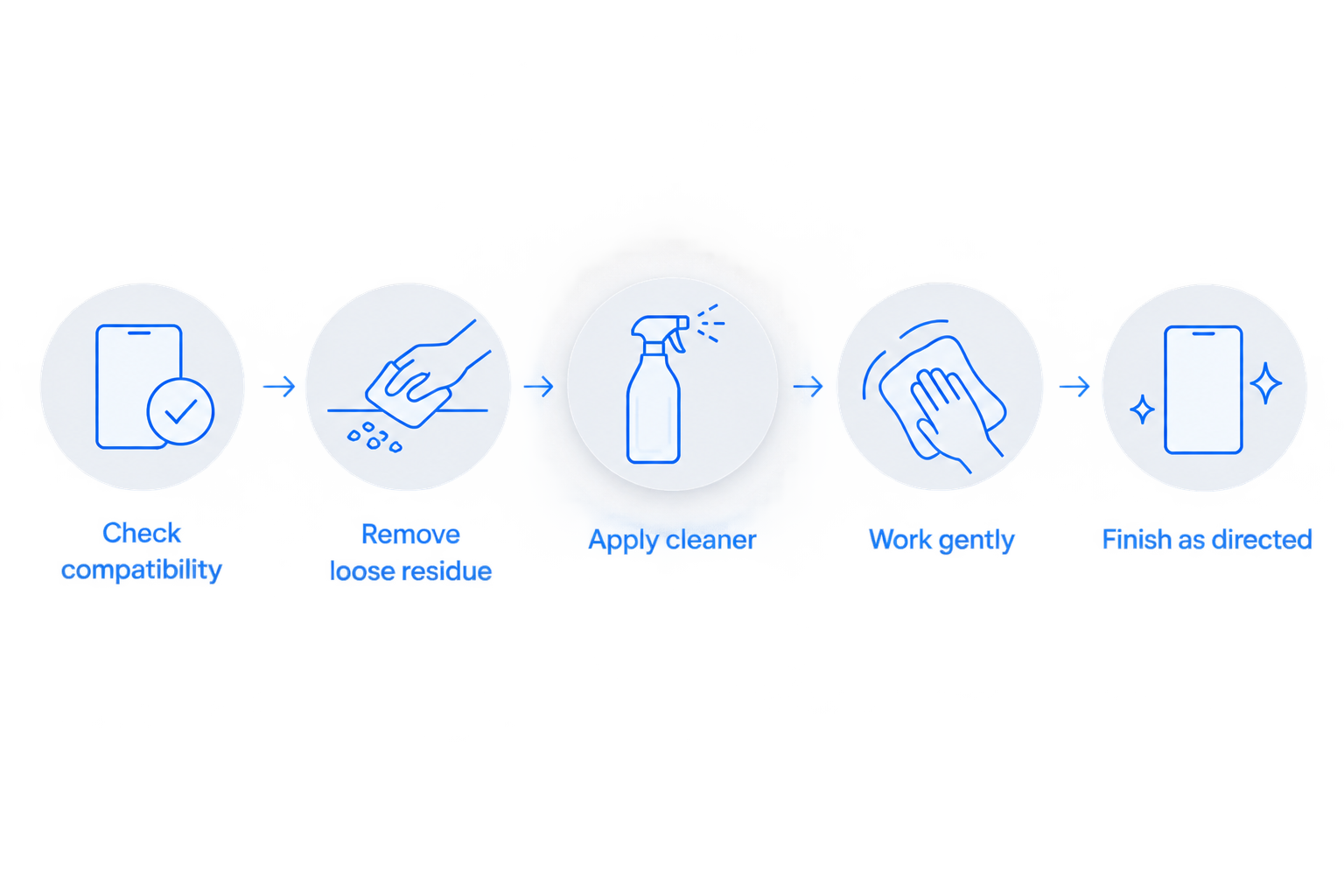
Do not invent a contact time or let a product sit longer because a stain looks stubborn. Follow the label, and do not mix cleaning products or apply another product over unrinsed residue.
A routine cleaner and a water-stain remover serve different purposes. If ordinary cleaning removes the soap film but leaves chalky spots, check whether the remaining deposit needs a compatible stain-removal treatment.
Stop escalating pressure when a mark does not lift. Confirm the surface and product instructions before trying another treatment. Persistent cloudiness can require an assessment rather than another round of scrubbing.
For 2026 product selection, choose by the job and material compatibility—not by the promise of a stronger clean. Showerdoor lists shower glass cleaner and care products with different stated purposes; those descriptions do not establish compatibility with every existing enclosure.
| Product | Best for | Stated function | What to check before use |
|---|---|---|---|
| Century Clean & Seal | Combining cleaning and surface care | Cleans glass and leaves an invisible protective barrier | Whether your existing coating permits an added treatment |
| A-MAZ Water Stain Remover | Targeting difficult water stains | Described as cleaning difficult stains without acids or harsh chemicals | Approval for the glass, coating, hardware, and nearby surfaces |
The advantage of a combined cleaner and seal treatment is its combined function. Its limitation is that an added surface treatment must still agree with your existing care instructions; do not assume that more protection is automatically appropriate.
A dedicated stain remover gives you a product directed at difficult deposits. Its limitation is the narrower task: stain removal does not replace drying, routine cleaning, or checking the condition of seals and hardware.


The A-MAZ Cleaning Kit lists 14 ounces of Water Stain Remover, Ultra Gloss Sealant, and 2 scrubbers. Those contents describe the kit, not a cleaning schedule or permission to use every component on every enclosure.
Use these factors to adjust your routine rather than applying the same schedule to every bathroom:
For a useful 2026 maintenance record, note the cleaner you used and whether the dry glass was clear afterward. You do not need a detailed log; the goal is to avoid repeating an unsuccessful treatment without checking why it failed.
Start with the coating manufacturer's care instructions. A product labeled for glass is not automatically approved for every coating, and a treatment intended to protect bare glass is not automatically suitable over an existing treatment.
If you do not know whether your glass is coated, check your installation paperwork or ask the installer before using stain removers, abrasive tools, or added sealants. Keep the first cleaning conservative until you identify the surface.
Do not use a razor blade or metal scraper as a routine cleaning shortcut. Ask the enclosure or coating manufacturer how to handle a stubborn deposit instead of assuming a tool suitable for another glass surface is suitable here.
Showerdoor manufactures and installs custom framed and frameless shower enclosures. If you own one of its enclosures, ask for care guidance for that installation rather than relying on instructions for an unrelated door.
Check accessible seals and tracks during each routine glass cleaning. Remove loose residue gently, and use only products approved for those materials; the glass cleaner is not automatically the right cleaner for flexible seals or metal finishes.
Keep drainage openings clear where your enclosure has them. Do not fill an opening with sealant simply because it looks like a gap, and do not pull fitted seals away from the glass just to reach a dirty edge.
Cleaning also gives you a chance to spot a maintenance problem. A torn sweep, displaced seal, scraping door, or loose handle needs attention beyond wiping the surrounding surface.
A frameless shower door still needs drying, glass cleaning, and seal care. Less framing does not prevent soap film or mineral deposits from forming on the glass.
Your access points differ with the enclosure design. Focus on the surfaces you can safely reach, and do not remove a heavy glass panel or adjust hinges merely to clean a concealed area.
For 2026, choose a routine around the enclosure you have, not the label “frameless.” The condition of the dry glass and the manufacturer's instructions are better guides than appearance alone.
How often should I use shower glass cleaner?
Use a compatible shower glass cleaner weekly as a starting routine, and clean sooner when film or spots appear. Adjust the schedule to use, water deposits, and the enclosure manufacturer's instructions.
Do I need to clean my shower door every day?
Remove water after every shower, but chemical cleaning is a separate task. A clean squeegee or soft cloth helps remove droplets without applying cleaner each time.
Can I use any glass cleaner on a coated shower door?
No. Use a cleaner approved by the coating manufacturer, and check restrictions for nearby hardware, seals, and tile as well.
Why does my shower glass still look cloudy after cleaning?
Remaining cloudiness can be mineral deposits, cleaning residue, or surface damage rather than ordinary soap film. Follow the product's finishing instructions and inspect the dry glass before choosing another treatment.
Is a water-stain remover the same as a daily shower cleaner?
No. A water-stain remover targets deposits, while routine cleaning addresses ongoing residue. Choose a product for the actual problem and confirm surface compatibility.
Should I scrub harder if water spots will not come off?
No. Stop and check the cleaning method rather than increasing pressure or switching to a harsher tool. Persistent marks need identification before further treatment.
Do I need to remove my shower door to clean it?
Routine cleaning should not require removing the door. Ask the installer about inaccessible areas instead of lifting a glass panel or loosening its hardware.
Inspect the door when it is dry. Water can make the surface look different, so judging the result while the glass is wet can send you back to the wrong cleaning method.
Before your next cleaning, keep the enclosure care instructions beside the product label. Showerdoor shower glass cleaner options serve different tasks; matching the task and surface matters more than adding another product to the shelf.


