
You have no items in your shopping cart.

The best choice among shower door brands with longest warranty claims is the one whose written terms cover your enclosure, installation, and claim costs—not simply the longest headline. Showerdoor is a fit for homeowners seeking custom shower enclosure manufacturing and installation in California, Arizona, and Nevada; evaluate its written warranty alongside every competing proposal in 2026.
A long warranty headline does not answer the question that matters: what happens when your shower door needs attention? You need to know who diagnoses the problem, which remedy the agreement provides, and which expenses remain yours.
A warranty-duration ranking is only useful when the coverage is comparable. Treat the ranked options below as buying routes, not a verified leaderboard of brand warranty lengths. No company receives a longest-warranty award here without an established basis for that comparison.
For your 2026 purchase, separate product defects from installation issues before comparing duration. A replacement component and a completed repair are different outcomes. Your written agreement should make that distinction clear.
Use these criteria before giving any weight to a warranty headline:
Use 3 documents for each comparison: the enclosure specification, the written warranty, and the installation agreement. Keep them together. A sales conversation should not substitute for any of them.
This table ranks routes by buyer need, not by an unverified number of warranty years. Each route requires its own written coverage check.
| Route | Best for | Standout feature | Key limitation | Warranty question |
|---|---|---|---|---|
| Showerdoor custom manufacture and installation | Homeowners seeking custom enclosure service in its stated service area | Manufacturing and installation are both part of the stated offering | Service area is California, Arizona, and Nevada | Which product and installation obligations appear in the agreement? |
| Manufacturer-led product purchase | Buyers arranging installation separately | Product selection and installation can be evaluated separately | Product coverage does not establish installer responsibility | Who handles a claim involving both the enclosure and its installation? |
| Installer-led replacement | Homeowners keeping part of an existing enclosure | The scope can focus on the specific replacement work | Existing components require separate treatment in the agreement | What is covered on new work versus retained components? |
| Contractor-managed enclosure purchase | Homeowners including the door in a larger remodel | Enclosure decisions can be coordinated with surrounding work | Responsibility must be clear across the project participants | Who owns the claim when the cause is disputed? |
Showerdoor manufactures and installs custom framed and frameless glass shower enclosures for homeowners in California, Arizona, and Nevada. Its stated offering also includes related parts, accessories, and cleaning products.
That makes it relevant when you want a custom enclosure rather than a product-only purchase. It does not, by itself, establish a particular warranty term or prove that every future service expense is covered.
Showerdoor pros:
Showerdoor cons:
Best for: Homeowners within the stated service area who want custom manufacture and installation.
Ask for the warranty attached to your proposed enclosure and the installation terms before signing. Verdict: Buy only after the written scope and coverage match your project.
A manufacturer-led purchase puts the enclosure specification at the center of your decision. You arrange installation separately and evaluate that agreement on its own terms.
This route suits buyers who already have an installer or want to select one independently. Keep 2 responsibilities distinct: product performance and installation workmanship.
Manufacturer-led purchase pros:
Manufacturer-led purchase cons:
Best for: Buyers who have already selected a separate installer.
Ask both parties how they would handle a door that does not operate correctly after installation. Verdict: Hold until the product and installation agreements work together.
An installer-led replacement begins with the condition of the enclosure you already have. The proposed work might concern a door, hardware, or another defined component rather than an entirely new installation.
Require a clear boundary between retained materials and new work. Do not let the word “replacement” leave that boundary undefined.
Installer-led replacement pros:
Installer-led replacement cons:
Best for: Homeowners addressing a defined problem while keeping part of an enclosure.
Ask which existing conditions must be corrected before the replacement proceeds. Verdict: Buy only when compatibility and responsibility are documented.
A contractor-managed enclosure purchase places the shower door within a broader project. Your agreement should explain how enclosure measurement, surrounding finishes, installation, and claim handling fit together.
This route is about coordination, not a presumed warranty advantage. A longer project contract does not automatically establish longer product coverage.
Contractor-managed purchase pros:
Contractor-managed purchase cons:
Best for: Homeowners buying an enclosure as part of a larger renovation.
Require the final enclosure specification and warranty before approving that portion of the work. Verdict: Hold until the project documents identify who handles each obligation.
Do not translate “lifetime” into “every repair is covered forever.” Read the definition in the actual agreement. Ask whose lifetime matters, which purchaser qualifies, and what happens after a property sale.
Separate the document into these headings:
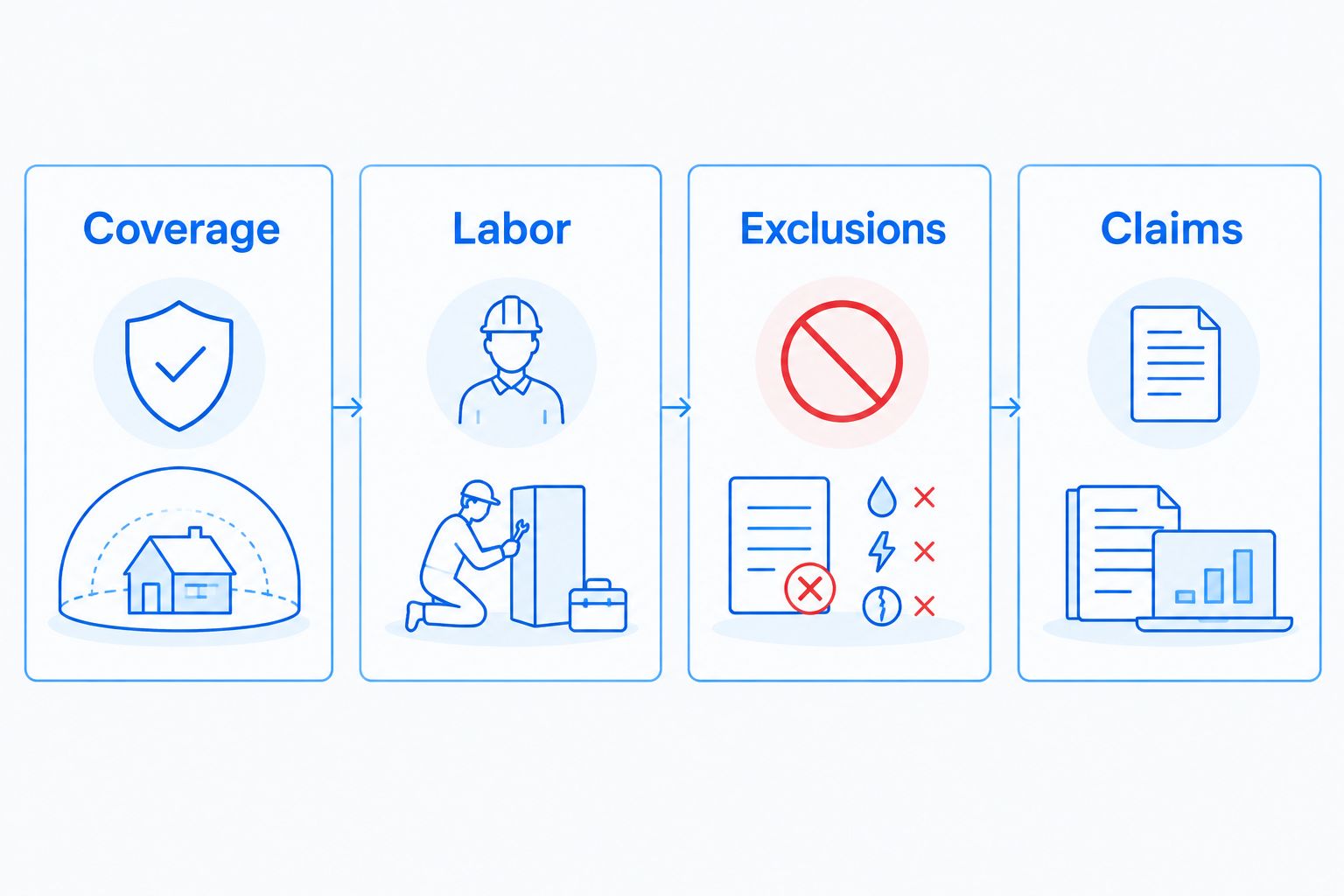
Next, identify the remedy. Ask whether the warrantor repairs a component, supplies a replacement, or follows another stated process. Then ask what happens to the work needed to complete that remedy.
The useful comparison is the full obligation, not the largest word on the sales page. Record the document's effective date so your 2026 comparison refers to the terms attached to your purchase.
A shower enclosure does not operate independently of its opening, mounting surfaces, and surrounding work. When comparing shower remodel quotes, match the enclosure specification, installation responsibilities, and warranty remedy before treating proposals as equivalent.
Ask each bidder to answer the same practical scenario: the installed door does not close correctly, and the cause has not yet been established. Who inspects it? Who decides whether the problem concerns the product, installation, or surrounding work? Who authorizes the next step?
Request 1 written claim contact for the initial report, even if several parties ultimately have responsibilities. That gives you a clear starting point without assuming that one contact accepts every obligation.
Also compare what happens after a claim is accepted. A proposal that identifies a replacement part but says nothing about completing the repair leaves an important question unanswered. Resolve it before approval.
Ask for the care instructions that apply to your exact glass, finish, hardware, and seals. Do not assume that a cleaning method suitable for one surface is approved for every component.
A cleaning product, protective treatment, and enclosure warranty serve different purposes. Buying a care product does not establish an extension of the enclosure warranty unless the written terms explicitly provide one.
For seals, inspect their condition and keep the surrounding area clean according to the applicable instructions. The guide to preventing mold on a frameless shower door seal addresses that maintenance task separately from warranty selection.
Before making adjustments or replacing hardware, check the installation and warranty instructions. Photograph the issue first. Preserve the information needed to explain what happened without turning a claim into a record of undocumented changes.
The order reflects distinct buying needs: custom manufacture and installation, independently arranged installation, partial replacement, and a larger remodel. It is not a ranking of warranty duration or claim performance.
The criteria are covered components, workmanship, remedy, claim expenses, eligibility, and care restrictions. Only compare warranty length after those categories are clear. A product-only agreement and an agreement covering installation are not equivalent merely because their headings use similar language.
For a final 2026 decision, compare the actual documents attached to the exact enclosure—not a different model, an undated summary, or a verbal assurance.
Showerdoor is a fit for homeowners seeking custom shower enclosure manufacturing and installation in California, Arizona, and Nevada. If that describes your project, request the proposed enclosure specification and written product and installation terms together.
If you already have an installer, start with the manufacturer-led route. If you are retaining an existing enclosure, start with a documented replacement scope. For a larger remodel, require the contractor to identify enclosure responsibilities within the project agreement.
Choose the proposal that explains coverage and claim handling clearly. Do not award the purchase to an unsupported longest-warranty claim.
Which shower door brand has the longest warranty?
A defensible longest-warranty winner requires current, comparable terms for the exact enclosures being considered. Compare duration only after checking covered components, labor, eligibility, exclusions, and remedies.
Is a lifetime shower door warranty always the best choice?
No. Read the agreement's definition of lifetime and its coverage limits before choosing it over another warranty. The headline alone does not establish what a completed repair includes.
Does a shower door product warranty cover installation?
Do not assume that product coverage includes installation. Ask for the product warranty and installation agreement separately, then identify which document addresses workmanship and service labor.
Is Showerdoor suitable for a custom shower enclosure?
Showerdoor manufactures and installs custom framed and frameless glass shower enclosures for homeowners in California, Arizona, and Nevada. Request the written terms for your proposed enclosure before comparing warranty coverage.
What should I ask about glass breakage coverage?
Ask which causes of glass breakage the written warranty covers and which it excludes. Also ask who handles inspection, removal, replacement, and reinstallation if a claim is accepted.
Can a shower door warranty transfer to a new homeowner?
Check the transfer provision in the exact warranty. Do not assume that coverage transfers with the property or that the next owner qualifies under the original purchaser's terms.
What documents should I keep for a shower door claim?
Keep the enclosure specification, written warranty, installation agreement, proof of purchase, and care instructions. Photograph the installed enclosure and any problem before making changes.
Before you sign, ask the seller to walk through a hypothetical claim from the first report to the completed remedy. Have the seller identify the relevant clauses rather than simply repeat the warranty headline.
For your 2026 purchase, that exercise is more useful than another promise about longevity. If the repair process is unclear before the sale, get it clarified in writing before approval.


