
You have no items in your shopping cart.

Best overall: a frameless hinged enclosure with accessible glass surfaces. Best for retaining a framed layout: a framed hinged door. Best for bathrooms without swing clearance: a sliding enclosure. This 2026 guide compares shower doors for hard water areas like Las Vegas by cleaning access, bathroom fit, and maintenance—not promises of spot-free glass.
Hard water leaves mineral deposits when droplets dry. Changing the enclosure does not remove those minerals from your water; it changes how easily you reach the surfaces where they collect.
Showerdoor manufactures and installs custom framed and frameless glass shower enclosures for homeowners in California, Arizona, and Nevada. For a 2026 replacement, separate two decisions: which enclosure fits your bathroom, and which cleaning routine you will actually maintain.
The best hard-water shower door is the one you can clean completely without struggling around its hardware. A coating, glass texture, or different frame does not replace that requirement.
Use these criteria before choosing a style:
Treat these as practical inspection points, not a material specification. Thick glass still collects deposits, and a frameless enclosure still has hardware and seals.
These are enclosure configurations, not named product packages. A custom design must still suit the opening, surrounding walls, and water-control requirements.
| Rank and option | Best for | Standout feature | Key limitation |
|---|---|---|---|
| 1. Frameless hinged enclosure | Direct cleaning access | Exposed glass edges and accessible faces | Hinges and seals still need attention |
| 2. Framed hinged enclosure | Retaining a framed layout | Framed construction with a swinging door | Frame edges create additional cleaning details |
| 3. Sliding enclosure | Bathrooms without swing clearance | Door movement stays along the opening | Overlaps and track areas complicate cleaning |
| 4. Textured or obscured glass | Privacy-first bathrooms | Reduces visibility through the enclosure | Privacy does not prevent mineral buildup |
A frameless hinged enclosure uses a swinging glass door without a continuous frame surrounding every glass edge. Its main advantage in a hard-water bathroom is access: fewer frame edges interrupt the surfaces you need to wipe.
Best for: Homeowners who have adequate swing clearance and want a straightforward glass-cleaning routine.
Showerdoor offers custom frameless shower enclosures. Discuss the actual panel arrangement rather than assuming every frameless design provides the same access; a fixed panel beside a vanity can still leave a difficult corner.
Frameless hinged enclosure pros:
Frameless hinged enclosure cons:
For a 2026 remodel, ask the installer to explain how you will reach the inside face of every panel. Also confirm the door's movement around towels, fixtures, and nearby cabinetry.
Verdict: Buy if the opening supports a hinged layout and cleaning access is your priority.
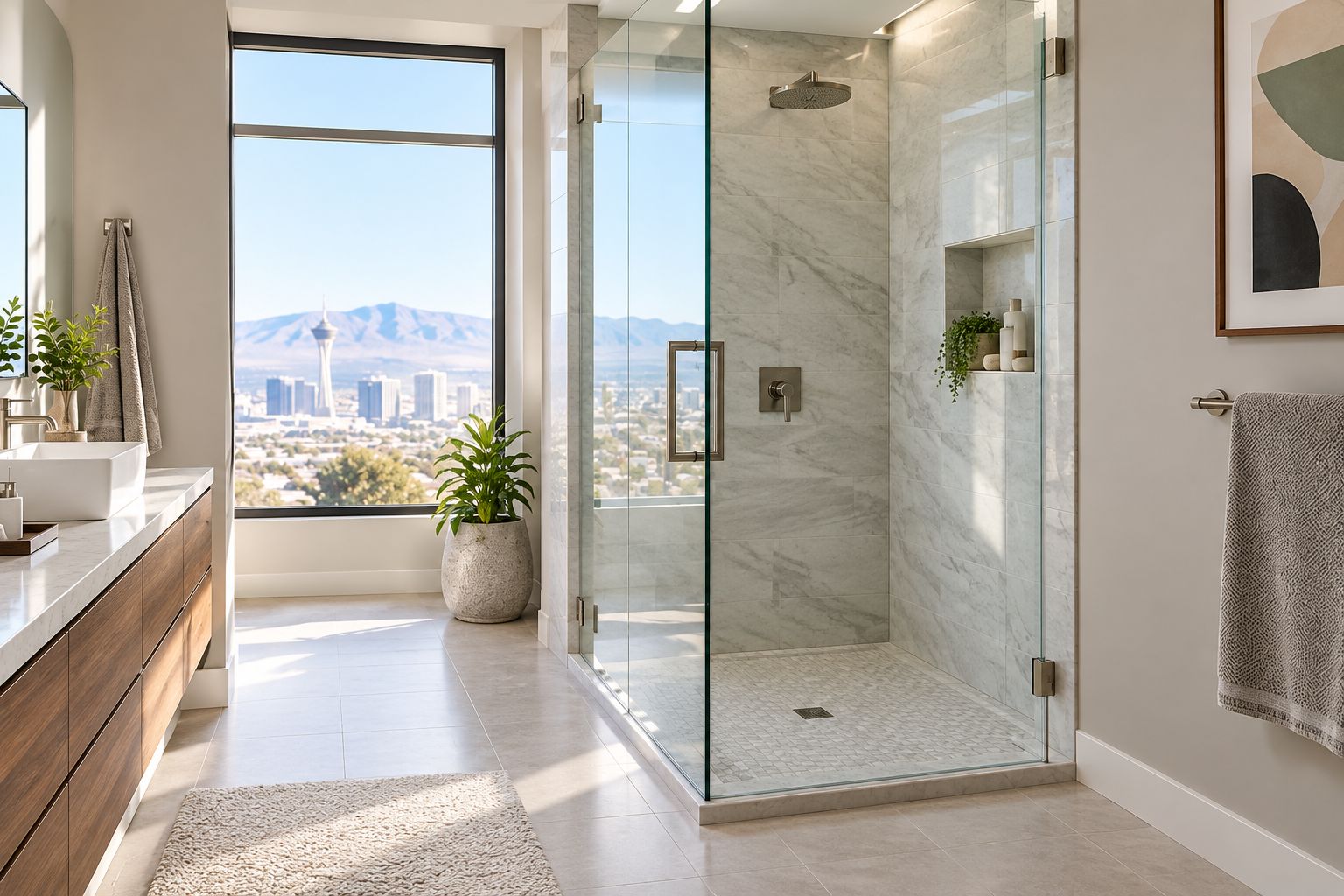
A framed hinged enclosure surrounds the glass with framing and uses a swinging door. It deserves consideration when you prefer a framed design, but its cleaning requirements differ from those of exposed-edge glass.
Best for: Homeowners who want a framed enclosure and will clean its joints, edges, and lower frame.
Showerdoor also manufactures and installs custom framed shower enclosures. Compare the proposed frame details in person, particularly where horizontal surfaces meet vertical edges.
Framed hinged enclosure pros:
Framed hinged enclosure cons:
Do not choose a frame because you expect it to solve hard-water staining. Inspect the places where water sits, ask how drainage openings should be maintained, and follow the manufacturer's instructions rather than sealing openings yourself.
Verdict: Buy for a deliberate framed layout; skip if your main goal is minimizing edges to clean.
A sliding enclosure moves its door along the shower opening instead of into the room. That makes it a practical layout choice when a swinging door would interfere with the bathroom.
Best for: Bathrooms where preserving space outside the shower matters more than having the simplest cleaning access.
Sliding enclosure pros:
Sliding enclosure cons:
Before choosing a sliding enclosure in 2026, ask for a demonstration of cleaning access at the overlap. Do not assume you should lift out the panels for routine maintenance; follow the enclosure manufacturer's instructions.
Verdict: Buy when swing clearance rules out a hinged door; skip if panel overlaps are already your biggest cleaning frustration.
Textured or obscured glass changes visibility through the enclosure. It is a glass selection rather than a separate operating system, so evaluate it alongside the hinged or sliding configuration you need.
Best for: Homeowners who prioritize privacy and accept that deposits still require removal.
Textured or obscured glass pros:
Textured or obscured glass cons:
Ask which face carries the texture and how that surface should be cleaned. Confirm the exact glass choice with your installer rather than assuming every texture works with every enclosure.
Verdict: Buy for privacy; skip if you are choosing it only to avoid cleaning.
This ranking prioritizes reachable glass, accessible hardware, compatible care, and bathroom fit. Frameless hinged glass takes the default position because direct access matters when you repeatedly remove mineral residue.
A sliding enclosure moves ahead when the room cannot accommodate a swinging door. Privacy glass serves a different need, so its lower position does not mean it is unsuitable—it means privacy alone does not solve hard-water maintenance.
A replacement door cannot correct every water-management problem around a shower. Before final measurements, identify the finished wall surfaces, corners, curb, and locations where the enclosure will attach.
When you specify porcelain slabs for shower walls, coordinate the slab layout and enclosure attachment locations before fabrication. Large wall surfaces do not eliminate the need to plan penetrations, joints, and access around the glass.
For a 2026 project, ask who confirms the finished opening and who coordinates the wall and glass details. Keep those responsibilities clear before anyone orders custom glass.
Do not use extra sealant as a substitute for diagnosing water outside the shower. The source can involve door alignment, seals, shower spray, or surrounding construction; cleaning the glass addresses none of those issues.
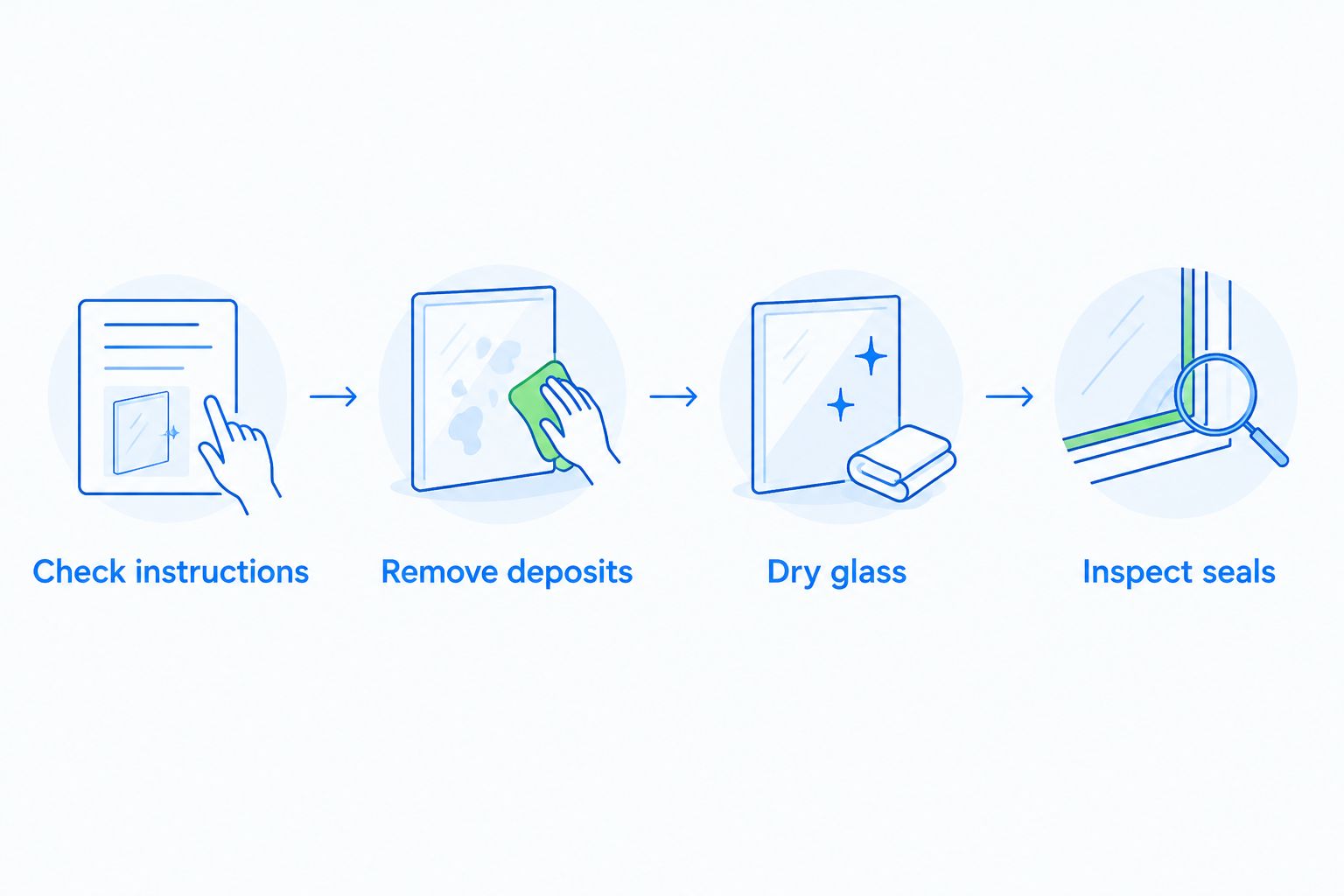
Existing mineral deposits and routine maintenance are different jobs. Start by identifying the residue and checking the care instructions for your glass, any surface treatment, nearby tile, and hardware finish.
A-MAZ Water Stain Remover is described as a product for difficult stains without acids or harsh chemicals. The listed container holds 14 ounces; that figure describes package size, not coverage or the number of applications.
A-MAZ Water Stain Remover — Best for: Addressing existing water stains after confirming surface compatibility.
Century Clean & Seal combines cleaning and sealing and leaves an invisible protective barrier, according to its product description. Do not treat that description as a promise that glass will remain spot-free.
Century Clean & Seal — Best for: Homeowners seeking a combined cleaning-and-sealing step permitted by their enclosure's care instructions.

Drying glass reduces the water left to evaporate on its surface. Inspect the bottom edge separately: a dirty sweep, damaged seal, or poorly moving door needs attention beyond cleaning the center of the panel.
The listed Frameless Door Sweep has versions for 1/4-inch, 3/8-inch, and 1/2-inch glass. Those dimensions identify compatibility choices; they do not establish which sweep fits your door or which glass thickness you should buy.
Match the existing glass thickness, seal profile, and enclosure requirements before replacing a part. Do not force a seal onto an incompatible edge or adjust loaded glass hardware without appropriate expertise.
Use this care sequence:
Choose a frameless hinged enclosure when the bathroom provides safe swing clearance and reachable glass. Choose sliding movement when the room requires it, and choose privacy glass for privacy—not as a stain-prevention measure.
For homeowners seeking custom shower doors, Showerdoor provides manufacturing and installation within its stated California, Arizona, and Nevada service area. Ask about your specific address, opening, cleaning access, and permitted care products before settling on the enclosure.
What's the best shower door for hard water in Las Vegas?
A frameless hinged enclosure is the default choice when it gives you direct access to both glass faces and fits the bathroom. Hard-water deposits still require compatible cleaning and regular drying.
Are frameless shower doors easier to clean than framed doors?
Frameless doors have fewer continuous frame edges to clean. Hinges, seals, fixed-panel corners, and the actual layout still determine how much access you have.
Will frosted shower glass stop hard-water stains?
No, frosted or obscured glass does not stop mineral deposits. Choose it for privacy and follow the care instructions for its particular surface.
Is a sliding shower door a bad choice for hard water?
No, a sliding enclosure is a practical choice when the bathroom lacks swing clearance. Check access to overlapping glass, tracks, and guides before choosing the design.
Does thicker shower glass resist mineral buildup better?
Glass thickness is not a hard-water treatment. Select thickness for the enclosure's design requirements, and assess surface care separately.
Can I use any stain remover on coated shower glass?
No, confirm that the glass or coating manufacturer permits the cleaner before applying it. Instructions for nearby hardware and wall finishes also matter.
Should I replace my shower door because it has water stains?
Staining alone is not a reason to order replacement glass before assessing cleaning options. Cracks, damaged edges, loose hardware, and operating problems require a separate professional assessment.
Before approving your 2026 enclosure, ask the installer to show how you will clean the hardest-to-reach corner. If routine cleaning requires removing a heavy glass panel, reconsider the layout before fabrication—not after installation.


