
You have no items in your shopping cart.

Best overall for a typical alcove tub: framed bypass doors. Best for an open sightline: frameless sliding doors. Best for minimal hardware: a fixed glass screen, provided you accept an open entry. This 2026 guide compares the best bathtub glass doors by fit, access, splash control, and cleaning—not appearance alone. Showerdoor manufactures and installs custom framed and frameless glass enclosures for homeowners in California, Arizona, and Nevada.
A bathtub door has to work above a raised rim. You step over that rim, reach around glass, and clean surfaces that hardware can partly obstruct. A design that looks right in a photograph can make those everyday tasks harder.
For a 2026 replacement, choose the opening method before the finish. Sliding doors avoid an outward swing; hinged doors need a clear movement path; fixed screens leave part of the tub open. None of those choices removes the need to confirm that the tub and surrounding walls support the proposed installation.
Use these criteria to judge each configuration before choosing hardware:
Reject an incompatible mounting arrangement before comparing its appearance. Custom glass does not correct a weak mounting surface or an unsuitable tub rim.
These are configuration recommendations, not a ranking of unverified manufacturer models. Frame descriptions vary, so judge the actual enclosure drawing rather than its label.
| Configuration | Best for | Standout feature | Key limitation |
|---|---|---|---|
| Framed bypass | Everyday alcove tub showers | Sliding panels without an outward swing | Tracks and overlapping glass need cleaning |
| Semi-frameless bypass | Less framing around moving panels | Sliding operation with reduced panel framing | Fixed framing and guides remain |
| Frameless sliding | Open sightlines | Exposed glass edges and sliding access | Supports, guides, and seals still affect fit |
| Hinged tub door | Direct access where swing space exists | A door that moves away from the entry | Requires a safe, unobstructed swing path |
| Fixed glass screen | Bathing-first layouts | No moving door hardware | Open entry provides less splash containment |
Framed bypass, semi-frameless bypass, and frameless sliding designs solve the same clearance problem differently. Hinged tub doors and fixed glass screens change how you enter and use the tub, so they need a separate access check.
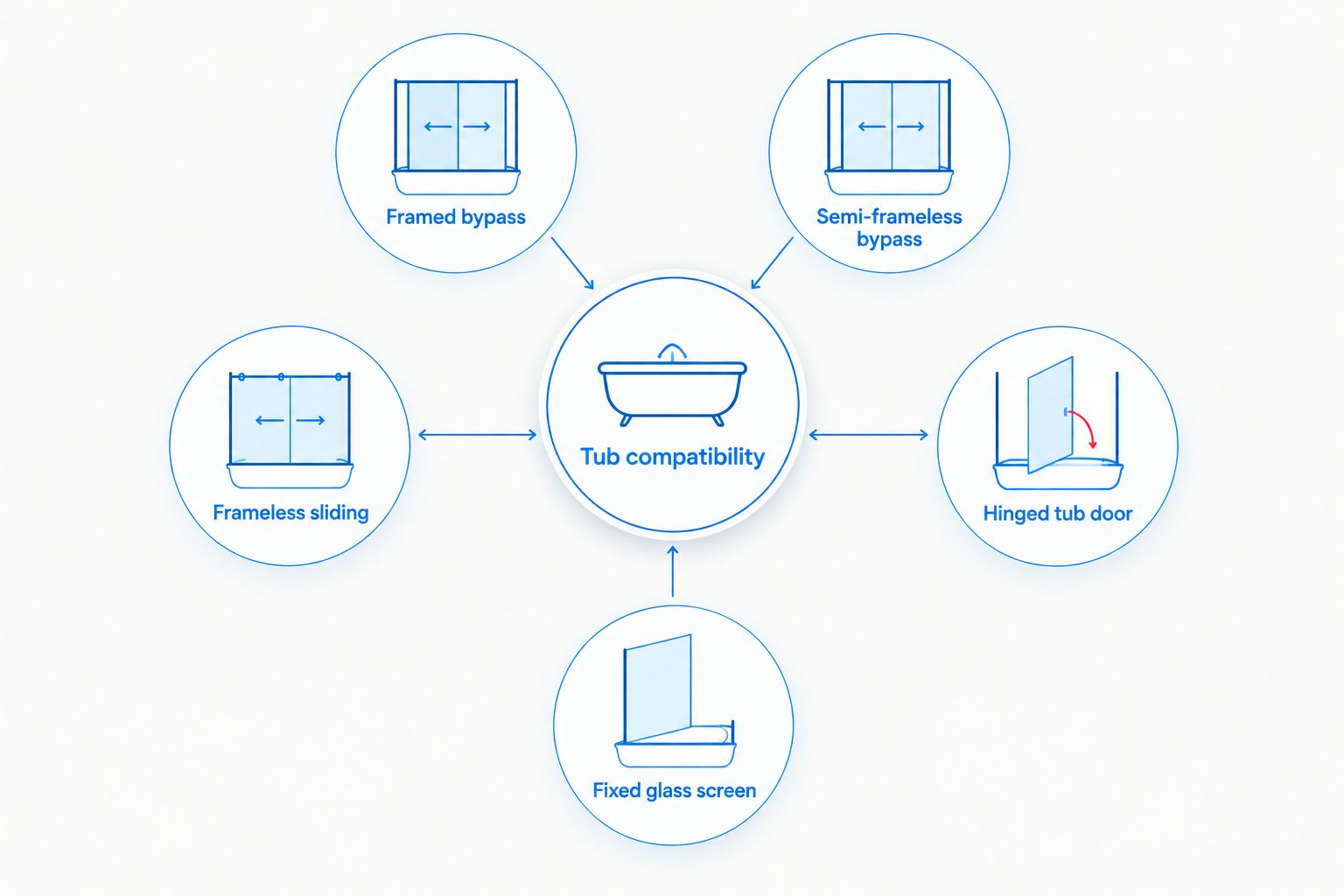
Framed bypass doors use overlapping sliding panels within a framed assembly. They suit an alcove tub when the bathroom cannot accommodate a door swinging toward a toilet or vanity. The frame is visible, but the operating arrangement is straightforward.
Framed bypass pros:
Framed bypass cons:
Best for: A frequently used tub shower where avoiding a swing matters more than reducing visible metal.
Inspect the lower channel before choosing. You need to understand where water drains and how you will clean around the guides without disturbing their adjustment.
Verdict: Buy framed bypass doors when compatible fit and straightforward sliding access are your priorities.
Semi-frameless bypass doors retain framing in parts of the enclosure while leaving other glass edges exposed. The exact arrangement differs by design. Ask which components are framed rather than assuming the name describes a standard construction.
Semi-frameless bypass pros:
Semi-frameless bypass cons:
Best for: A homeowner who wants less visible panel framing without changing from sliding operation.
For your 2026 comparison, request an elevation drawing showing the actual frame, handle, and guide locations. That drawing is more useful than a close-up photograph that omits the tub rim.
Verdict: Buy semi-frameless bypass doors when the actual frame layout—not the label—matches your preference.
Frameless sliding doors reduce perimeter framing while retaining hardware that supports and guides the glass. They do not eliminate rollers, guides, overlaps, or sealing details. Judge the complete assembly rather than treating frameless glass as an absence of hardware.
Frameless sliding pros:
Frameless sliding cons:
Best for: A tub shower where reduced framing is a priority and the mounting conditions support the specified system.
Showerdoor manufactures custom framed and frameless glass enclosures. For a bathtub project, have the proposed sliding arrangement assessed against the actual tub and walls rather than assuming any frameless configuration will fit.
Verdict: Buy frameless sliding doors after the support, entry opening, and cleaning access are confirmed.
A hinged tub door moves away from the entry rather than sliding behind another panel. Its suitability depends on the proposed panel layout, hinge location, and surrounding fixtures. The door must operate without striking the tub fittings or bathroom furniture.
Hinged tub door pros:
Hinged tub door cons:
Best for: A bathroom with a verified clear swing path and a tub arrangement suited to the proposed door.
Check the door in its open position while imagining where you stand to enter and exit. A panel that clears the vanity can still occupy the space you need for your feet.
Verdict: Hold until the installer confirms the full swing path and usable standing space.
A fixed glass screen covers part of the tub opening without a moving door. It belongs in this comparison because it replaces a door in some layouts, but it does not provide equivalent closure. Shower spray can escape through the open portion.
Fixed glass screen pros:
Fixed glass screen cons:
Best for: A bathing-first bathroom where limited shower coverage is an accepted compromise.
Do not choose a fixed screen simply because it looks easier to maintain. First decide whether the open layout suits your shower routine and the surfaces outside the tub.
Verdict: Skip for containment-first showering; buy only when the open-entry trade-off fits your use.
A 2026 bathroom plan should treat the bathtub and enclosure as a connected assembly. Comparing the best alcove bathtubs involves more than basin shape: the rim and surrounding installation also affect whether your proposed glass enclosure can be mounted as specified.
Use this sequence before authorizing fabrication:
Use the guide to measuring for a custom frameless shower door to understand the opening checks. Preliminary measurements help planning; they do not replace the installer's final assessment.
Do not order glass from the tub's nominal dimensions alone. The finished opening and approved hardware arrangement determine the enclosure.
Discuss your custom enclosure
Showerdoor manufactures and installs custom glass enclosures in California, Arizona, and Nevada.
Before choosing a 2026 enclosure, ask the installer to explain how you will reach every wet surface. Sliding designs deserve particular attention at panel overlaps, lower guides, and channels. A clear panel is not easy to clean if hardware blocks your hand.
For framed and semi-frameless designs, identify the drainage openings and keep them unobstructed. For frameless designs, include exposed edges, seals, and hardware in the care plan. Follow the enclosure's cleaning instructions rather than assuming one cleaner suits glass, metal finishes, and flexible seals equally.
Ask how routine service differs from removal. Cleaning accessible surfaces is one task; lifting out a heavy glass panel is another. Do not remove glass merely to reach an awkward spot without the specified procedure and suitable help.
This 2026 ranking prioritizes tub compatibility, usable entry, splash control, cleaning access, movement clearance, and serviceability. It compares configuration trade-offs, not laboratory performance or customer-review scores.
Framed bypass takes the default slot because it combines sliding access with coverage across a typical alcove opening. The other options win narrower decisions: reduced framing, open sightlines, direct hinged entry, or an intentionally open bathing layout. A verified fit overrides the ranking.
Choose framed bypass doors if you want a practical starting point for a conventional alcove tub shower. Move to semi-frameless or frameless sliding when reduced framing matters and the proposed installation meets the tub's requirements.
Choose a hinged door only after checking its entire movement path. Choose a fixed screen only after accepting its open-entry splash trade-off. If you cannot identify the tub or confirm its mounting requirements, pause the enclosure order rather than guessing.
What's the best bathtub glass door for a small bathroom?
A compatible sliding bathtub door is the starting point when a small bathroom lacks swing clearance. Check the actual entry width and handle position before choosing framed, semi-frameless, or frameless construction.
Are frameless bathtub doors better than framed doors?
Frameless bathtub doors are better for reducing visible framing, not automatically better for every tub. Framed doors remain a practical choice when their mounting arrangement, sliding access, and care requirements fit your bathroom.
Can I put glass doors on my existing bathtub?
You can install glass doors on an existing bathtub when the tub, walls, and proposed enclosure meet the installation requirements. Identify the tub and have its rim, mounting restrictions, and surrounding supports checked first.
Do sliding bathtub doors open across the whole tub?
Bypass bathtub doors do not provide an opening across the full tub because the panels overlap. Confirm the usable entry opening on the proposed drawing rather than judging access from the alcove width.
Does a fixed glass tub screen keep all the water inside?
A fixed glass tub screen leaves an open entry, so it does not provide full closure. Whether splashes escape depends on coverage, spray direction, and how you use the shower.
Which bathtub glass doors are easiest to clean?
A fixed panel exposes glass without moving-door hardware, but its open-entry trade-off is substantial. Among enclosed designs, compare access to tracks, overlaps, guides, and seals rather than relying on the framed or frameless label.
Who is Showerdoor best for?
Showerdoor is best for homeowners seeking custom glass enclosure manufacturing and installation in California, Arizona, and Nevada. For a bathtub enclosure, confirm the proposed configuration against the actual tub and finished opening.
Check whether you can reach the tub controls without stepping into the spray. A sliding panel that parks on the wrong side or a fixed screen placed in front of the faucet can make an otherwise suitable enclosure frustrating to use. Put control access on the drawing before approving the glass.


