
You have no items in your shopping cart.

Yes, shower door glass can be tinted or given a frosted appearance after installation with a surface film approved for the glass and its exposure conditions. Film changes the surface appearance; it does not turn clear glass into factory-tinted or permanently frosted glass. Before applying anything, confirm compatibility with existing coatings, moisture exposure, and the enclosure manufacturer's care instructions.
Choose the treatment around privacy and maintenance, not color alone. A smoky-looking door can still show the person behind it, while a frosted surface can obscure detail without creating the same dark appearance. Neither treatment repairs damaged glass or fixes a leaking enclosure.
For a 2026 bathroom update, decide whether you want to keep the existing enclosure or change the glass itself. Showerdoor manufactures and installs custom framed and frameless glass shower enclosures for homeowners in California, Arizona, and Nevada. That is a different service from applying decorative film to an existing door.
Yes. The practical retrofit is a compatible applied film, while a permanent change to the glass itself generally means ordering a replacement panel with the desired finish. Do not assume that ordinary window film is suitable for a shower door.
Ask the film manufacturer about the exact installation location, including direct spray, humidity, cleaning products, and any glass coating. Approval for a bathroom window does not establish approval for a shower enclosure.
| Option | Best for | Main advantage | Main limitation |
|---|---|---|---|
| Tinted film | Changing color while retaining some visibility | Changes the appearance of existing glass | Darkness alone does not guarantee privacy |
| Frosted film | Obscuring detail without replacing sound glass | Creates a diffused privacy effect | Silhouettes can remain visible; edges need compatible care |
| Replacement finished glass | A permanent finish without an applied film layer | Makes the selected appearance part of the replacement panel | Requires professional specification and installation |
These options solve different problems. Compare samples for appearance, then check whether the proposed treatment fits the actual enclosure and its maintenance requirements.
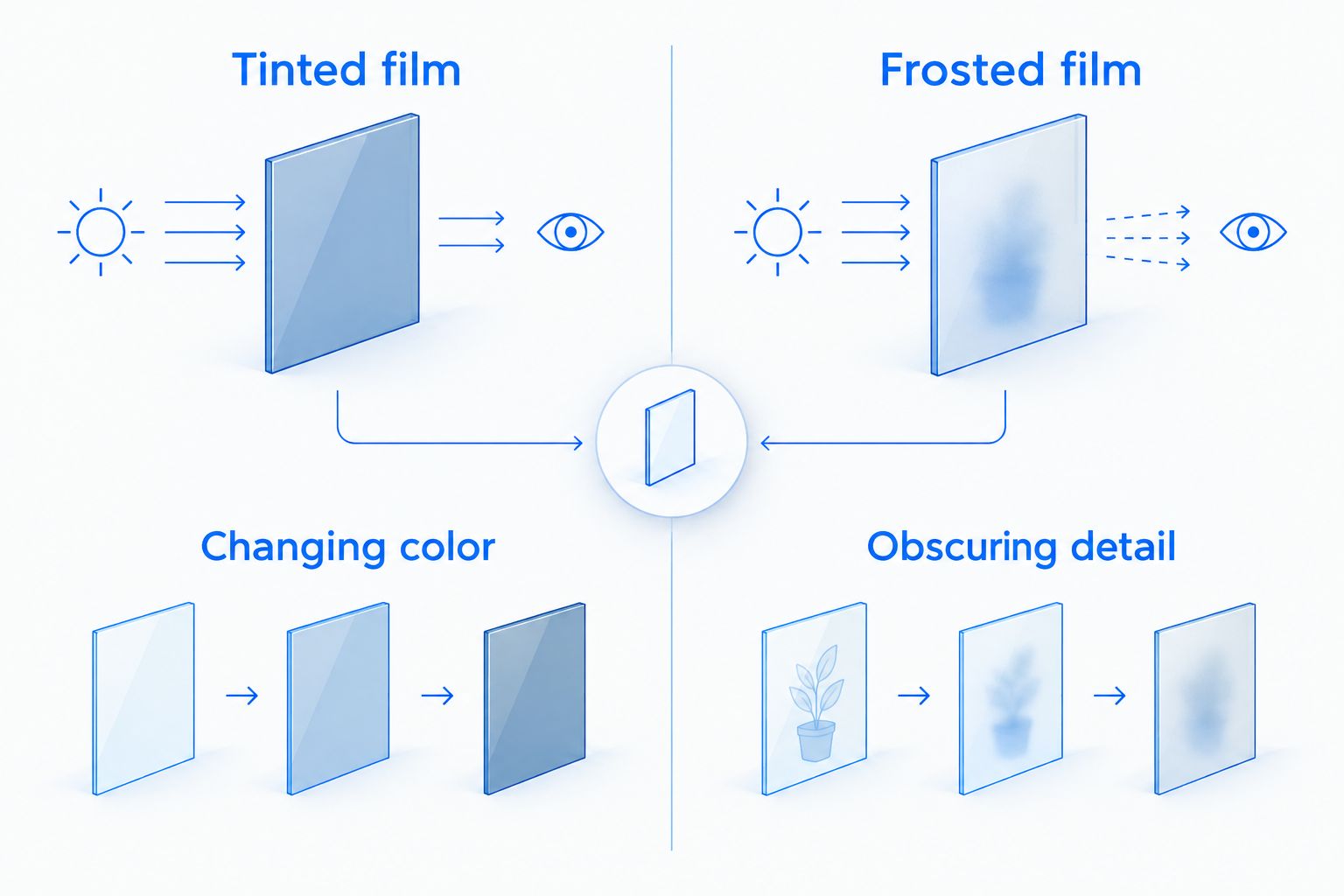
Tinted film is the relevant option when you want a darker or colored appearance but do not necessarily need strong visual screening. The underlying glass remains the same, with an added surface layer.
Choose tinted film for appearance, not as an automatic privacy solution. View a sample with the shower light on and the rest of the bathroom at its normal brightness. A sample held against a wall does not show how the finished enclosure will look.
Reflective films need particular caution. Their privacy effect depends on the lighting difference across the glass, so an illuminated shower is not equivalent to a daytime exterior window. Ask for a demonstration in conditions that resemble your bathroom.
For a 2026 tint project, get written confirmation that the proposed film suits the glass, its coating, and the intended side of application. The limitation is ongoing care: the exposed surface becomes film, so the glass cleaner you already use is not automatically appropriate.
Frosted film scatters light and reduces the clear view through the enclosure. It is the more relevant starting point when your concern is someone seeing directly into the shower rather than changing the glass color.
Frosted does not mean completely opaque. A person close to the glass can still create a visible silhouette, especially with strong lighting behind them. Test the actual sample with someone standing where they would normally shower.
A full panel offers different coverage from a narrow privacy band. A band preserves a clearer view above and below it, but only screens the area it covers; check sightlines from the bathroom doorway and other normal viewing positions.
For a 2026 privacy update, judge the sample both dry and wet where its instructions permit. Ask how water affects the appearance and what the manufacturer requires at edges. Do not treat a decorative finish as proof of suitability for direct shower spray.
Replacement glass is the option to discuss when you want a permanent finish without a film layer or when the existing panel needs replacement anyway. Specify the appearance before the new glass is fabricated, rather than planning to alter an installed tempered panel afterward.
The installer must assess the enclosure, not just the visible rectangle. Hinges, handle holes, cutouts, glass thickness, seals, and adjacent panels all affect whether a replacement fits and operates correctly.
Do not assume the existing hardware can accept any replacement panel. A finish choice does not remove the need to check the door's dimensions, weight, hardware requirements, and safety-glazing specification.
For a 2026 replacement project, ask to see a finish sample before approving fabrication. This route avoids a separate film surface, but it involves more work than treating sound existing glass. It also does not automatically correct drainage, alignment, or waterproofing problems elsewhere in the shower.
The same film can face very different conditions on different enclosures. These checks determine whether a surface treatment is appropriate:
A darker sample is not a substitute for these checks. Reject a treatment if its manufacturer cannot confirm suitability for your intended use.
Treat preparation as a compatibility check before treating it as an application job. Do not remove the door, loosen hinges, or disturb seals just to make film installation easier.
Look for the original enclosure paperwork and care instructions. Ask the installer or manufacturer whether the glass has a protective treatment and whether applying film changes any applicable warranty terms.
Do not infer compatibility from how the glass feels. A clear surface does not tell you whether a treatment is present.
Ask for the film's installation and maintenance instructions. Confirm the permitted substrate, exposure conditions, application side, and any restrictions around coated glass.
Do not choose adhesive-backed film or static-cling film solely because one sounds easier to remove. Either type still needs approval for the intended use.
Check the glass, exposed edges, seals, and hardware for visible problems. Stop if you find a crack, a chipped edge, or unstable hardware; decorative film is not a repair material.
For an enclosure with damaged glass, review whether a cracked shower door panel can be repaired before considering a cosmetic treatment.
Remove soap residue and deposits using methods compatible with the enclosure and the film instructions. Avoid abrasive pads, improvised scraping, and unapproved solvents.
Do not add a water-repellent treatment as a final preparation step unless the film manufacturer explicitly requires it. A product intended to change surface behavior is not automatically compatible with film adhesion.
Use the specified placement, trimming method, edge clearances, and drying or curing instructions. Keep blades away from glass edges, seals, and hardware, and leave complicated trimming to an experienced installer.
Your 2026 installation checklist should include written cleaning instructions for the finished surface. Do not resume shower use based on guesswork; follow the treatment manufacturer's instructions.
Do not sand, grind, sandblast, or chemically etch an installed tempered shower door as a DIY project. These processes alter the glass surface and require professional assessment of the material, process, and safety implications.
A decorative film is fundamentally different because it adds a layer rather than intentionally removing glass. If permanent frosting is the goal, discuss replacement glass fabricated with the desired finish instead of experimenting on the installed panel.
Frosted-effect sprays also need explicit approval for the intended surface and shower exposure. A decorative coating described for general glass use is not automatically suitable for an enclosure that gets wet and needs repeated cleaning.
Decorative tinting does not repair damaged glass or establish safety-glazing compliance. Keep the distinction between changing appearance and specifying a safety system clear.
Do not describe ordinary privacy film as safety film. Any claimed safety function needs documentation for the particular product and application, rather than an assumption based on the presence of an adhesive layer.
If the panel is damaged, arrange an assessment before using the enclosure. Covering a defect makes it less visible; it does not resolve the reason it needs attention.
Frosting is a privacy choice, not a cleaning treatment. Soap residue and mineral deposits still need maintenance, and an applied film introduces its own cleaning restrictions.
Clean the surface you now have, not the glass you used to have. A cleaner or pad suitable for bare glass can be unsuitable for film. Keep the film instructions with the enclosure's care information so everyone cleaning the bathroom follows the same rules.
Before choosing the finish, ask how to remove routine residue without scratching, clouding, or disturbing the surface. If your preferred cleaning method conflicts with the treatment instructions, choose a different treatment rather than ignoring the restrictions.
Can shower door glass be tinted after installation without replacing it?
Yes, compatible tinted film can change an existing shower door's appearance without replacing the panel. Confirm approval for the glass, existing coatings, and intended water exposure before applying it.
Is frosted film better than dark tint for shower privacy?
Frosted film is the more relevant starting point for obscuring detail; dark tint primarily changes color and light transmission. Check a sample under your bathroom lighting because silhouettes and visibility depend on the finish and viewing conditions.
Should privacy film go inside or outside the shower door?
Use only the application side approved by the film manufacturer and compatible with the enclosure. The outward-facing side is not automatically dry or suitable, so confirm exposure and edge-clearance requirements.
Can I use ordinary window tint on a shower door?
Do not use ordinary window tint unless its manufacturer approves the specific shower-door application. Approval for windows does not establish compatibility with direct spray, shower cleaners, or coated glass.
Can frosted film be removed later?
Removal depends on the film, adhesive, glass coating, and removal instructions. Confirm the process before installation, and do not assume removal will be residue-free or compatible with every protective coating.
Does Showerdoor offer custom replacement shower enclosures?
Showerdoor manufactures and installs custom framed and frameless glass shower enclosures for homeowners in California, Arizona, and Nevada. Ask about your desired finish and existing enclosure rather than assuming a retrofit film service is included.
Can I put privacy film over a crack in shower glass?
No, decorative privacy film is not a repair for cracked shower glass. Stop using the affected enclosure and arrange a professional assessment rather than covering the damage.
Test privacy from outside the shower, not from inside it. Put the proposed sample at the height you want screened, turn on the normal lighting, and check the view from the doorway with someone behind the glass.
That simple check answers the question a color swatch cannot: whether the treatment screens the view that actually matters to you. Approve the appearance only after confirming that the material also suits the enclosure.


