
You have no items in your shopping cart.

No—if a shower door glass panel is genuinely cracked, replace the damaged panel rather than patching it. Resin, glue, silicone, and tape do not restore its safety performance; stop using the enclosure and have a glass professional assess the panel, its supports, and the cause of damage.
A shower panel separates a wet bathing area from the rest of your bathroom, but damaged glass creates a safety problem before it creates a leak. A repair that hides a line is not proof that the glass can safely withstand normal handling.
Showerdoor is best for homeowners in California, Arizona, and Nevada seeking custom shower enclosure manufacturing and installation. If that matches your project, Showerdoor is a relevant starting point for discussing the enclosure; panel compatibility still requires an assessment.
For a 2026 replacement project, separate the immediate safety decision from the purchasing decision. Stop using damaged glass first, then determine whether the enclosure needs a replacement panel or a broader replacement.
A genuine crack in shower door safety glass calls for replacement, not a structural patch. The useful question is whether you can replace just the damaged panel while retaining suitable hardware and the surrounding enclosure.
U.S. Consumer Product Safety Commission requirements in 16 CFR Part 1201 cover architectural glazing materials used in applications including shower doors and enclosures. For your 2026 project, ask the installer to identify the applicable safety-glazing requirements and the replacement glass documentation. Ordinary window glass is not an interchangeable substitute.
| Approach | Best for | Advantage | Limitation | Recommendation |
|---|---|---|---|---|
| Replace the damaged panel | An enclosure with suitable remaining glass, hardware, and supports | Retains components that pass inspection | Requires a correctly specified panel and compatible mounting details | Choose after inspection confirms suitability |
| Replace the enclosure | An enclosure whose condition or compatibility prevents a sound panel-only replacement | Addresses the assembly as a whole | Involves a broader scope than replacing one panel | Choose when inspection supports the larger scope |
| Fill or cover the crack | No structural repair application | Can obscure the appearance of damage | Does not restore the panel's safety performance | Skip as a repair |
Do not select an approach from appearance alone. A good-looking frame does not establish that its fasteners, gaskets, or mounting surfaces remain suitable.
Keep the shower out of use. Do not open and close the door to see whether it still works, and do not press on the glass to test the line.
If the panel has already broken apart, keep the bathroom closed off. Glass fragments can remain in tracks, corners, and nearby surfaces; removing visible pieces alone does not establish that the area is safe.
If you can do so safely, take 4 photos: an overall enclosure view, the visible damage, the mounting hardware, and any readable glass marking. Use your camera's zoom rather than approaching exposed edges.
These photos help describe the problem, but they do not replace an inspection or final measurements. Skip any photograph that requires handling damaged glass.
Treat an uncertain line as damage until a qualified professional identifies it. A photograph can help with an initial discussion, but reflections, coatings, and deposits can make different surface conditions look similar.
A scratch affects the surface; a crack is a fracture in the glass. A mineral deposit sits on the surface rather than restoring or changing the underlying glass. The distinction matters because cleaning a deposit is a maintenance task, while cracked safety glass requires replacement.
Do not run a fingernail along a suspected crack, scrape it with a blade, or polish it to see whether it disappears. Those tests require contact with potentially damaged glass and do not establish structural safety.
Tempered glass commonly breaks into many small pieces when it fails. That does not make an intact-looking panel with a suspicious line safe: the glass type and the nature of the mark still need confirmation.
Yes, panel-only replacement is an option when the remaining enclosure and mounting system are suitable. It is not automatic, even when only one panel appears damaged.
The replacement must match the requirements of the actual installation. Overall shape, glass specification, edge treatment, hinge preparation, handle holes, and mounting details all affect whether the panel fits and functions correctly.
Tempered glass cannot be cut or drilled after tempering. Required holes and cutouts must be prepared before that process, so an approximate panel is not something an installer can simply trim into place on site.
For a 2026 panel-only replacement, ask for a written description of what stays and what changes. That separates necessary replacement work from optional enclosure changes and gives you a clear scope to approve.
A frame does not make cracked glass repairable. The installer must assess the glazing channels, retaining components, seals, and frame condition before deciding whether a replacement panel can be installed properly.
The advantage of retaining a suitable frame is a narrower replacement scope. The limitation is compatibility: a frame that looks reusable still needs the right glass and retaining components.
A frameless replacement requires close attention to the glass and its hardware connections. Hinges, clamps, gaskets, and the supporting surfaces must suit the replacement panel.
Retaining suitable hardware can avoid replacing the entire enclosure. However, an existing hinge or clamp is not approved for reuse merely because it can still move or tighten.
A sliding enclosure also needs its rollers, guides, track, and stops checked. Replacing the glass without addressing binding or unwanted contact leaves the operating problem unresolved.
The benefit of panel-only replacement is retaining a suitable track system. The limitation is that the new panel must work with that system, not just match the visible width and height.
The decision changes with the enclosure, not with how small the crack looks. These factors determine the appropriate scope:
Do not accept a cause based solely on where the damage appears. An installer should distinguish what the inspection establishes from what remains unknown.
Confirm the glass specification and the operating problem before manufacturing the replacement. Ordering from a rough opening measurement alone does not resolve hinge preparation, wall alignment, or contact between moving parts.
For a 2026 replacement assessment, organize the inspection around these checks:
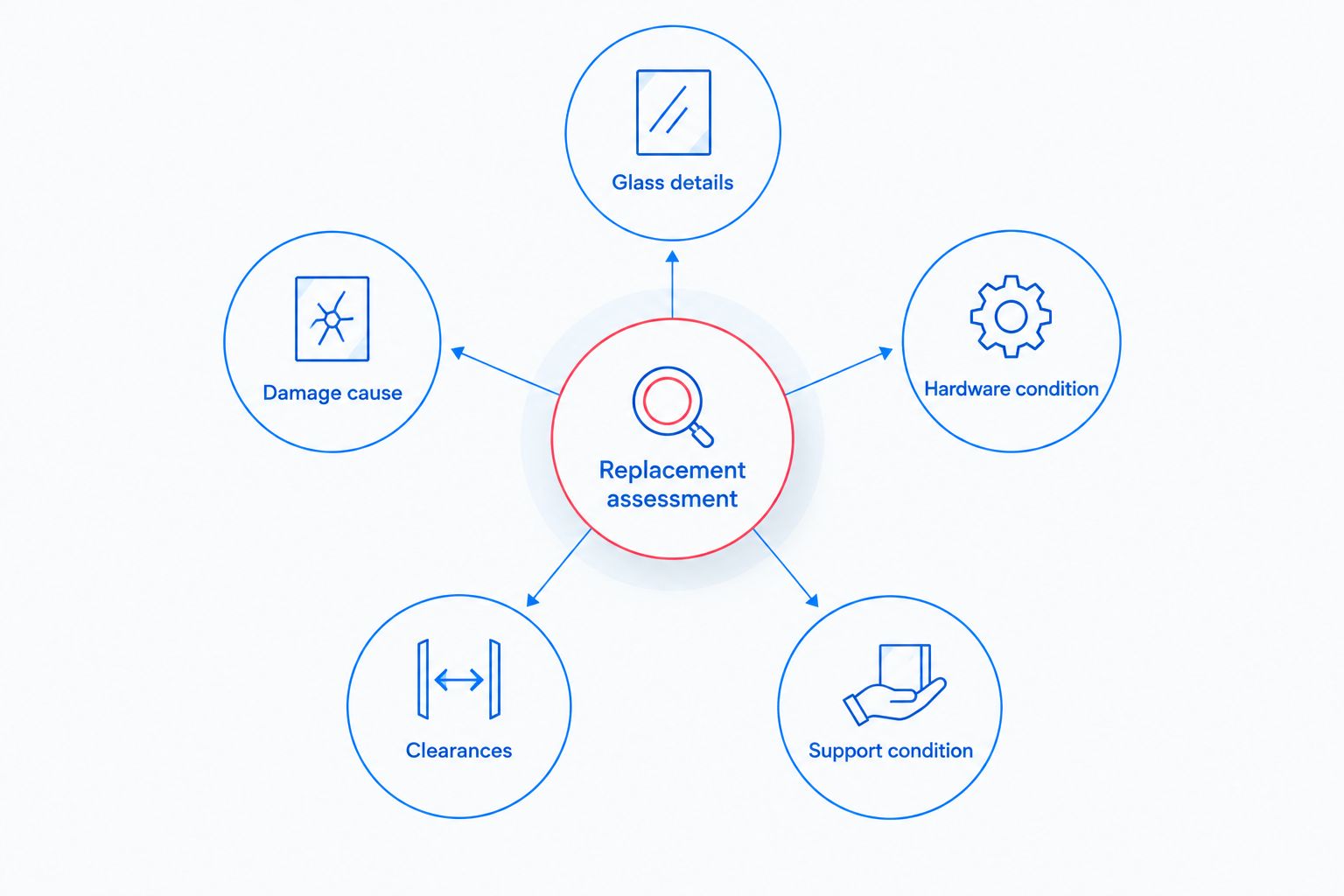
Your role is to describe what happened, not to dismantle the enclosure. Mention a recent impact or a door that began scraping, but leave adjustments and removal to the professional handling the damaged panel.
No—adhesives and sealants do not restore cracked shower glass to its original safety performance. A filled line is still a damaged panel, even when the filler makes it less visible.
Silicone has a role in enclosure sealing where the installation calls for it. It is not a substitute for intact glass, and applying it over a crack does not establish that the panel is safe to use.
Tape also does not turn cracked glass into a usable shower door. Do not apply a patch and resume bathing while waiting for replacement.
No—the ability to open a door does not establish that cracked shower glass is safe. Do not use crack length, leak performance, or smooth movement as permission to keep using the enclosure.
Avoid making a test opening to show a contractor the problem. Describe the previous operation instead and let the professional decide how to inspect or remove the panel.
Not necessarily—a damaged panel does not by itself prove that every enclosure component needs replacement. Panel-only replacement depends on compatible glass, suitable supports, and serviceable remaining components.
A full enclosure replacement becomes the appropriate discussion when the existing assembly cannot support a suitable panel-only solution. Ask for the reason in writing rather than accepting either “replace everything” or “keep everything” without an inspection.
Make 2 separate decisions: what is necessary to address the damaged glass, and what optional changes you want. Do not let a style upgrade obscure the safety work.
Ask 3 questions before approving your 2026 replacement scope:
Showerdoor manufactures and installs custom framed and frameless shower enclosures. For a project within its stated service area, discuss the existing enclosure and the required replacement scope without assuming that every component can be retained.
Discuss your shower enclosure
Ask about custom shower enclosure manufacturing and installation in California, Arizona, and Nevada.
Can you repair cracked shower door glass without replacing it?
No—a genuine crack in shower door safety glass requires replacement of the damaged glass. Glue, resin, silicone, and tape do not restore its safety performance.
Can I use the shower while waiting for replacement glass?
Do not use the shower while the cracked panel remains in place. Restrict access and arrange professional assessment rather than relying on a temporary patch.
Does one cracked panel mean I need an entirely new enclosure?
No—one cracked panel does not automatically require a new enclosure. Panel-only replacement depends on the suitability of the remaining glass, hardware, supports, and mounting system.
Can a glass shop cut a replacement tempered panel to fit?
Tempered glass cannot be cut or drilled after tempering. The required dimensions, holes, and cutouts must be established before the glass is tempered.
Is a hairline crack less urgent than a large crack?
A hairline crack still requires taking the damaged enclosure out of use. Crack size alone does not establish whether a shower panel is safe.
Should I replace the hinges when replacing cracked shower glass?
Replace hinges when inspection establishes that they are unsuitable for reuse. Existing hinges need assessment for condition and compatibility with the replacement panel.
Does Showerdoor serve homeowners outside California, Arizona, and Nevada?
Showerdoor's stated service area is California, Arizona, and Nevada. Confirm that your project location falls within the installation service area before planning work.
The replacement panel should not inherit the old panel's operating problem. If the door scraped tile, struck another panel, or bound in its track, include that history in the assessment. New glass addresses the damaged component; identified contact or support problems need their own correction.


