
You have no items in your shopping cart.

Shower door installation takes a project-specific amount of time; your installer should confirm the onsite work window after checking the opening, door design, and removal requirements. For a 2026 bathroom project, separate that appointment from custom fabrication and any sealant-curing period before shower use. An installation completion time is not automatically a shower-ready time.
The installation window depends on the actual enclosure and the condition of the bathroom. A useful schedule identifies what must happen before the crew arrives, what the crew will complete onsite, and when you can use the shower afterward.
For custom manufacture and installation, Showerdoor serves homeowners in California, Arizona, and Nevada. Showerdoor serves homeowners who need custom shower enclosure manufacture and installation. Ask for a schedule tied to your opening rather than a generic estimate for another bathroom.
Use this sequence to get a usable answer:
These are different milestones. Combining them into a single promise makes it harder to plan access, other trades, and bathroom use.
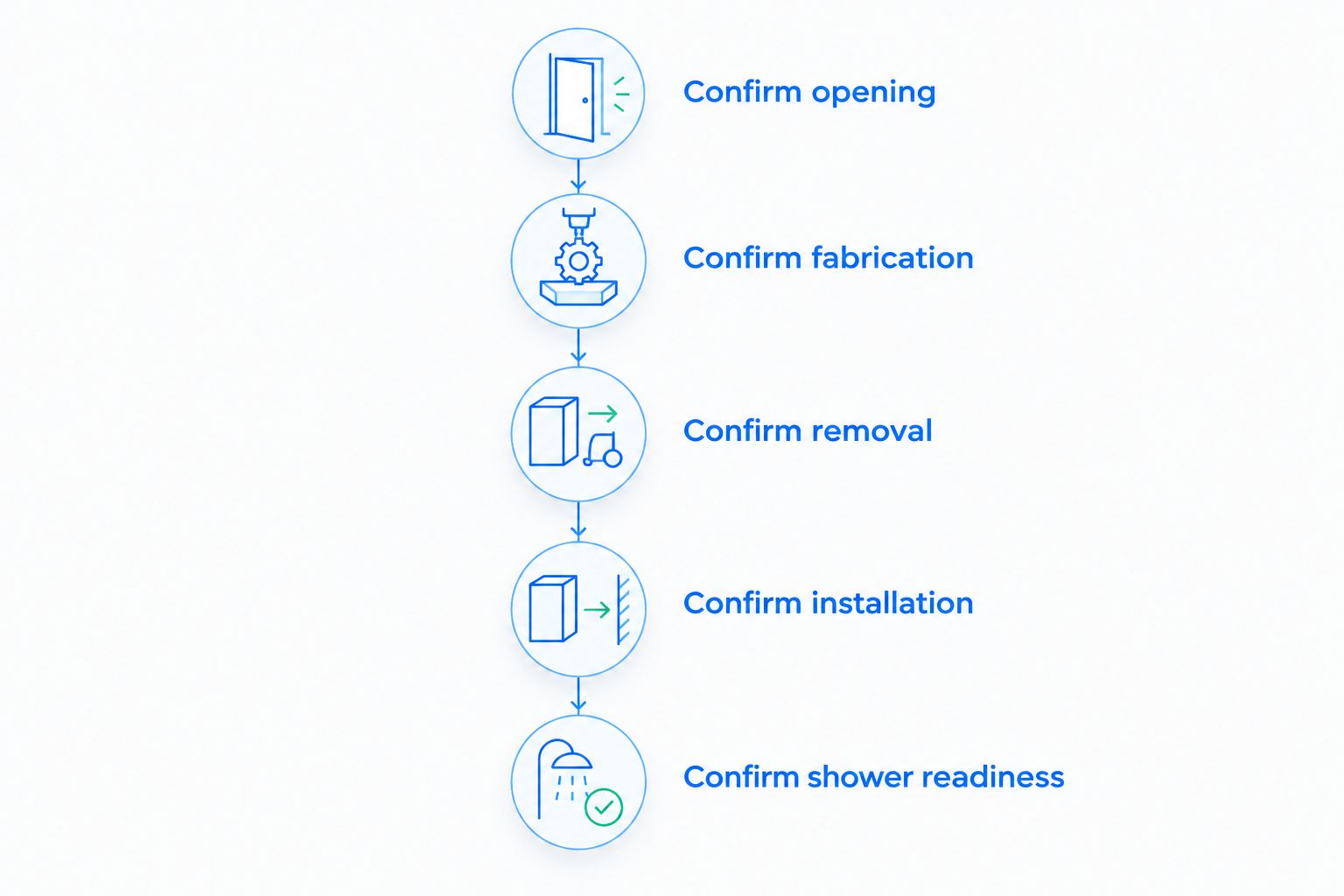
If you have another usable bathroom, the main concern is access for the crew. If this is your only shower, the important deadline is when you can safely get it wet—not when the installer leaves.
The distinction also matters during a remodel. A glass appointment does not complete unfinished tile, repair damaged mounting surfaces, or replace the need to follow sealant instructions. Plan around the last required step, not the most visible step.
Before you arrange time off or coordinate another contractor, ask what the installation appointment includes. Removal, surface preparation, fitting, adjustment, sealing, and cleanup should not remain implied parts of the schedule.
For a custom enclosure, the schedule starts before installation day. The opening, finished surfaces, door configuration, and hardware requirements must be established so the enclosure can be made for that bathroom.
Treat your 2026 remodel schedule as a sequence of dependencies. Tell the enclosure installer if tile, the curb, or other relevant surfaces will change after the initial discussion. A measurement taken before those changes does not describe the same finished opening.
Give the installer a clear account of the work still underway:
Do not treat fabrication timing as onsite labor. Ask when the enclosure is expected to be ready, what must happen before installation can be scheduled, and whether the proposed appointment depends on another task being completed.
Confirm the opening before you commit to the installation date. This gives you a schedule based on the bathroom that will actually receive the enclosure.
Replacing an existing shower door includes a different starting condition from installing an enclosure in a newly finished opening. The old assembly has to come out, and the installer needs to assess the surfaces left behind.
Old mounting holes, sealant residue, damaged tile, and unsuitable attachment locations need attention before the new enclosure is fitted. Describe any known damage when arranging the job. Do not assume a new door will cover or correct it.
For replacement work, establish the boundary between enclosure installation and bathroom repair:
The useful answer is a responsibility, not just a duration. If repair work belongs to another contractor, that work needs its own place in the schedule.
A replacement appointment should account for what is underneath the old enclosure. Matching the apparent size of the old door does not establish that every existing attachment point suits the new design.
Framed and frameless enclosures use different support and fitting arrangements. That difference does not establish a universal installation duration: the opening, configuration, hardware, and site condition still determine the work.
Choose the enclosure around your bathroom and preferences. Then ask the installer to explain the tasks associated with that specific design.
| Enclosure option | Best for | Practical advantage | Limitation to plan around | Scheduling question |
|---|---|---|---|---|
| Framed enclosure | Homeowners who prefer a framed glass enclosure | Framing supports and defines the enclosure assembly | Frame components and seals require fitting and cleaning attention | What frame assembly and sealing work is included? |
| Frameless enclosure | Homeowners who prefer less visible framing | Uses less visible framing around the glass | Attachment points, glass fit, and clearances need careful checking | What mounting, alignment, and seal checks are included? |
Neither option should be selected on an unsupported claim that it installs faster. A straightforward opening and a complicated opening are different jobs, even when both use the same enclosure style.
Compare the proposed scope, not the style name alone. Ask how the door will operate, where it will attach, and what the installer needs to verify before work begins.
The main scheduling factors are physical conditions and agreed work—not the calendar year. For a 2026 installation, use these factors to make the appointment description specific:
Tell the installer about these conditions before the visit. A photograph helps communicate layout, but it does not replace the measurements and checks needed for a custom fit.
For sealant-specific questions, the shower door sealant and caulk comparison provides a related topic to review. The installed material’s instructions remain the basis for curing and water-exposure requirements.
Clear the route to the bathroom and remove toiletries, mats, and loose objects from the work area. Keep children and pets away from the glass-handling area, and identify where the crew can safely place tools and components.
Walk through access arrangements before installation day. If your building has entry rules or restrictions affecting contractor access, communicate those requirements when booking—not when the crew is waiting outside.
Use this preparation checklist:
These preparations do not create a guaranteed shorter appointment. They make the agreed installation work possible without avoidable access problems or unresolved decisions.
Leave door positioning and hardware adjustments to the installer. If a component appears misplaced, raise it during the walkthrough rather than altering it yourself.
The final fit check should address door operation, clearances, hardware, and seals. Watch the door move through its intended path and ask the installer to explain any adjustment or operating instruction relevant to your enclosure.
A swinging door needs an unobstructed operating path. A sliding assembly needs its travel and closing position checked. In either case, ask about contact with nearby fixtures, walls, and enclosure components.
Look at the finished installation from inside and outside the shower. This makes it easier to discuss a seal, gap, handle position, or operation concern while the installer is present.
Do not test water containment before the installer permits water exposure. First confirm the dry operation checks; then follow the instructions for shower use and any later inspection.
For your 2026 handover, record the operating instructions alongside the shower-ready time. Keeping those details together prevents a finished-looking installation from being mistaken for permission to use it immediately.
Use the shower only when the installer confirms that the installed materials permit water exposure. Finishing the glass and hardware work does not establish that every sealant has completed its required cure.
Ask for the instruction in a form you can act on: the earliest permitted date and time, any ventilation requirements, and any restriction on cleaning or touching newly applied material. Follow the specific product instructions rather than a generic waiting period.
Do not use appearance as a curing test. A sealant surface that looks dry does not, by itself, establish that the joint is ready for shower use.
Replacement adds removal and inspection, but the total work still depends on the opening and enclosure. A new installation can also involve complicated fitting or unfinished surfaces.
Ask for the replacement tasks to be named separately. That makes it clear whether the appointment includes removal alone or also includes the preparation required afterward.
Ask for the arrival window, expected onsite work window, included tasks, and shower-ready instruction. Also ask what conditions would require the appointment or scope to change.
For a 2026 project, keep that confirmation with your other contractor schedules. A useful booking tells you both what will be completed and what must already be ready.
How long does shower door installation take from start to finish?
The full schedule includes opening checks, any custom fabrication, onsite installation, and any required waiting period before shower use. Ask the installer to confirm each milestone for your enclosure rather than treating the onsite appointment as the entire project.
Can I get a firm installation time before someone checks my bathroom?
A firm work window should be based on the opening, enclosure design, removal scope, and site conditions. Describe unfinished work and known damage before the appointment is scheduled.
Does a frameless shower door always take longer to install?
Frameless construction alone does not establish a longer installation time. The mounting arrangement, glass configuration, opening condition, and fitting requirements determine the work.
Can I shower immediately after the installer leaves?
Use the shower only after the installer confirms that water exposure is permitted. Follow the installed sealant’s instructions and request an earliest-use date and time.
Does Showerdoor manufacture and install custom enclosures?
Showerdoor manufactures and installs custom framed and frameless glass shower enclosures for homeowners in California, Arizona, and Nevada. Discuss the actual opening and enclosure scope when asking about the project schedule.
What should I confirm for a shower door installation in 2026?
For a 2026 installation, confirm the arrival window, onsite work scope, removal responsibilities, and shower-ready time. Also establish who handles unfinished surfaces or damage discovered during removal.
Should I measure before the tile work is finished?
Tell the enclosure installer about any unfinished tile or surface work before measurement. Changes to finished surfaces can change the opening the enclosure must fit.
Before the installer leaves, ask: What is the earliest date and time I can use this shower? Write down the answer and keep it where everyone using the bathroom can see it.
That instruction is more useful than an estimated labor duration. It connects the completed installation to the moment your bathroom is ready for normal use.


