
You have no items in your shopping cart.

Frameless shower doors do not inherently leak more than framed doors: water escaping depends on the opening, seals, showerhead direction, and installation—not just the presence of a frame. Frameless doors have exposed joints that need suitable water control, while framed doors can also leak through worn seals, failed fixed joints, or obstructed drainage paths.
Neither design guarantees a dry bathroom floor. Framing changes how an enclosure manages water; it does not replace correct measurements, suitable seals, or a properly built shower base.
For your 2026 bathroom project, compare the complete enclosure rather than judging the glass alone. The door, adjoining panels, threshold, and showerhead must work together.
| Enclosure | How it manages water | Main advantage | Main limitation | Best for |
|---|---|---|---|---|
| Framed shower door | Uses perimeter framing, seals, and design-specific drainage paths | Framing provides defined channels and edges for water management | Frame joints and drainage openings still need attention | Homeowners who prefer a framed enclosure and accept cleaning its channels |
| Frameless shower door | Uses glass placement, sweeps, seals, and fixed-joint sealing where specified | Leaves fewer frame channels around the glass | Exposed moving joints need careful placement and suitable seals | Homeowners who prefer exposed glass and accept maintaining its edge seals |
A puddle beside either enclosure is a reason to investigate, not proof that you chose the wrong style. Start with the location of the first escaping drop; the shower door sweeps and seals comparison explains the parts used at different joints.
Replacing a door without finding the leak can leave the original problem untouched. A new enclosure cannot correct water escaping through a failed shower base or waterproofing assembly.
Separate water passing around the door from water passing through the shower construction. You need a different repair for each, and adding sealant indiscriminately can conceal the source or obstruct an intended drainage opening.
If water reaches adjacent flooring, dry it promptly and arrange an inspection. Stop using the shower when water enters surrounding construction, the glass touches tile or metal, or the door becomes difficult to operate.
A frameless door needs clearance to move without striking nearby glass, tile, or hardware. A sweep or edge seal helps manage water at those clearances; it does not turn every moving joint into a watertight connection.
The advantage is fewer surrounding frame channels. The limitation is that direct spray aimed at an exposed joint can challenge the seal, especially when the opening or showerhead arrangement puts that joint in the spray path.
Choose frameless glass for the layout and appearance you want—not because it eliminates maintenance. Ask how the proposed enclosure will manage water at the bottom edge, closing edge, and hinges before approving the design.
A framed enclosure uses its surrounding profiles as part of its water-management design. Depending on the enclosure, those profiles include channels or openings that return collected water toward the shower.
The advantage is a defined perimeter around the glass. The limitation is that debris, deteriorated seals, or failed joints can interfere with that system.
Do not cover an opening merely because it looks like a gap. First confirm whether it is an intended drainage path, and follow the enclosure manufacturer's sealing instructions rather than copying a repair from a different door design.
These factors explain where to look when comparing or troubleshooting a shower door in 2026:
Find the first wet location, not just the largest puddle. Water can travel along a threshold or frame before reaching the bathroom floor, so the final puddle does not necessarily identify the failed joint.
Use this inspection sequence for an existing enclosure. Keep the floor dry enough to stand safely, and do not loosen hinges, remove glass, or adjust mounting hardware yourself.
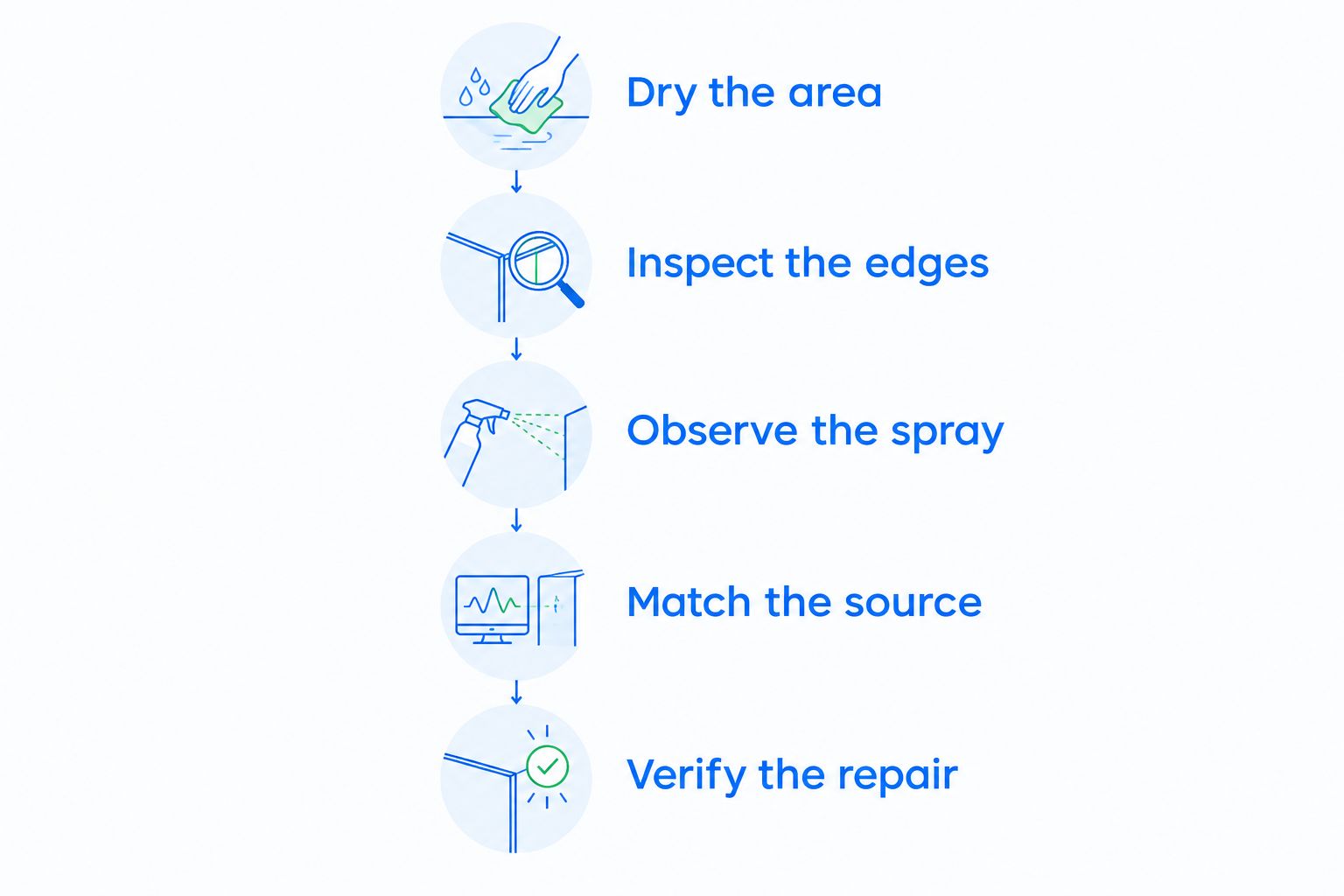
During your 2026 inspection, record whether the leak occurs with the door closed, while it moves, or after you finish showering. Those observations help separate a containment problem from water carried outward on wet glass.
Match the repair to the water path. Replacing every seal at once makes it harder to know which change corrected the problem, and unnecessary modifications can affect door operation.
| First wet location | What to inspect | What not to assume |
|---|---|---|
| Beneath the moving door | Sweep condition, fit, door position, and threshold drainage direction | A longer sweep will correct every bottom leak |
| At the closing edge | Seal condition, contact, alignment, and direct spray | Every visible clearance should be filled with caulk |
| At a stationary glass joint | Specified sealing detail and condition of the existing joint | A moving-door seal is the correct repair |
| Along a frame channel | Debris, intended drainage openings, and frame joints | Every opening is a manufacturing defect |
| Outside the curb or adjoining wall | Enclosure joints and the underlying shower construction | The glass door is necessarily the source |
For a damaged bottom strip, the Frameless Door Sweep is a polycarbonate seal used at the bottom of a frameless shower door. The listed glass options are 1/4 inch, 3/8 inch, and 1/2 inch; match the actual glass thickness and the existing enclosure's requirements before selecting a replacement.
A sweep addresses its intended moving-door joint. It does not repair a leaking shower pan, an outward-draining threshold, or a failed stationary connection. Confirm compatibility instead of treating the listed thickness alone as proof of fit.
A moving frameless shower door should not be treated as a watertight barrier under direct spray. Its operation requires clearances, and the enclosure uses its layout and seals to contain normal shower water.
Ask the installer which joints are designed to remain open, which receive seals, and which stationary connections require sealant. That distinction matters more than a blanket promise that no water can ever cross the enclosure.
For a new 2026 enclosure, discuss the actual showerhead location before approving the glass arrangement. Include how you use any handheld showerhead rather than assessing only the fixed head.
Thicker glass is not a leak repair. Glass thickness affects the enclosure's construction and hardware requirements, but it does not close a poorly fitted joint or redirect water flowing off a threshold.
If your existing enclosure leaks, identify the source before discussing replacement glass. A correctly matched seal or an installation correction addresses a different problem from changing the glass specification.
Do not replace a frameless door with a framed door until you know why it leaks. If the source is a worn sweep or an installation issue that can be corrected, changing the entire enclosure does not address the decision efficiently.
A different enclosure becomes relevant when you are redesigning the opening or correcting a layout that places vulnerable joints in the spray path. Compare both proposals against the same shower layout, and ask each installer to explain water management rather than relying on the style name.
Bring photographs of the opening, showerhead, threshold, and first wet location. Explain whether the leak is new, follows a change in door operation, or has existed since installation.
Showerdoor is best for homeowners in California, Arizona, and Nevada who want custom shower enclosures manufactured and installed. Showerdoor offers both framed and frameless shower enclosures, so your discussion can start with the bathroom rather than a predetermined door style.
Ask how the proposed design handles spray, where seals belong, and what maintenance the moving joints require. Custom manufacture and installation do not remove the need to assess the shower base and surrounding construction separately.
Do frameless shower doors leak more than framed doors?
Frameless shower doors do not inherently leak more than framed doors. Water containment depends on the complete layout, installation, seals, and drainage; framing alone does not establish which enclosure will leak.
Is a little water outside a frameless shower door normal?
Water outside a closed shower door deserves investigation, especially when it repeatedly wets the floor. Distinguish water escaping during use from water dripping off wet glass when you open the door.
Can I caulk the gap under my shower door?
Do not caulk a clearance that the door needs to move. Identify the specified sweep or seal, and keep intended drainage openings clear according to the enclosure manufacturer's instructions.
Why does my shower door leak only when I use the handheld showerhead?
A handheld showerhead can direct water at joints that receive less spray during fixed-head use. Check the spray direction and have the affected seal and enclosure layout assessed.
How do I choose a replacement frameless door sweep?
Choose a replacement sweep by matching the glass thickness, profile, and enclosure requirements. Do not assume that a strip fitting onto the glass will also provide the correct clearance or water control.
What should I check before ordering a shower door in 2026?
Before ordering a shower door in 2026, check the finished opening, showerhead direction, threshold drainage, and proposed seal locations. Ask how the enclosure will contain water under your normal shower use.
Does Showerdoor offer framed and frameless shower enclosures?
Showerdoor manufactures and installs custom framed and frameless glass shower enclosures for homeowners in California, Arizona, and Nevada. Discuss the opening and water-management requirements before choosing between the styles.
Check when the water appears. If the floor stays dry while you shower but gets wet as the door opens, investigate water carried outward on the glass before assuming a fixed joint has failed.
For your 2026 project, give Showerdoor that observation alongside the leak location. A description of the conditions is more useful than the conclusion that “frameless doors leak.”


