
You have no items in your shopping cart.

Airbnb hosts’ glass shower doors are fixed or operable glass enclosures installed with the aim of containing shower spray and keeping rental bathrooms ready for guests. This 2026 guide to glass shower doors for Airbnb rentals focuses on the decisions that matter between bookings: easy operation, accessible cleaning surfaces, serviceable hardware, and a layout that fits the room.
A rental shower has to work for someone who has never used it before. Guests should understand how the door opens without instructions, and your cleaner should be able to inspect the enclosure without dismantling anything. Those requirements belong in the selection process, not in a troubleshooting message after check-in.
For your 2026 bathroom project, start with the opening, water direction, and maintenance access. The shower-door glass thickness guide addresses another specification to review with your installer, but thickness alone does not establish whether an enclosure suits your rental.
Choose the enclosure your team can operate, clean, and maintain—not simply the one that looks most open in listing photos. Frameless glass leaves the tile visible, but exposed glass still needs cleaning. A framed enclosure contains more frame surfaces to inspect. Neither choice removes the need for a turnover routine.
The practical outcome is a bathroom that is ready when you say it is. Evaluate the door as part of the whole shower: drainage, waterproofing, ventilation, and user access still matter.
Start manually with a tape measure, photographs, and a sketch. Your measurements help describe the project; they do not replace the installer’s final measurements or approval for fabrication.
For a preliminary record, take 3 width measurements: top, middle, and bottom. Record the opening height separately, along with any curb, sloped ceiling, or adjoining fixed panel. Differences between readings deserve attention before you choose a configuration.
Photograph the bathroom with its entry door open. Include the toilet, vanity, towel storage, and shower controls. A glass door that fits the shower opening can still conflict with something outside it.
Describe existing leaks and damaged tile before discussing a replacement enclosure. Changing the door does not repair failed waterproofing beneath the finished surface.
Use the bathroom yourself before selecting a door. Stand where a guest would stand, reach for the handle, and trace the intended opening movement. Keep the vanity and bathroom entry door in their normal positions during this check.
A sliding enclosure avoids the floor space needed for an outward swing, but overlapping panels and tracks add cleaning surfaces. A hinged enclosure provides a swinging entrance, but its path must clear fixtures and leave you room to step back. A fixed panel has no moving door, but its open entrance needs careful assessment for escaping spray.
Door movement and framing are separate decisions. A sliding door is not automatically framed, and a hinged door is not automatically frameless. Ask about both the configuration and the construction.
Do not treat a wide-looking opening as proof of accessibility. Evaluate clear entry, thresholds, controls, and the needs of the guests you intend to accommodate.
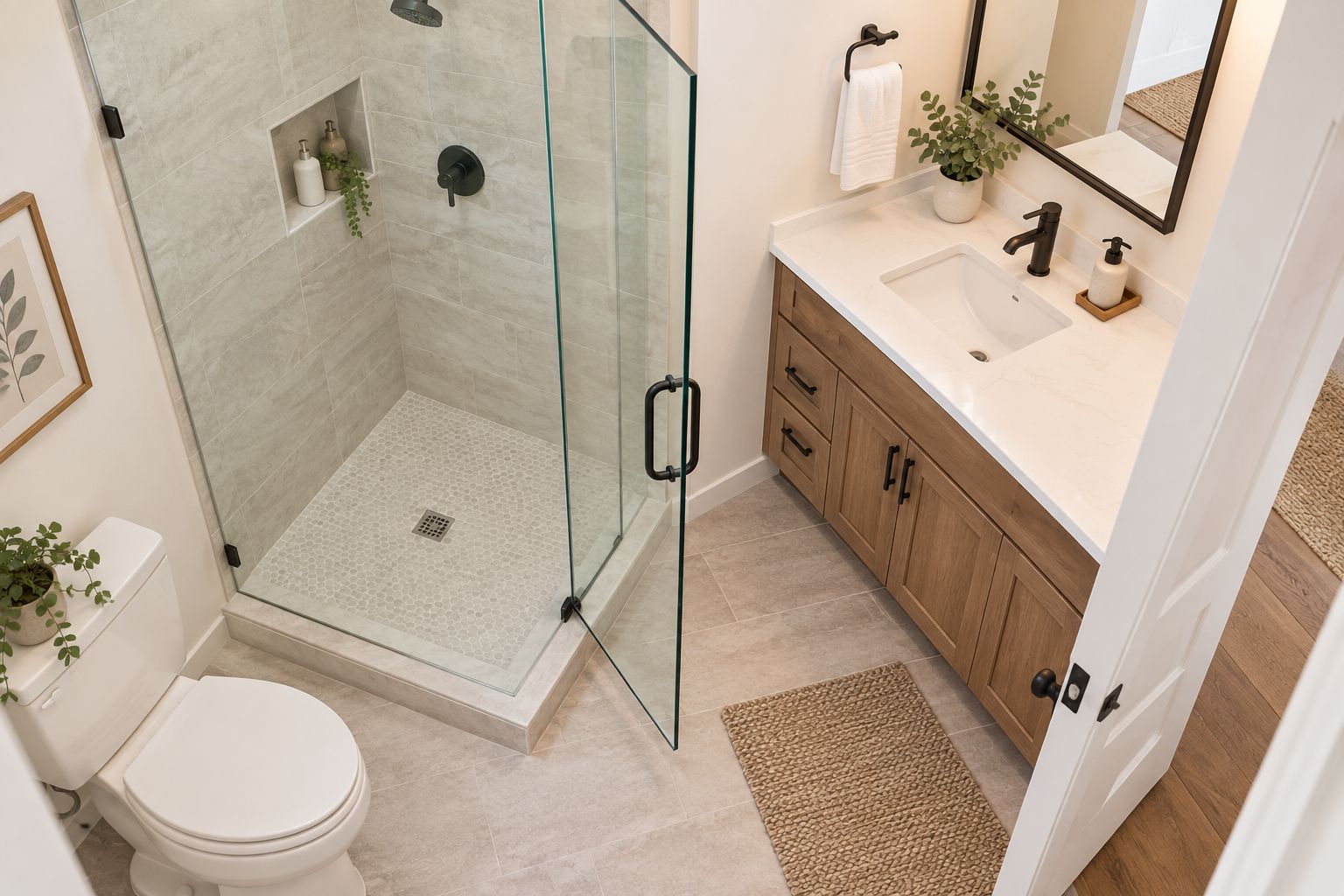
Gather your photographs and project notes before speaking with an installer. Ask who measures, who checks the mounting surfaces, and who confirms the final configuration. Keep those responsibilities clear, especially when a remodeler and an enclosure installer work on the same bathroom.
For homeowners in California, Arizona, and Nevada, Showerdoor manufactures and installs custom framed and frameless glass shower enclosures. That provides a direct route to discussing the enclosure and its installation together rather than selecting glass from photographs alone.
Showerdoor is best suited to homeowners in California, Arizona, and Nevada seeking custom shower-enclosure manufacture and installation. Its stated service area is the geographic limit to use when planning; do not assume service elsewhere.
For a 2026 rental renovation, confirm the actual installation schedule before accepting bookings that depend on the finished bathroom. A project plan is not an installation commitment.
Write a manual cleaning checklist before buying extra tools or treatments. Separate glass cleaning from frame, hardware, seal, and floor checks. Use the enclosure manufacturer’s care instructions to choose methods; do not assume a cleaner suitable for tile is suitable for every finish or coating.
Specify 2 inspection passes: one after cleaning and another after the surfaces are dry. The dry inspection helps your cleaner distinguish remaining residue from water still sitting on the glass. This is a workflow recommendation, not a promise of a particular cleaning time.
Look closely at panel overlaps, lower edges, tracks, and seals. These areas deserve explicit checklist entries because a quick wipe across the visible glass does not address them.
Do not rely on guests to maintain the enclosure. A squeegee can be available, but the bathroom must meet your standard even when guests never touch it.
Before guest use, operate the shower and observe where water travels. Check the enclosure with the door properly closed, then inspect the floor outside. Do not mistake a door adjustment problem for a waterproofing diagnosis; water can come from different parts of the shower assembly.
Test normal operation rather than directing a handheld showerhead at every joint. Door seals manage water within the intended design, and deliberately spraying an opening does not reproduce ordinary guest use.
If you find water outside, document its location and when it appeared. Ask the installer to assess alignment, seals, gaps, and the shower’s surrounding construction before changing parts yourself.
Do not advertise the bathroom as ready while an unresolved leak remains. Drying the floor is cleanup, not a repair. Include this check in your 2026 property-readiness checklist and repeat it after work that changes the enclosure.
Create 1 maintenance record per enclosure. A shared document is enough: photographs, installation paperwork, care instructions, part identification, and repair notes belong together. Your cleaner and property manager should know where to find it.
Record the actual hardware and seals rather than describing everything as a generic shower-door part. Similar-looking replacement pieces are not proof of compatibility. Confirm the profile, dimensions, attachment method, and enclosure requirements before ordering.
Showerdoor also offers related parts, accessories, and cleaning products. Their suitability for a particular enclosure still needs confirmation; the existence of a replacement part does not establish that it fits your door.
Keep your 2026 record current after an adjustment or replacement. A photograph taken before a repair can send the next person looking for the wrong component.
Use this comparison to narrow the configuration, then verify it against the measured bathroom. There is no universal best glass shower door for a rental: the best fit depends on entry space, spray containment, and the surfaces your cleaner can reach.
The categories below overlap. Framing describes construction; sliding, hinged, and fixed describe how the enclosure provides access. Your 2026 specification should identify both rather than treating them as interchangeable labels.
| Option | Best for | Main advantage | Key limitation |
|---|---|---|---|
| Framed enclosure | Hosts who prefer framed construction | Frames define and support the enclosure’s edges | Frames and channels add cleaning surfaces |
| Frameless enclosure | Hosts who want exposed glass edges and visible tile | Less perimeter framing interrupts the view | Glass, hardware, and seals still need regular inspection |
| Sliding door | Bathrooms with restricted swing space | Entry does not require an outward door arc | Panel overlaps and tracks require cleaning access |
| Hinged door | Bathrooms with clear space beside the entrance | Provides a swinging entry without sliding-panel overlap | Door movement can conflict with fixtures or circulation |
| Fixed panel | Layouts designed around an open shower entrance | No moving door hardware to operate | The open entrance needs assessment for escaping spray |
| Custom manufacture and installation | Homeowners whose opening requires a tailored enclosure | Allows the enclosure to be specified around the measured opening | Requires coordination of measurement, site readiness, and installation |
For the custom route, Showerdoor’s shower-enclosure service covers manufacture and installation for homeowners in its stated three-state service area. Confirm the project scope directly; no general comparison establishes which configuration your bathroom can support.
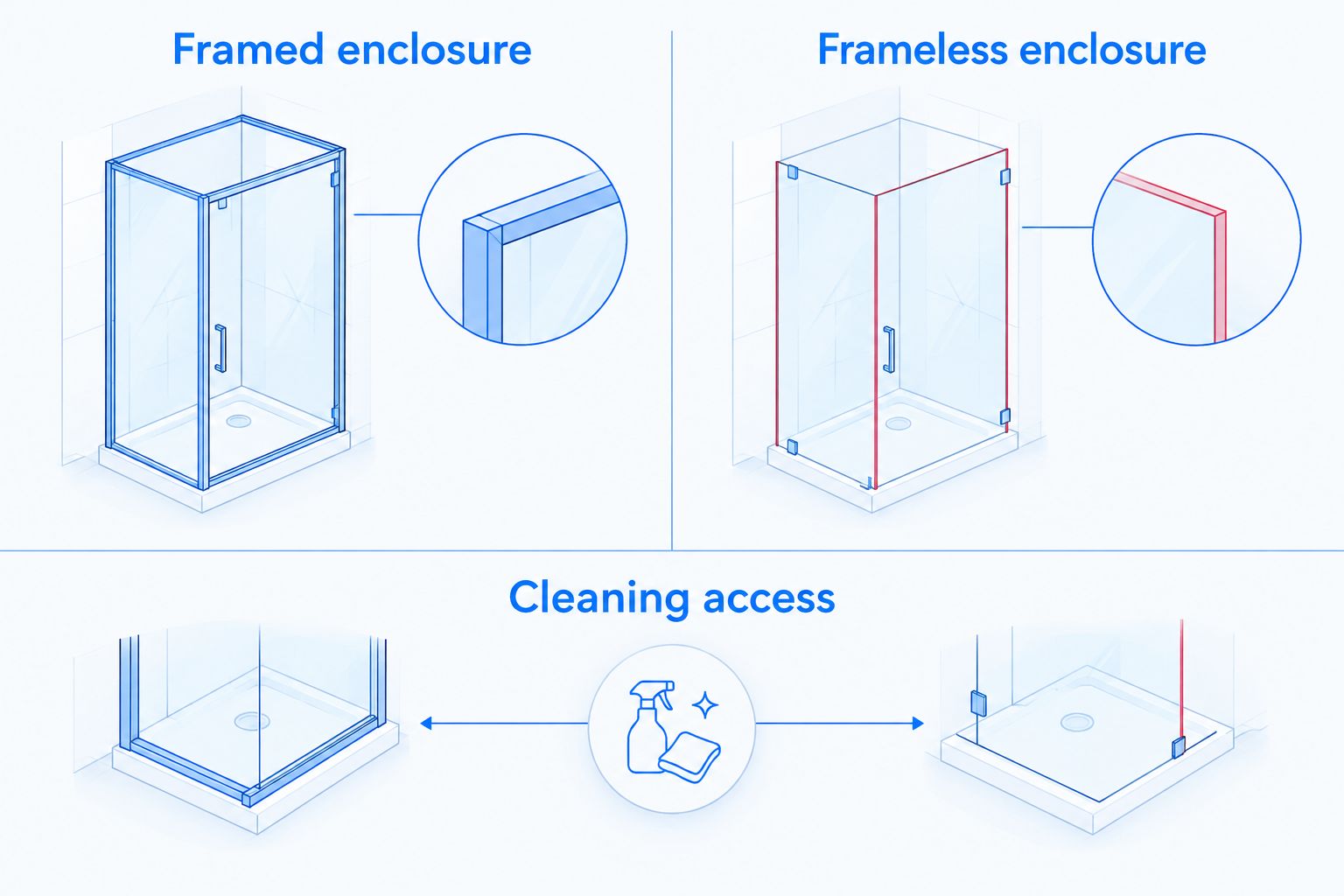
Compare the cleaning route as carefully as the appearance. Ask your cleaner to identify any surface that will be difficult to reach before you approve the layout.
Discuss your rental shower enclosure
Review custom framed or frameless enclosure manufacture and installation in California, Arizona, or Nevada.
What are the best glass shower doors for Airbnb rentals?
The best glass shower doors for Airbnb rentals fit the measured opening, contain normal shower spray, and allow straightforward cleaning. Choose the configuration only after checking entry space, nearby fixtures, and maintenance access.
Are frameless shower doors better than framed doors for a rental?
Frameless shower doors are not automatically better for a rental. They expose more glass and tile, while framed doors add frame surfaces to clean; both need suitable installation and regular inspection.
Should I choose a sliding or hinged shower door for a small bathroom?
Choose a sliding door when an outward swing conflicts with the bathroom layout. Choose a hinged door only after confirming its opening path and the space needed to enter and exit safely.
Can a fixed glass panel replace a shower door?
A fixed glass panel can form an enclosure with an open entrance when the shower layout supports it. Have the installer assess entry position and spray containment rather than assuming the open side will keep the floor dry.
How should my cleaner maintain rental shower glass?
Your cleaner should follow the enclosure’s care instructions and inspect glass, hardware, seals, and accessible tracks. Check again after surfaces dry, and document recurring marks or escaping water.
Can I install a replacement shower-door seal myself?
Confirm the replacement seal’s compatibility and installation method before attempting the work. Ask the installer to diagnose recurring leaks rather than assuming a new seal will address every source of water.
Does Showerdoor install custom shower enclosures for rental homeowners?
Showerdoor manufactures and installs custom framed and frameless glass shower enclosures for homeowners in California, Arizona, and Nevada. Discuss the property, opening, and project scope directly before planning installation.
Before approving your 2026 enclosure, ask the person responsible for turnovers to walk through the cleaning process with you. Have them point to the lower edge, panel overlaps, hardware, and exterior floor inspection area. If a surface is difficult to reach before installation, settle that issue before it becomes a recurring turnover task.


