
You have no items in your shopping cart.

Frameless rolling barn-door track systems win for most walk-in showers in 2026, framed bypass tracks win on budget for tub-to-shower conversions, and recessed in-floor tracks win for curbless, ADA-accessible bathrooms. If you want a shower door with zero track to clean, a pivot hinge is the trade-off worth knowing about before you order glass.
The track is the part of a shower door that fails first. Glass panels rarely crack; rollers seize, bottom channels grow mineral scale, and bypass tracks turn into a hard water stain trap within a year or two. Picking the wrong shower door track system for your bathroom layout means regrouting or reordering glass sooner than you would like.
Century Shower Door has built and installed custom frameless and framed enclosures across California, Arizona, and Nevada, and the track choice is the first decision that determines how the whole enclosure ages. A door that looks identical to another in the showroom can behave completely differently five years in, depending on whether it rolls on a top-hung track or drags through a bottom channel.
This guide ranks five track system types by the bathroom situation each one actually solves, not by which one photographs best in 2026 catalogs.
| Track System | Best For | Standout Feature | Key Limitation |
|---|---|---|---|
| Frameless rolling barn-door track | Modern walk-in showers | Sealed ball-bearing rollers, minimal frame | Requires a wide, unobstructed wall section |
| Framed bypass sliding track | Tub-to-shower conversions on a budget | Fits standard tub alcove widths | Bottom track collects hair and hard water buildup |
| Top-hung rolling track (no bottom channel) | Low-maintenance, minimal water pooling | No bottom track to scrub | Needs precise header alignment during install |
| Recessed in-floor track | Curbless, ADA-accessible bathrooms | Sits flush with the shower pan | Installation must happen during pan construction |
| Pivot hinge (no track) | Skipping track maintenance in small bathrooms | Zero rollers or channels to clean | Door swings into the bathroom, needs floor clearance |
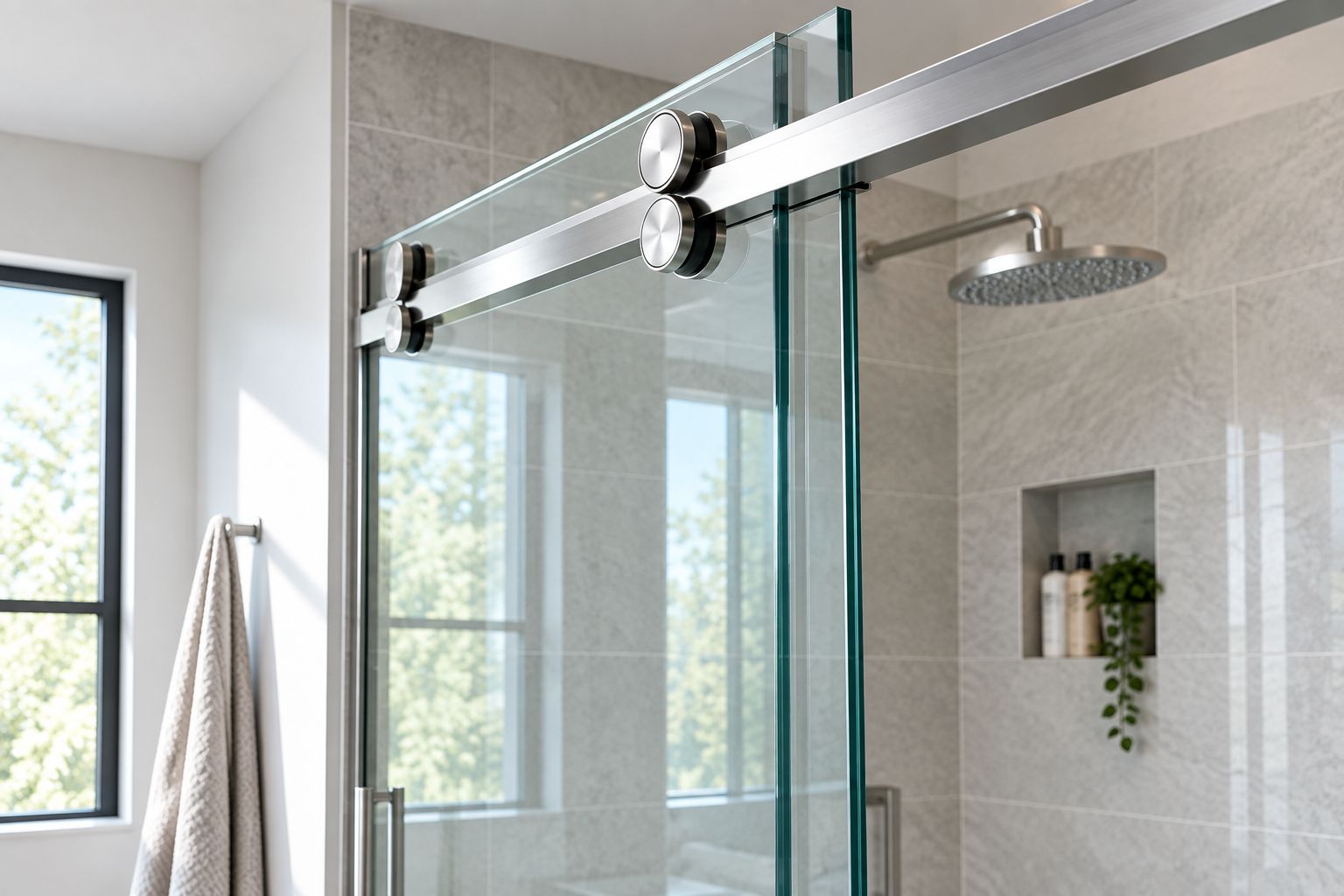
This system hangs the glass panel from a single overhead track using sealed ball-bearing rollers, letting the door slide past a fixed panel instead of pivoting on hinges. It is the layout most homeowners picture when they say "frameless shower door" in 2026, and it pairs naturally with 3/8-inch or 1/2-inch tempered glass.
A related option, the barn door style shower door, uses the same top-hung mechanics with a heavier hardware profile for a more industrial look.
Frameless barn-door track pros:
Frameless barn-door track cons:
Best for: walk-in showers with at least a few feet of clear wall space and a preference for minimal hardware. Verdict: Buy for most 2026 remodels where the wall layout allows it.
Bypass tracks use two parallel channels, one on top and one on the bottom, so two door panels slide independently across a tub or shower opening. It is the system most homeowners already have if their bathroom was built before frameless glass became common.
Framed bypass pros:
Framed bypass cons:
Best for: homeowners converting a tub to a shower who want to keep costs down and do not mind a maintenance routine. Compare the full breakdown in best sliding shower doors for walk-in showers if the space is a true walk-in rather than a tub. Verdict: Hold unless budget is the deciding factor — the bottom track upkeep is real.
This is a variant of the rolling system where the door hangs entirely from the header and a small guide at the floor keeps it from swinging, but there is no continuous bottom channel for water to sit in. It is the track a lot of 2026 remodels default to specifically to avoid scrubbing a bottom groove every week.
A frameless door sweep seals the small gap at the bottom of the door on this style, available for 1/4-inch, 3/8-inch, and 1/2-inch glass, and it does the water-blocking job the bottom track would otherwise handle.
Top-hung rolling track pros:
Top-hung rolling track cons:
Best for: anyone who has scrubbed a bypass track and decided never again. Verdict: Buy if low maintenance matters more than upfront cost.
This system sinks the track into the shower pan itself so the door glides flush with the floor instead of riding on a raised channel. It only works if it is planned before the pan is poured or tiled, which makes it a new-construction or full-gut-remodel choice rather than a retrofit.
Recessed in-floor track pros:
Recessed in-floor track cons:
Best for: ADA-compliant or curbless bathroom projects planned from the ground up. Verdict: Buy for accessibility-focused remodels; Skip for a straightforward retrofit.
A pivot door does not slide at all — it swings on a top and bottom pivot point, meaning there is no track, no rollers, and nothing to scrub. It is technically not a track system, which is exactly why it belongs in this comparison: some bathrooms are better off without one.
Pivot hinge pros:
Pivot hinge cons:
Best for: small bathrooms where a swinging door has room to clear and the homeowner wants zero track maintenance. Verdict: Buy for tight budgets on upkeep; Wait if floor space is limited.
Each system was scored against the six criteria above: rolling smoothness, water drainage, cleaning access, glass weight capacity, maintenance frequency, and fit for the space. No single track wins on every criterion — that is the point of a decision tree instead of a leaderboard. A frameless barn-door track beats a bypass system on maintenance but loses on wall-space flexibility; a pivot door beats both on cleaning but loses on doorway footprint.
For a straightforward 2026 remodel with a wide wall section, the frameless rolling barn-door track is the default pick — sealed ball-bearing rollers and no bottom channel mean the least maintenance over the life of the enclosure. If the bathroom is a tub conversion on a fixed budget, the framed bypass system gets the job done as long as the bottom track gets cleaned regularly. Curbless and accessibility-driven remodels should plan for a recessed in-floor track from the start, since it cannot be retrofitted later.
“A bypass track is only a maintenance problem if nobody cleans it — the hardware itself is not the weak point.”
What is the best shower door track system for 2026?
The frameless rolling barn-door track is the best overall shower door track system for 2026 for most walk-in showers, using sealed ball-bearing rollers and no bottom channel to trap water. It needs a wide, unobstructed wall section to slide past.
Is a top-hung track better than a bypass track?
A top-hung rolling track with no bottom channel is lower maintenance than a bypass track because there is no groove at floor level to collect hard water and soap scum. A framed bypass track costs less and fits standard tub alcove widths, which makes it the better choice on a tight budget.
Do frameless shower doors need a bottom track?
No. Many frameless designs hang from an overhead track and use a door sweep at the bottom instead of a continuous channel. The door sweep seals the gap and is sized for 1/4-inch, 3/8-inch, or 1/2-inch glass.
Can a recessed in-floor track be added after the shower is built?
No. A recessed in-floor track has to be planned before the shower pan is poured or tiled, which makes it a new-construction or full-remodel decision rather than a retrofit option.
What causes shower door tracks to stick or stop rolling smoothly?
Hard water mineral buildup and soap scum inside the roller channel are the most common causes. Bypass tracks with a bottom channel are more prone to this than top-hung rolling tracks because the channel holds standing water.
Is a pivot door better than a sliding track system?
A pivot door has no track at all, so there is nothing to clean or replace on the hardware side. It requires floor clearance for the swing, which makes it a poor fit for very small or narrow bathrooms.
What glass thickness works with most shower door tracks?
Most track systems in 2026 are built around 1/4-inch, 3/8-inch, or 1/2-inch tempered glass. Heavier 1/2-inch glass needs a track rated for the added weight, which rules out some lighter-duty bypass hardware.
How often should a shower door track be cleaned?
A bypass track with a bottom channel should be wiped down weekly to prevent hard water buildup from seizing the rollers. A top-hung track with no bottom channel needs far less frequent attention, usually just an occasional wipe of the header.
The detail most homeowners skip: the door sweep at the bottom of a frameless door does more work than the track itself on a top-hung system. A track with sealed rollers can outlast the enclosure, but a cracked or worn sweep will let water reach the floor regardless of how well the track performs — check it annually, not just when a leak shows up.


