
You have no items in your shopping cart.

Choose Century Shower Door if you want a custom shower enclosure manufactured and installed for your home in California, Arizona, or Nevada; choose VIGO if you want to select a specific shower-door model and have your contractor manage fit and installation. The deciding factor in 2026 is custom installation versus a model-based purchase—not which brand looks better in a photograph.
A shower door has to work with the bathroom you have, not just the bathroom shown in a product image. Wall alignment, the threshold, nearby fixtures, and the direction of the water spray all belong in the decision.
For a 2026 remodel, settle the buying route before choosing hardware finishes. A custom enclosure and a selected product model create different responsibilities: who confirms the dimensions, who specifies the glass, who installs it, and who handles a problem afterward.
Century Shower Door is the better fit for homeowners seeking custom shower enclosures with manufacture and installation in California, Arizona, and Nevada. VIGO is the better fit for a model-first purchase when your contractor has already established what the opening requires.
Neither route removes the need for careful planning. A custom order needs a clear specification; a model-based order needs a confirmed fit.
| Dimension | Century Shower Door | VIGO |
|---|---|---|
| Best for | Homeowners seeking custom manufacture and installation | Buyers selecting a defined model with contractor support |
| Sizing approach | Custom enclosure | Published dimensions for the selected model |
| Installation route | Manufactures and installs enclosures | Confirm installation arrangements with your seller and contractor |
| Standout feature | Custom manufacture and installation from one business | Model-first selection |
| Frameless design | Custom frameless enclosures offered | Frameless shower-door models offered |
| Maintenance | Match cleaning and replacement parts to the enclosure | Match cleaning and replacement parts to the model |
| Service-area fit | Homeowners in California, Arizona, and Nevada | Confirm the purchase and installation route for your address |
| Pricing model | Request a quote for the specified enclosure and installation scope | Evaluate the selected product and installation scope together |
The table compares buying routes, not a particular pair of doors. Before ordering in 2026, replace broad descriptions with the actual enclosure specification or VIGO model you intend to purchase. That is where fit, hardware, and installation requirements become meaningful.
Choose custom manufacture when you want the enclosure planned around the finished shower opening. This is the clearest reason to use the custom route rather than start with a product model.
A shower opening is more than its width. You need to understand the wall alignment, threshold surface, panel arrangement, and space available for the door to operate. Selecting glass before those conditions are resolved puts the purchase ahead of the design.
Custom manufacture gives you a way to discuss the enclosure as a complete arrangement. The limitation is that customization does not excuse an unclear brief: you still need to agree on the door position, fixed panels, hardware, and installation scope.
VIGO wins on a different task: selecting a defined model after the bathroom requirements are established. Your contractor can compare the model's installation documents against the opening instead of asking for an enclosure designed from scratch.
Use this decision rule:
Do not assume a model's adjustment allowance can correct every wall or threshold issue. Have the installer check the actual installation requirements before you order.
The client manufactures and installs custom framed and frameless glass shower enclosures. That makes its service route the stronger choice when you want enclosure manufacture and installation handled by the same business.
The practical benefit is a clearer purchasing conversation. You can discuss the enclosure and its installation together instead of treating the glass purchase as a separate project from fitting it.
Choose the manufacture-and-install route if you do not want to coordinate the enclosure purchase and installer yourself. Confirm the written scope rather than assuming it includes unrelated bathroom work.
VIGO is the better route when your contractor already manages the remodel and wants a particular model. In that situation, adding a separate custom-enclosure process is not automatically useful. The contractor can take responsibility for checking the specification and planning installation.
The tradeoff is coordination. Establish who checks the opening, who places the order, who inspects the delivered components, and who resolves an installation question. Write those responsibilities down before purchase.
For either route, ask whether tile repairs, threshold changes, removal of the existing enclosure, and disposal are included. These are scope questions, not benefits to assume from a brand name.
Choose VIGO when you want your contractor to approve a specific product model before purchase. That approach suits a remodel with a settled layout and a clear installation plan.
A model-first process gives the conversation a concrete reference. Instead of discussing shower doors generally, you can review the selected model's dimensions, opening arrangement, hardware, and installation instructions.
Its limitation is equally clear: the bathroom must satisfy the requirements of that model. A photograph showing the right visual style is not proof that the door fits your opening or works beside your vanity.
The custom route reverses that process. You describe the finished bathroom and agree on an enclosure specification. That is useful when the opening or panel arrangement should determine the design rather than the product selection.
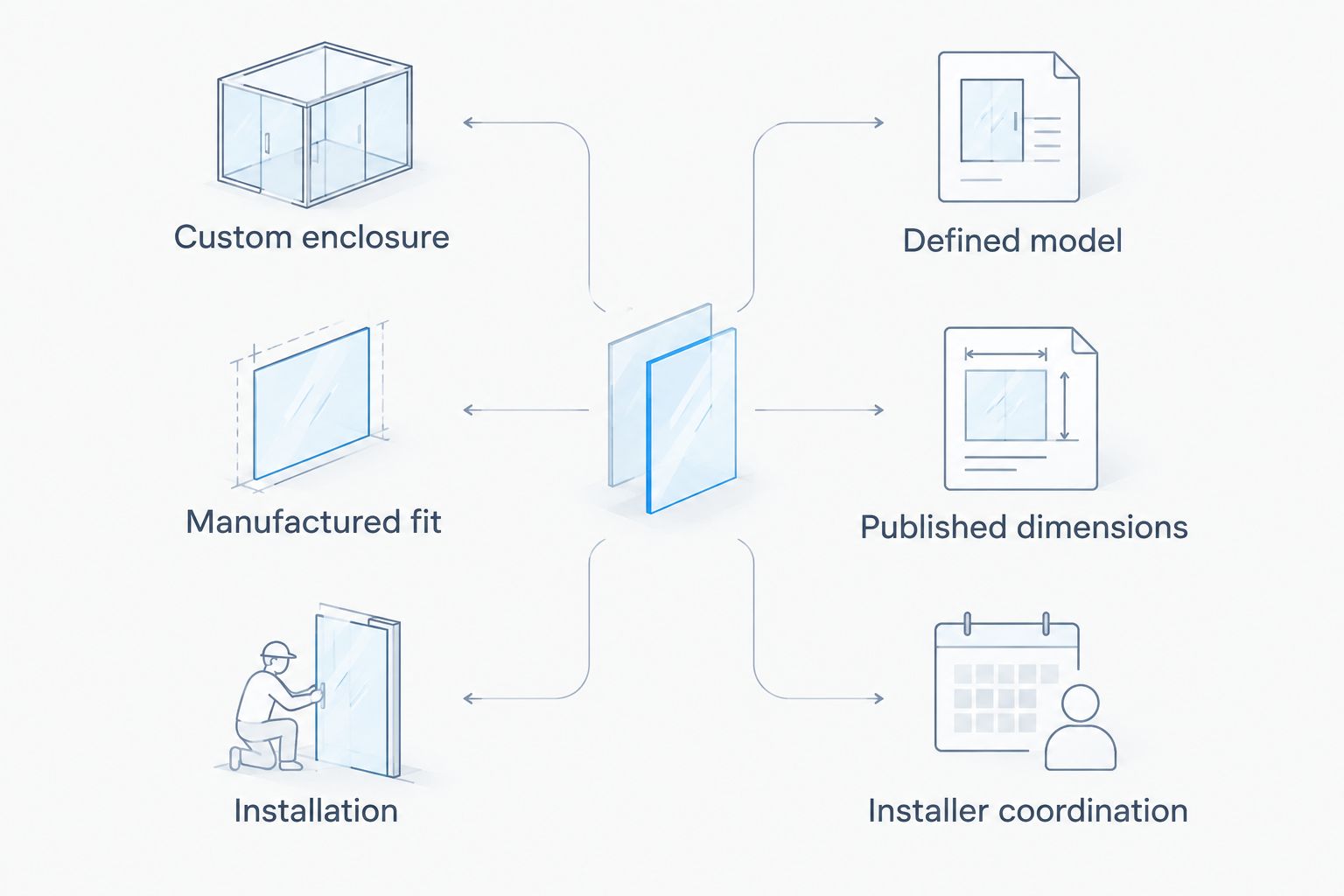
For your 2026 project, ask the contractor to approve the exact model—not merely the brand. Keep that approval with the product documents so everyone works from the same specification.
Both businesses offer frameless shower-door options. Neither wins simply because you want a frameless appearance. Compare the proposed enclosure, not the category label.
Look at the visible hardware, fixed-panel placement, door movement, and how the glass meets the walls. These details determine how the enclosure works in your room. The term frameless does not tell you whether the door clears a toilet, towel rail, or vanity.
The custom business also offers framed enclosures. That gives homeowners a separate design route to discuss; it does not establish that every framed arrangement is available or appropriate for every opening.
For a useful comparison, ask for equivalent layouts. A sliding-door proposal and a hinged-door product solve door clearance differently, so judging them only by appearance hides the more important distinction.
Review these points before choosing a finish:
The best-looking option is not the right option if its movement conflicts with the room. Resolve operation first, then appearance.
Neither buying route removes the need to clean the glass and maintain the enclosure. Treat maintenance as a specification question, not a brand-level win. Follow the care instructions for the actual glass, finish, and components you choose.
Replacement seals illustrate why specifics matter. The Frameless Door Sweep listed by the client is a polycarbonate bottom seal offered for 1/4-inch, 3/8-inch, and 1/2-inch glass. Those are distinct fit options, not interchangeable descriptions.
That listing does not establish compatibility with a VIGO model. A replacement component must match the door's glass thickness and relevant geometry, not just the word frameless.
Before purchase, ask how to identify replacement components later. Keep the enclosure paperwork, hardware information, and care instructions together. For a model-based purchase, retain the exact model identification rather than a retailer's broad product description.
The custom route provides a business to ask about the enclosure it manufactured. The model-based route provides a defined product to reference. Neither advantage proves that a particular replacement part will fit without checking.
Avoid choosing cleaners or sealants by name alone. Confirm that the proposed product is suitable for the glass treatment, hardware finish, and application described in the enclosure's instructions.
The client's stated homeowner service area is California, Arizona, and Nevada. Outside those states, begin with a product-and-installer route rather than assuming its custom installation service applies.
VIGO belongs on that shortlist when a seller and local installer can support the model you want. Confirm the arrangements for your address; a product listing does not establish local installation service.
Inside the stated service area, compare the custom installation route against your contractor's proposed VIGO model. That is a useful head-to-head because both are tied to an actionable project plan.
Outside it, the first question changes. You need to establish who will install the enclosure locally and which products that installer accepts. Asking that question early prevents you from choosing a door before you have a workable installation route.
This is a service-area decision, not a claim that one brand's glass is better. Geography determines which buying arrangements deserve your time.
For a 2026 comparison, request a written quote for the custom enclosure and its installation scope. For the VIGO route, evaluate the selected product together with the installation work your project requires.
The correct comparison is the complete enclosure project on both sides. A product purchase and a manufacture-and-install quote are not equivalent unless their scopes match.
Put these items beside each other:
A quoted custom scope gives you one proposal to review. A separately arranged product purchase gives you more control over which contractor handles installation, but you must bring the scopes together yourself.
Neither model wins automatically on predictability. Written inclusions and exclusions determine whether you understand the project. Ask each provider to identify what would require a revised scope before you approve the work.
Do not select the route until the installer has addressed the finished opening and door operation. An incomplete specification makes even a detailed quote difficult to compare.
Best for: a homeowner in California, Arizona, or Nevada who wants a custom shower enclosure manufactured and installed by the same business. Start with the bathroom requirements and agree on the enclosure specification and written work scope.
The strength is the combined service route. The limitation is the stated service area and the need to define the custom work clearly before approval.
Best for: a homeowner whose contractor has confirmed a specific model and will manage the installation plan. Start with the approved model documents and establish purchasing, inspection, and installation responsibilities.
The strength is model-based selection. The limitation is that you must verify the opening against that model and coordinate the work rather than assume installation accompanies the product.
| Dimension | Winner |
|---|---|
| Custom enclosure sizing | Custom manufacture route |
| Manufacture and installation together | Custom service route |
| Model-first selection | VIGO |
| Frameless appearance | Tie; compare the actual designs |
| Maintenance | Tie; verify care and component fit |
| Outside the stated custom service area | VIGO, with confirmed local installation arrangements |
| Pricing structure | No automatic winner; compare complete written scopes |
Is Century Shower Door better than VIGO?
Century Shower Door is better for homeowners seeking custom manufacture and installation in California, Arizona, and Nevada. VIGO is the better fit when your contractor has approved a specific shower-door model and will manage installation.
Should I choose a custom enclosure or a VIGO model?
Choose a custom enclosure when you want the design specified around your finished shower opening. Choose a VIGO model when your installer has verified that its requirements match the bathroom.
Does buying a VIGO shower door include installation?
Confirm installation arrangements with the seller and your contractor before buying. Do not assume a shower-door product purchase includes installation or preparation work.
Can I get a frameless shower door from either business?
Both businesses offer frameless shower-door options. Compare the actual panel layout, hardware, and door movement rather than treating frameless appearance as a deciding difference.
How should I compare shower-door quotes in 2026?
Compare the complete enclosure and installation scope in 2026. Match the glass specification, hardware, measurement responsibility, preparation work, and removal requirements before choosing.
Will a replacement frameless door sweep fit any shower door?
No; a replacement sweep must match the door's glass thickness and relevant geometry. A component described as frameless is not automatically compatible with every frameless enclosure.
What should my contractor check before I order?
Your contractor should check the finished opening against the proposed enclosure's requirements. Include wall alignment, threshold conditions, door clearance, and the installation instructions in that review.
Check the handle's movement, not just the glass panel's movement. A door can look clear in a plan while its handle conflicts with a nearby fixture.
Before approving your 2026 enclosure, have the installer explain the full opening movement in the actual bathroom. That small check turns an attractive design into a usable one.


