
You have no items in your shopping cart.

To fix a shower door that won't slide smoothly, clean the accessible track and guide, then check for a rubbing seal, damaged rollers, or a panel that sits unevenly. Stop using the door if the glass is chipped, the panel feels unstable, or mounting hardware moves; cleaning does not correct a loose or damaged support system.
A sticking shower door needs a diagnosis, not a harder pull. Dirt in a guide calls for cleaning; a loose hanger calls for a different repair. Forcing either problem makes it harder to control the panel.
Before buying replacement hardware in 2026, identify where the panel carries its weight and where it is only guided. The guide to shower door track systems for smooth sliding provides context for that distinction. A bottom channel does not necessarily contain the rollers supporting the glass.
Start with the least invasive checks and stop before any task that requires unsupported glass. Keep the bathroom floor dry, keep other people clear of the opening, and do not stand inside the enclosure while testing an unstable door.
Record the symptom before changing anything. A photo of the guide and a description of where the door catches are more useful than ordering a part because it looks similar.
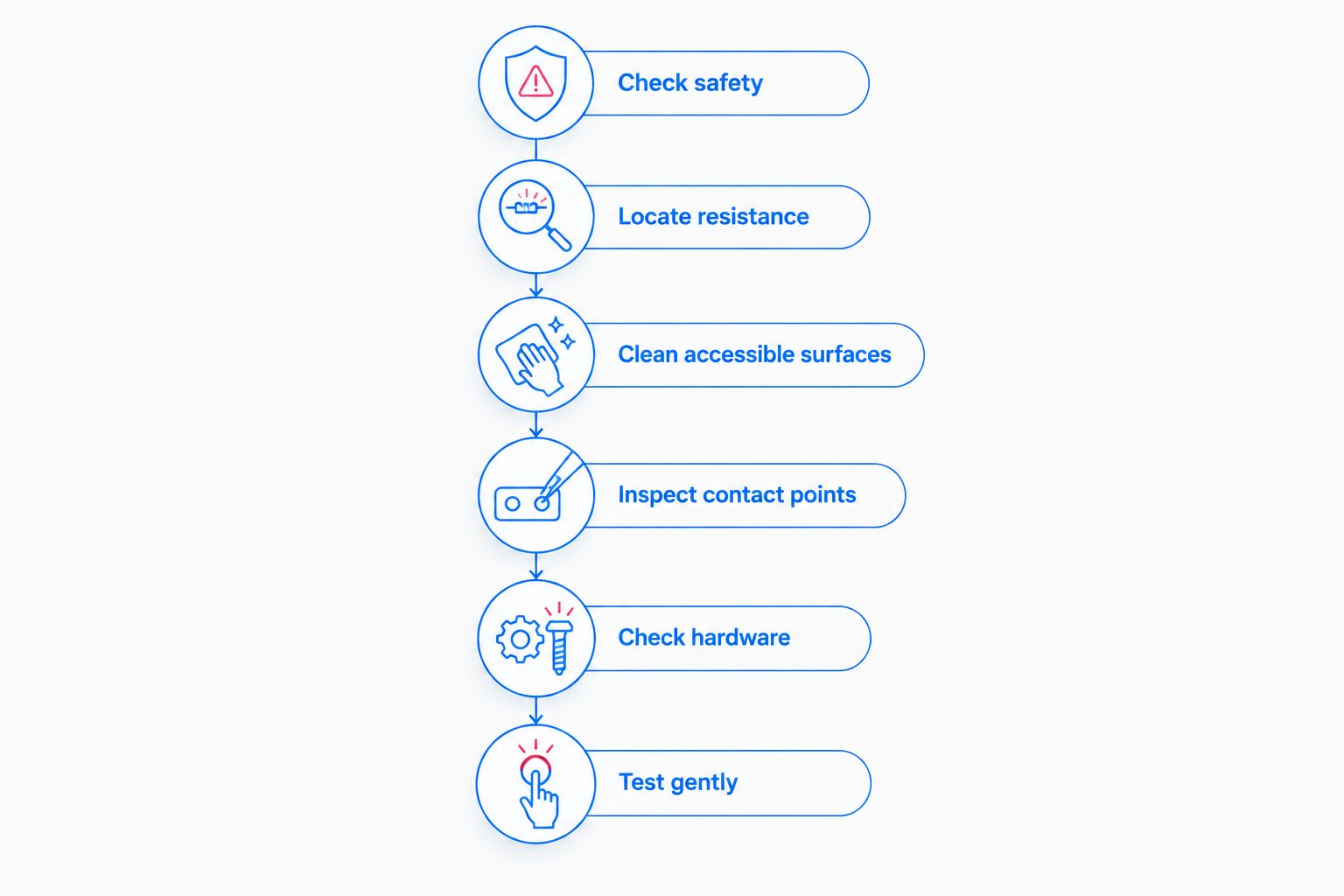
Use this 2026 troubleshooting table to decide what to inspect, not to identify a replacement part from symptoms alone. Different faults can produce similar resistance.
| Repair route | Best for | Advantage | Limitation or caution |
|---|---|---|---|
| Accessible cleaning | Visible hair, soap residue, or debris | Does not require removing the panel | Does not repair worn bearings or loose supports |
| Seal inspection | Visible flexible material dragging against a surface | Helps locate a specific contact point | Removing a seal can affect water containment |
| Manufacturer-directed adjustment | Uneven alignment on an otherwise secure system | Addresses alignment when the design permits adjustment | Wrong adjustments can affect clearances and retention |
| Compatible roller replacement | Confirmed damaged or seized rollers | Addresses the failed moving component | Can require safe panel removal and exact part identification |
| Professional inspection | Loose supports, unstable glass, or unresolved binding | Keeps hazardous disassembly out of a DIY repair | Requires arranging an assessment rather than an immediate DIY fix |
Choose the repair that matches the confirmed fault. A rough-running roller and a dirty guide can both make noise, but cleaning only addresses contamination.
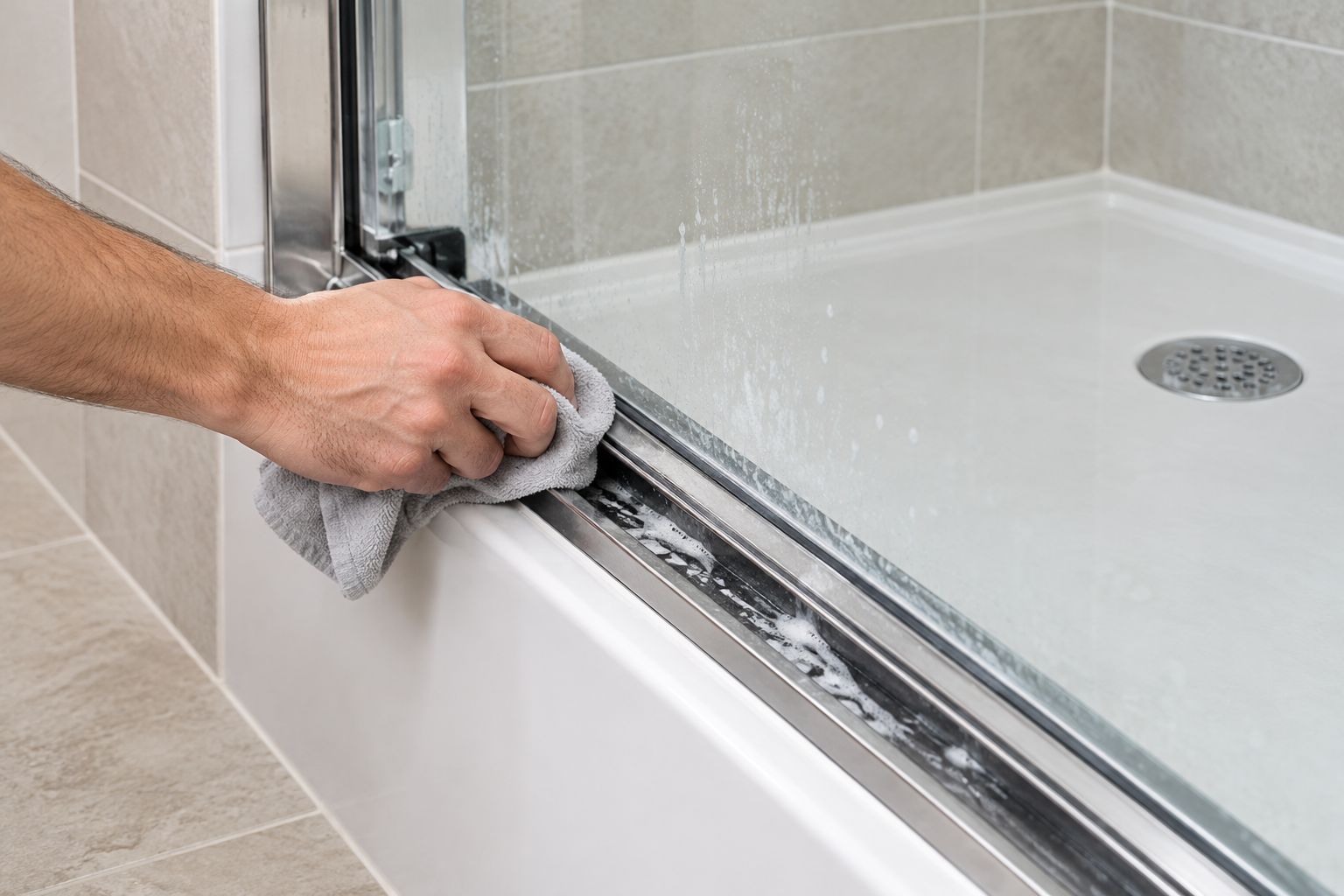
Use a soft brush or cloth to lift out loose debris from accessible channels. Follow with a cleaner approved for the enclosure's glass, coatings, metal finish, and seals; follow its label for application and rinsing.
Do not assume a glass cleaner is suitable for every component around the glass. Keep abrasive pads, metal scraping tools, and incompatible chemicals away from finished surfaces and coated panels.
Work around the panel without lifting it out of its guide. Wipe away residue and leave drainage openings unobstructed. Do not push debris deeper into a concealed roller assembly or fill openings with sealant.
Once the area is clean, dry the surfaces and test the stable door gently. If movement improves but a catch remains in the same location, inspect that location rather than repeating increasingly aggressive cleaning.
A damaged roller, seized bearing, or contaminated running surface can interrupt movement. Look at exposed components without removing covers that support or retain the panel, and listen for whether the sound follows the panel or stays at one location.
Do not order rollers solely by wheel diameter or appearance. The attachment, profile, mounting arrangement, and retention system must match the enclosure. Use the manufacturer's parts information to establish compatibility.
If inspection requires taking the glass down, leave that work to a qualified installer. Do not lift the panel to see whether it slides better. Lifting can disengage a guide or retaining feature.
A bottom guide keeps the panel positioned as it moves. Look for trapped debris, broken material, displaced components, or a panel rubbing against the guide rather than passing through it as designed.
Do not remove a guide to eliminate friction and then keep using the shower. A guide is part of the door's control system, not an optional obstruction. Restore the intended arrangement with compatible parts.
An uneven closing gap or repeated rubbing deserves an alignment check. Some systems include adjustment features, but their location and operation depend on the hardware design.
Your 2026 repair checklist should start with the enclosure model and installation instructions, not a universal screw-turning rule. Do not loosen rail brackets, glass clamps, or unidentified fasteners to experiment. Those components can carry or retain the panel.
A folded, displaced, or incorrect seal can rub against the threshold or neighboring glass. Watch the contact point while moving a stable panel gently; do not put your hand beneath the moving glass.
Replace a damaged seal only after confirming its application and fit. Glass thickness alone does not establish compatibility. The seal profile, position, clearance, and enclosure design also matter.
For example, the Frameless Door Sweep is described for the bottom of a frameless shower door, with options for 1/4-inch, 3/8-inch, and 1/2-inch glass. Those dimensions identify glass-fit options; they do not establish that the sweep belongs on your sliding enclosure.
Do not cut away a seal simply because the door becomes easier to move without it. The missing seal can change water containment, and a replacement that presses too tightly can recreate the drag.
The amount and location of resistance depend on what is touching, carrying, or guiding the panel. Check these factors separately:
A door that catches at the same spot deserves a close look at that location. A door that resists across its full travel calls for checking the moving components and continuous contact surfaces as well.
Lubricate only where the enclosure manufacturer specifies a compatible lubricant. Spraying an unknown product across the track is not a substitute for cleaning or diagnosing a damaged component.
Some assemblies have specific lubrication requirements; others are not intended for routine homeowner lubrication. Keep products off walking surfaces and glass unless their instructions explicitly permit that use, and do not use lubricant to disguise continuing grinding or instability.
Adjust the door yourself only when its instructions identify a homeowner procedure that does not require unsupported glass. Stop if the hardware is unfamiliar, the panel is unstable, or adjustment requires releasing a support or retaining component.
For a 2026 repair, save the model information and photograph the original hardware positions before any permitted adjustment. Follow the specified sequence and checks rather than applying advice intended for a different enclosure.
Stop DIY work when the fault involves glass damage, loose supports, panel removal, or uncertain retention. The same applies when cleaning does not resolve persistent grinding or the glass contacts another hard surface.
Prepare clear photos of the entire enclosure, the affected guide or roller, and any identification label. Describe whether the problem appeared suddenly, followed other bathroom work, or developed gradually. Do not keep operating an unstable door to record a video.
Showerdoor is best for homeowners seeking custom shower enclosure manufacture and installation in California, Arizona, or Nevada. That service fits a replacement project; it does not establish compatibility between an existing enclosure and an unrelated replacement part.
Showerdoor's stated service area is California, Arizona, and Nevada. If your enclosure is outside that area, use the original manufacturer or a qualified local shower enclosure installer for the inspection.
What's the first thing to do when my shower door won't slide smoothly?
Check that the glass and mounting hardware are secure before cleaning accessible tracks and guides. Stop using the door if the panel wobbles, has chipped glass, or moves out of its guide.
Why does my shower door stick in the same place?
A repeatable catch points to something interacting at that position, such as debris, a damaged running surface, or rubbing contact. Inspect the location without forcing the panel through it.
Can I spray lubricant on my shower door track?
Use lubricant only where the enclosure manufacturer specifies a compatible product. Clean accessible debris first, and do not use lubrication to mask damaged rollers or loose hardware.
Do I need to remove the shower door to clean the track?
You can clean accessible channels and guides without removing the panel. If reaching the problem requires taking down the glass, arrange qualified help rather than lifting it out yourself.
Will a new bottom seal make my shower door slide better?
A new seal addresses drag only when the existing seal is the confirmed cause and the replacement fits the enclosure. A seal cannot repair a damaged roller or loose support.
How do I know which replacement rollers fit my shower door?
Identify replacement rollers using the enclosure model and the manufacturer's parts information. Appearance alone does not confirm the attachment, profile, or retention system is compatible.
Can Showerdoor help if I need a replacement enclosure?
Showerdoor manufactures and installs custom framed and frameless shower enclosures for homeowners in California, Arizona, and Nevada. A replacement project is different from identifying a repair part for an existing enclosure.
Do not judge the repair by how easily the door moves alone. A panel with a missing guide can move more freely while being less controlled. Confirm that guides, stops, and retaining components remain in their intended positions.
For your 2026 maintenance record, keep the enclosure instructions, identification details, and photos together. Identifying the installed system is the starting point for the next repair—not guessing from a similar-looking part.


