
You have no items in your shopping cart.

A locally made shower door is worth the extra cost when a made-to-measure enclosure solves a fit problem or gives you a clearly defined manufacturing-and-installation service. The extra expense is not justified by a local address alone, and the comparison must include installation, hardware, removal, and responsibility for measurement errors—not just the glass. For a custom shower door vs big box decision in 2026, choose the proposal that fits your finished opening and states who is responsible for the completed installation.
Yes, when custom sizing and installation responsibility address a specific need in your bathroom. If a standard enclosure meets every installation requirement, a local manufacturing claim does not establish an additional benefit on its own.
Start with the finished opening, not a photograph. The questions in this guide to getting a shower door quote without an in-home visit help separate preliminary planning from the measurements needed to order glass.
| Buying route | Best for | Main advantage | Main limitation | What to verify |
|---|---|---|---|---|
| Custom enclosure | An opening or layout that needs made-to-measure glass | Glass dimensions can be specified for the project | Custom sizing does not correct faulty tile, waterproofing, or inadequate support | Final measurements, mounting details, and installation scope |
| Standard-size enclosure | An opening that meets a selected model’s requirements | You can assess a defined model against its installation instructions | You must stay within that model’s adjustment and mounting limits | Opening range, wall conditions, clearance, and installer responsibility |
A retailer can sell custom products, and a local installer can install standard products. Compare the actual enclosure and service agreement, not “local” against “big box” as labels.
A shower enclosure is an installed assembly. Glass, hinges or rollers, seals, mounting surfaces, and the shower’s layout must work together; a door that looks right in a display still needs to fit your bathroom.
For your 2026 remodel, judge value at the completed-project level. A glass-only offer and a measured-and-installed proposal cover different work, so their totals do not answer the same question.
Keep appearance separate from fit, too. A frameless design does not establish manufacturing quality, and a framed design is not automatically a compromise. Either needs an appropriate design and correct installation.
Best for: bathrooms with dimensions or geometry outside a selected enclosure’s installation limits. Custom sizing gives you a way to specify glass for the actual opening rather than choosing solely from predetermined dimensions.
That matters when the proposed enclosure includes angled panels, a return panel, or glass meeting a bench. Ask the installer to explain which feature requires custom fabrication. A clear explanation is more useful than a general claim that custom is better.
The limitation is equally important: custom glass is not a repair for defective construction. Resolve loose tile, questionable mounting support, and waterproofing concerns before authorizing fabrication.
Best for: homeowners who want clearly assigned responsibility for the enclosure. A proposal that names who measures, orders, and installs lets you establish responsibility before work begins.
Do not assume those responsibilities are included because the business is nearby. Ask what happens if the ordered glass does not fit the approved opening, and get the answer in writing.
Showerdoor custom shower enclosures are best for homeowners in California, Arizona, and Nevada seeking a company that manufactures and installs the enclosure. Showerdoor offers custom framed and frameless glass shower enclosures; confirm the scope for your particular bathroom before approving work.
Best for: bathrooms where entry clearance and surrounding fixtures constrain the design. A custom proposal lets you discuss panel arrangement, handle location, and the door’s movement as parts of the same project.
Have the installer show how you will enter, reach the controls, and clean around the enclosure. Check the proposed door movement against the toilet, vanity, towel bars, and other fixed objects.
Custom fabrication still has design limits. Ask whether the proposed arrangement suits the mounting surfaces and hardware rather than treating every sketch as buildable.
Best for: a finished opening that satisfies a particular model’s documented requirements. If the opening, mounting conditions, and clearance all match, you do not need custom fabrication merely to call the project an upgrade.
The benefit is a defined product specification. You can examine its dimensions, hardware requirements, installation instructions, and care instructions before deciding whether it fits your project.
The drawback is the need to work within those specifications. Do not treat an advertised opening range as permission to ignore wall alignment, curb geometry, or required support.
Ask whoever will install the enclosure to review the exact model before you order it. A general statement that “a standard door should fit” is not approval of a particular product.
For a useful custom shower door vs big box comparison in 2026, ask each seller to describe the same finished project. These factors define the work you are comparing:
Do not assume any item is included. Ask the seller to mark each item as included, excluded, or assigned to another contractor before you approve the proposal.
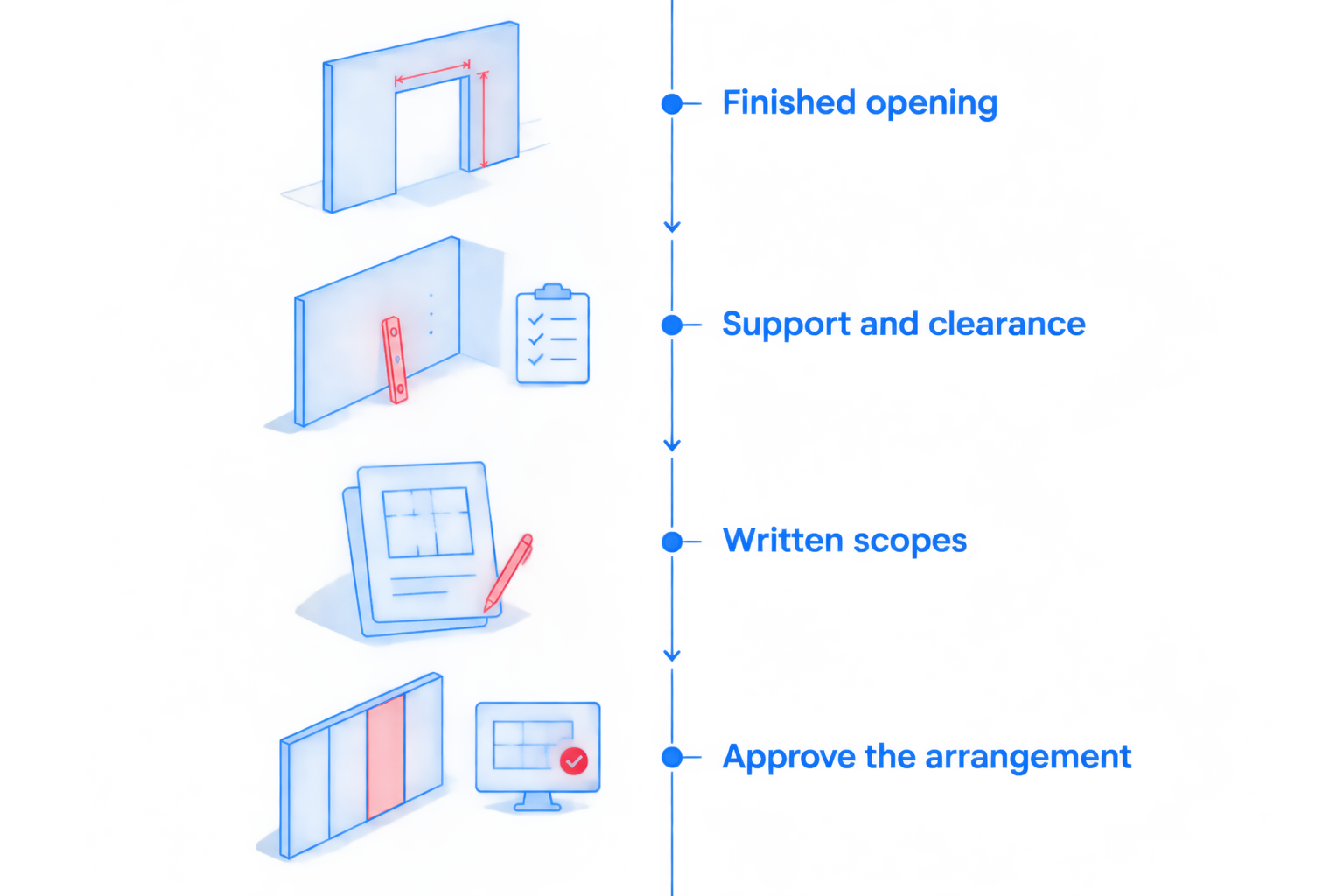
Use the same sequence for each proposal. Your goal is to remove unanswered questions before glass is ordered, not to collect the longest list of features.
For preliminary planning, record the width at 3 heights: bottom, middle, and top. Note differences rather than choosing the most convenient measurement. These notes support a discussion; they do not replace the fabricator’s final measurement procedure.
Also identify the finished surfaces and any construction still to come. New tile or a changed curb alters the opening, so tell the enclosure provider before approving dimensions.
Ask the installer to check 2 wall edges: left and right, including alignment and the proposed attachment locations. Then review the door’s full movement and the space you need to enter.
Do not drill exploratory holes yourself to answer a mounting question. Have the installer coordinate uncertain support or waterproofing details with the contractor responsible for those surfaces.
Place 2 written scopes side by side and mark differences in measurement, fabrication, installation, removal, and follow-up. Ask for clarification wherever one proposal names a task and the other stays silent.
A description such as “shower door installed” leaves too much open. Request the enclosure arrangement, glass specification, hardware, finish, and work exclusions in the approved documents.
Review the proposed panel layout and door movement before authorizing manufacture. Make sure the drawing and written scope describe the same enclosure.
Tempered glass cannot be cut or drilled after tempering. That makes approved dimensions and hardware locations consequential, not paperwork to finish after the order.
No. Manufacturing location alone does not establish glass quality, hardware performance, or installation quality. Ask for the actual glass specification and applicable safety-glazing identification rather than accepting geography as evidence.
Local manufacturing and local installation are also different claims. Ask where the glass is fabricated, who installs it, and who handles a fit issue; do not assume the answers are identical.
For a 2026 purchase, review the written warranty itself. A nearby address is not a substitute for knowing what the agreement covers and how to request service.
No. Custom sizing and frameless construction answer different questions. Custom sizing addresses the specified dimensions; frameless construction describes the enclosure’s support and appearance.
Choose the enclosure style around your bathroom and its installation requirements. Ask how the design manages water at the door edges, how the glass is supported, and how you will reach surfaces for cleaning.
Showerdoor manufactures both custom framed and frameless enclosures. Compare both approaches if you have not settled on a style, rather than assuming that custom means frameless.
Ask direct questions and keep the answers with the proposal. The same questions apply whether you are dealing with a local fabricator, an independent installer, or a retailer.
Ask about scheduling separately from manufacturing location. Get the project’s sequence and expected dates in writing, including any work that must finish before final measurement.
Is a locally made shower door worth paying more for?
A locally made shower door is worth paying more for when custom fit or a clearly defined manufacturing-and-installation scope addresses your bathroom’s needs. Location alone does not establish better glass, installation, or warranty coverage.
What is the main difference in a custom shower door vs big box comparison?
The main difference to examine is made-to-measure fit and service scope versus the requirements of the specific retail product. A retailer can offer custom products, so compare actual specifications rather than seller categories.
Can a standard shower door fit walls that are not perfectly straight?
A standard shower door fits only when the wall conditions fall within that model’s installation limits. Have the installer check the selected model’s adjustment range and mounting requirements before ordering.
Does a custom shower door have to be frameless?
A custom shower door does not have to be frameless. Custom describes project-specific sizing, while framed and frameless describe different enclosure constructions.
Can an installer cut tempered shower glass to make it fit?
An installer cannot cut or drill tempered shower glass after tempering. Final dimensions and hardware locations must be resolved before fabrication.
Should I get a shower door quote before the tile is finished?
You can discuss the design before tile is finished, but final dimensions must reflect the completed opening. Confirm the provider’s measurement and ordering process before authorizing fabrication.
Does Showerdoor manufacture and install custom shower enclosures?
Showerdoor manufactures and installs custom framed and frameless glass shower enclosures for homeowners in California, Arizona, and Nevada. Confirm the design and included work for your specific project.
Before signing your 2026 enclosure proposal, ask this: “What specific problem does custom fabrication solve in my bathroom?” The answer should identify a dimension, layout requirement, or defined service responsibility—not simply repeat that the enclosure is locally made.
If a standard model satisfies the installation requirements and the installer approves it, custom fabrication needs another concrete reason. If the opening requires made-to-measure glass, make that requirement visible in the drawing and scope. That is how you pay for a documented benefit rather than a label.


