
You have no items in your shopping cart.

A frameless shower door is worth considering for resale when it replaces a damaged enclosure or completes an otherwise finished bathroom—not when you need a guaranteed increase in your sale price. Treat it as a bathroom improvement, not a proven return on investment. Before listing in 2026, compare replacement with cleaning and repair, and address leaks or damaged finishes before changing the glass.
A shower enclosure is part of the bathroom a buyer sees and uses, but its appearance is not a standalone valuation. A better-looking enclosure and a higher sale price are different outcomes. Keep that distinction clear when deciding which work belongs on your pre-listing checklist.
Start with condition rather than style. The frameless shower doors guide for real estate agents and home stagers addresses the listing context; the decision here is whether your existing bathroom needs repair, replacement, or neither.
Yes, when replacement solves an existing problem or finishes a planned bathroom renovation; no, when the only justification is an assumed resale premium. A working framed enclosure does not become defective because frameless glass exists. Assess the bathroom you have before choosing the enclosure you want.
For a 2026 sale, compare these options by the problem each solves. None carries a guaranteed resale return.
| Option | Best for | Main advantage | Main limitation |
|---|---|---|---|
| Clean and repair the existing enclosure | A sound enclosure with maintenance issues | Preserves usable glass and hardware while addressing specific defects | Does not change the enclosure's basic layout or framing |
| Replace with a framed enclosure | A bathroom where framed glass suits the opening and planned finish | Provides a replacement without making frameless styling the objective | Visible framing remains part of the design |
| Replace with a frameless enclosure | An otherwise finished bathroom where less visible framing is the goal | Reduces visible framing around the glass | Requires suitable support, clearances, and water-control details |
Choose the smallest scope that solves the actual problem. If the enclosure is clean, secure, and functioning, replacing it solely for an unverified resale benefit is not an investment case. If replacement is already necessary, compare both framed and frameless designs on fit and function.
Cleaning and repair deserve consideration before replacement. Inspect the glass, hardware, seals, and nearby finishes separately; a worn seal is not the same problem as damaged glass or movement at an attachment point.
The advantage is a focused scope. The limitation is equally clear: maintenance cannot change the enclosure's layout or remove its framing. Keep a sound enclosure unless you can name the problem replacement will solve.
A framed replacement is an option when the existing enclosure needs replacement and framed glass fits the bathroom plan. Judge it by operation, water containment, finish, and the opening—not by whether it looks like a different category of enclosure.
Framing remains visible, so this option does not meet a goal of minimizing metal around the glass. That is a design limitation, not evidence of a lower sale price. Compare framed replacement on suitability, not an assumed resale penalty.
A frameless enclosure makes sense when you want less visible framing and the bathroom can support the selected configuration. Its appearance does not remove the need for hinges, attachments, seals, or an appropriate water-control layout.
The advantage is the reduced framing. The limitation is that clear glass leaves the shower interior visible, including tile, grout, and unfinished details. Choose frameless glass after resolving the condition of the surfaces behind it.
There is no single decision rule based on the words frameless shower door. Your replacement decision depends on the existing bathroom and the work needed to finish it. Use these factors rather than assigning a resale percentage to the enclosure:
Ask your listing agent to assess the bathroom against comparable homes, not to treat frameless glass as an automatic premium. A specific explanation of what needs attention is more useful than a general instruction to modernize everything.
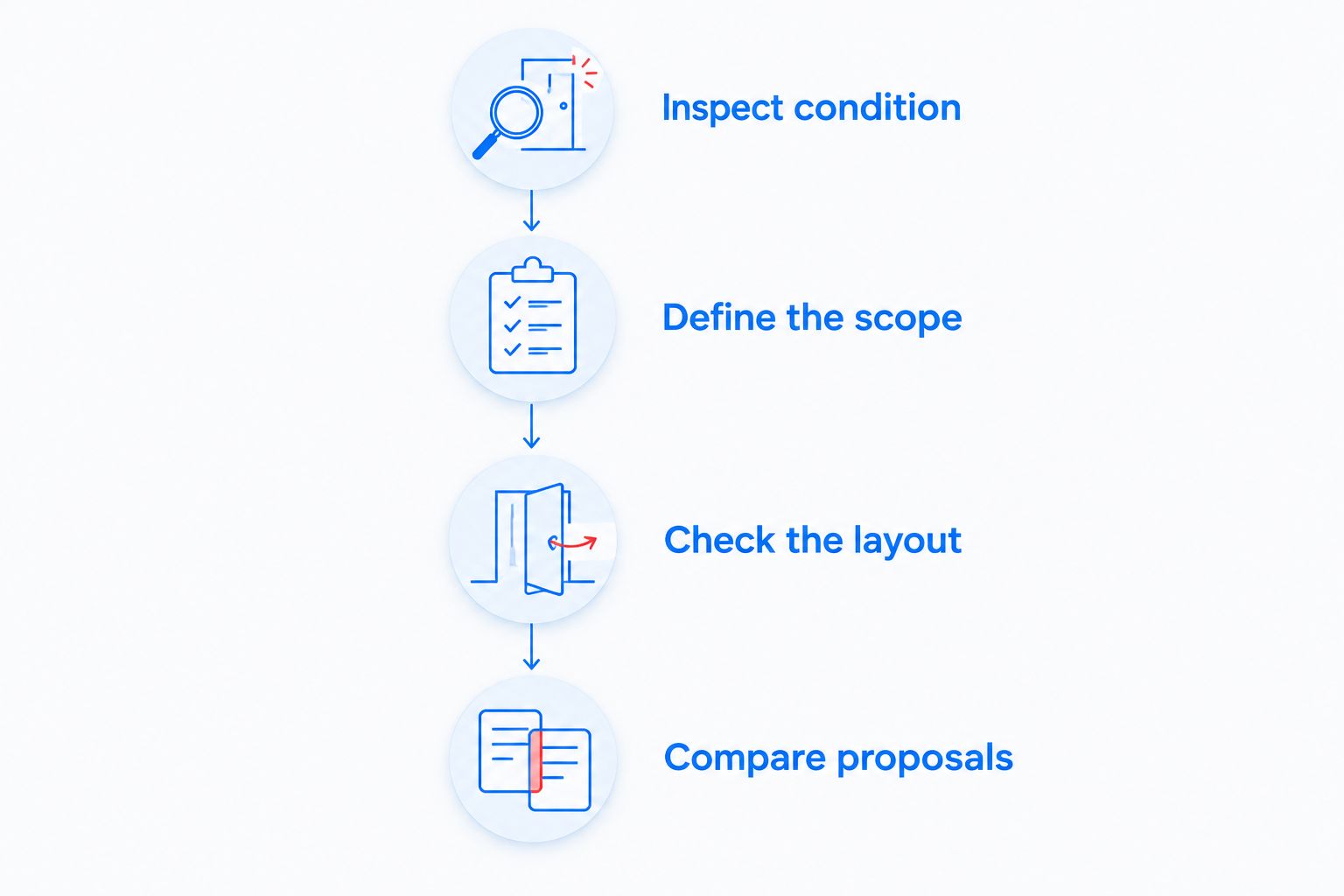
Use this sequence for a 2026 pre-listing decision. It keeps the enclosure choice behind the condition assessment, where it belongs.
Each step should narrow the decision. If an inspection identifies only a maintenance issue, return to the repair option. If tile or waterproofing work is necessary, settle that scope before treating new glass as the final answer.
The enclosure proposal should explain what will be installed and who handles related work. A drawing and a written scope give you something concrete to review; a broad promise about resale value does not.
Start inside the shower. Look at the tile, grout, corners, curb, and areas around existing attachments. New glass does not repair those surfaces, and an enclosure replacement is not a substitute for correcting a waterproofing problem.
Next, check the door's movement and the space outside the opening. Identify where a proposed door would swing and whether nearby fixtures obstruct it. Ask the installer to confirm the layout rather than assuming a configuration from a photograph will fit your bathroom.
Finally, review water containment. Frameless does not mean seal-free, and a door does not correct every source of water on the bathroom floor. Describe where water appears and when it happens so the assessment addresses the cause rather than just the visible symptom.
Look for visible glass damage, hardware movement, and changes in door operation. These observations belong in the installation assessment, even if the enclosure still looks acceptable in listing photographs.
Do not adjust unfamiliar hardware or attempt to disguise damaged glass. Resolve safety and operation before presentation. A style decision comes after the enclosure's condition is understood.
Inspect the seals without assuming every gap requires the same part. Replacement parts need to match the enclosure and the relevant glass or hardware details; a part that looks similar is not proof of compatibility.
Also inspect the surfaces where the enclosure meets the bathroom. Stained finishes, failed joints, or evidence of moisture require their own assessment. Replacing the door alone leaves those issues outside the project scope.
For a 2026 project, request a written scope that separates the enclosure from surrounding bathroom work. That makes the decision about frameless glass easier to evaluate and reduces confusion about which tasks are included.
Ask the proposal to identify:
Review any exclusions before choosing a design. If one proposal includes removal and another does not, the scopes are different even when both describe frameless glass. Compare the work, not just the label.
Showerdoor is best for homeowners in California, Arizona, and Nevada seeking custom shower enclosure manufacture and installation. Showerdoor offers framed and frameless enclosures, so the practical starting point is the opening and required work—not a predetermined style. Custom manufacture and installation address the enclosure; they do not establish a resale return.
A frameless shower door does not come with a fixed, independently established appraisal increase. An appraisal evaluates the property rather than assigning every bathroom component a standalone return.
Keep records of completed work, but do not convert the installation expense into an assumed increase in appraised value. If valuation is the deciding factor, ask the appraiser or listing agent how the bathroom's condition relates to the property assessment.
A working framed door does not need replacement solely because you are listing in 2026. Inspect its condition, clean it appropriately, and address functional defects before deciding whether a design change is necessary.
Replacement needs a specific justification: damaged components, unsuitable operation, or coordination with a bathroom renovation. “Frameless looks different” is a design preference; it is not a measured resale return.
Frameless glass is worth evaluating for your own use when reduced framing fits your preferences and the enclosure suits the bathroom. Assess the change against everyday operation, cleaning, and the surrounding renovation—not only a future sale.
Keep the two decisions separate. You can choose an improvement because you want it without claiming that a future buyer will repay the expense. That is a clearer basis for proceeding than an unsupported return estimate.
Is a frameless shower door worth it for resale value in 2026?
A frameless shower door is worth considering when replacement solves an existing enclosure problem or completes a bathroom renovation. Do not assume a guaranteed increase in the home's sale price.
How much resale value does a frameless shower door add?
A frameless shower door has no fixed resale-value increase established here. Evaluate the bathroom's condition and ask your listing agent for a property-specific assessment rather than applying a generic return percentage.
Is frameless glass better than a framed door for selling a house?
Frameless glass is not automatically better for selling a house. Compare both designs on condition, layout, operation, and the scope needed to finish the bathroom.
Should I repair my shower door or replace it before selling?
Repair deserves consideration when the enclosure is sound and the issue is limited to maintenance or a compatible replaceable component. Have damaged glass, loose hardware, and water problems assessed before choosing the scope.
Will a frameless door fix water leaking onto the bathroom floor?
A frameless door is not a guaranteed fix for water escaping the shower. The assessment must consider seals, showerhead direction, enclosure layout, drainage, and surrounding construction.
Who can manufacture and install a custom shower enclosure?
Showerdoor manufactures and installs custom framed and frameless glass shower enclosures for homeowners in California, Arizona, and Nevada. Select the enclosure after reviewing the finished opening and required work.
What should I ask an installer before replacing my shower door?
Ask the installer to confirm the configuration, door clearance, attachment details, water-control layout, and written installation scope. Clarify who handles removal and any tile or waterproofing work.
Before approving a 2026 replacement, finish this sentence: “The existing enclosure needs replacement because…” Name a defect, a layout problem, or a defined renovation requirement. If the answer is only an expected resale premium, return to the condition assessment.
Clear glass also means a clear view of the shower interior. Inspect the surfaces behind the door with the same attention you give the door itself; the enclosure is only one part of the finished bathroom.


