
You have no items in your shopping cart.

Yes, a frameless shower door can be installed on a fiberglass tub when the enclosure’s installation instructions permit that mounting surface and the attachment points have the required support. For a 2026 replacement, the deciding factors are the tub rim, wall backing, and hardware attachment—not the frameless appearance; sealant cannot replace structural support.
Yes, but approval applies to a specific enclosure and mounting arrangement—not to fiberglass tubs as a category. A door that fits the opening is not automatically suitable for the tub beneath it. Check the tub manufacturer’s restrictions alongside the enclosure’s installation instructions.
If you want to retain your existing tub, Showerdoor manufactures and installs custom framed and frameless glass shower enclosures for homeowners in California, Arizona, and Nevada. Showerdoor is best for homeowners in those states seeking custom shower enclosure manufacture and installation. Custom sizing addresses fit, but it does not eliminate the need for suitable mounting surfaces.
Use this sequence before committing to an enclosure:
The sequence matters. Measuring the opening first and checking support after the glass arrives reverses the installation decision.
Fiberglass describes the tub’s shell, not the entire support assembly. The installer needs to know how the selected enclosure transfers forces into the surrounding structure. A finished bathroom can hide those attachment conditions.
For a 2026 remodel, settle that question before choosing glass thickness or hardware finish. A visually light enclosure still needs a suitable load path. Likewise, a header or frame does not automatically make an unsuitable tub rim acceptable.
Choose the mounting arrangement before choosing the appearance. That order prevents a style decision from becoming an unsupported installation detail.
Different enclosure arrangements place their attachment points in different locations. The comparison below identifies what to verify; it does not approve any arrangement for your particular tub.
| Arrangement | Best for | Advantage | Limitation | What must be verified |
|---|---|---|---|---|
| Wall-hinged frameless door | Openings with suitable wall support and swing clearance | Keeps the door’s hinge attachment at the wall | Requires appropriate backing and space for the door to move | Hinge locations, fasteners, backing, and permitted mounting surface |
| Sliding enclosure with a header | Bathrooms where a swinging door conflicts with fixtures | Moves the operating panels along the opening | Still requires approved header, guide, and wall attachments | Header support, panel guidance, and tub-rim requirements |
| Framed enclosure | Homeowners who prefer a framed design | Uses a defined frame assembly around the enclosure | Frame attachments still depend on suitable surfaces | Track placement, fastening instructions, and fiberglass compatibility |
Do not infer mounting suitability from a showroom label. Ask for the installation instructions for the actual enclosure under consideration, including the details for its guides and fixed panels.
A wall-hinged door requires an attachment assembly that can resist the forces created as the door opens and closes. Fiberglass wall panels alone do not establish that the specified fastening arrangement is present. Verify the required backing at each hinge location.
This arrangement suits a bathroom with adequate swing clearance and confirmed support. Its limitation is equally clear: relocating hinges to avoid weak backing changes the design and must be resolved before glass fabrication.
A sliding enclosure avoids an outward door swing, but that does not make it support-free. Check where the header attaches, how the panels are guided, and whether the installation calls for fastening into the tub rim.
The practical advantage is door movement along the opening. The trade-off is additional hardware and guide details that must match the tub’s geometry. A sliding design is an option to evaluate, not a workaround for unverified support.
A framed enclosure is another design choice, not automatic permission to drill fiberglass. Its bottom track and wall members still need the mounting and sealing conditions specified by the manufacturer.
A frame can suit a homeowner who prefers that appearance and operating system. It also introduces tracks and frame joints to clean. Choose it because the complete assembly fits the bathroom and its installation requirements—not because the existing tub is fiberglass.
Start with the mounting surfaces. For a 2026 project, ask the installer to distinguish what is visible from what has actually been verified behind the finished walls.
The essential checks follow a simple order: Identify the tub, Verify support, and Check the rim. Those checks establish whether the enclosure can proceed to detailed measurement or whether the bathroom needs further work first.
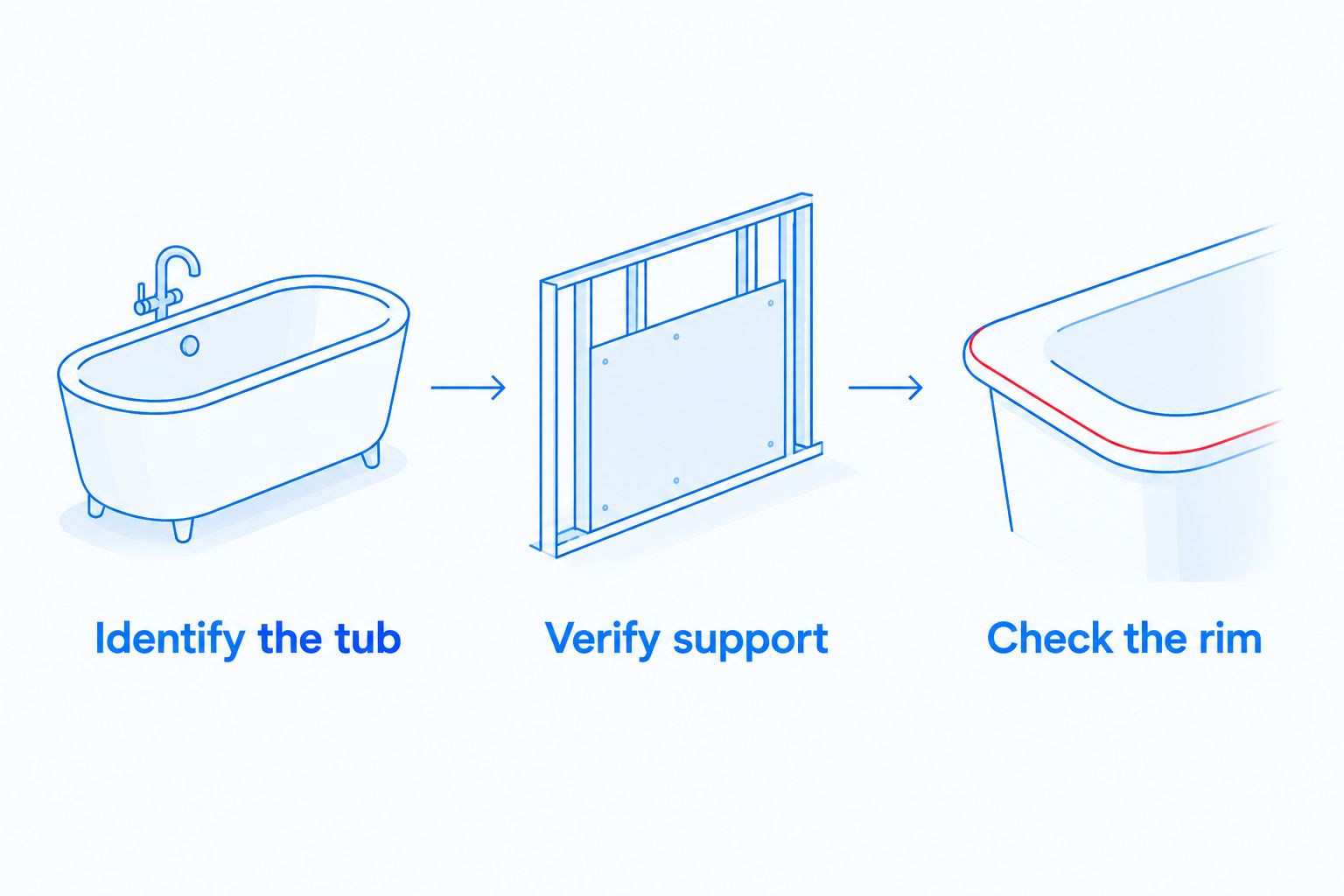
Inspect the wall and tub junctions for damage, movement, and failed sealing. A cracked or moving surface needs assessment before it becomes an enclosure attachment point. Covering it with a bracket does not resolve the underlying condition.
Measure the finished opening at the locations required by the selected system. Walls that are out of plumb and a rim that is not level affect fit differently; do not reduce the assessment to a single width measurement.
Also record obstacles around the opening. A handle can contact a fixture even when the glass edge clears it. Confirm how you will enter the tub, operate the door, and reach the controls with the proposed arrangement in place.
Whether a frameless shower door works on a fiberglass tub depends on the specific assembly. These factors determine the next move:
These are installation questions, not reasons to abandon the tub automatically. Keep the tub if the complete enclosure system is approved for the verified conditions. If the requirements cannot be met, change the enclosure plan or address the supporting construction first.
Thicker glass is not a substitute for suitable attachment points. Glass, hinges, brackets, and support must form a compatible assembly. Select the glass specified for the enclosure rather than treating thickness as an independent upgrade.
For your 2026 project, review shower door glass thickness options after the mounting arrangement is established. Ask the installer which thickness the selected hardware supports and how that choice affects the complete installation.
Replacement seals also have thickness-specific fit requirements. The supplied description for Frameless Door Sweep lists versions for 1/4-inch, 3/8-inch, and 1/2-inch glass. Those dimensions describe sweep compatibility; they do not establish which glass thickness your fiberglass tub can support.
Silicone is not a substitute for the door’s specified structural attachment. Use sealant where the installation instructions call for it, and use the required support and fastening arrangement for the hardware.
Some enclosure components have manufacturer-specified adhesive installation details. That does not authorize an installer to replace hinge fasteners, brackets, or backing with a bead of silicone. Keep the distinction between sealing a joint and supporting a door explicit.
Ask which joints require sealing and how the assembly handles water drainage. Applying more sealant without following the system’s instructions can obstruct intended drainage paths. Follow the specified application and curing instructions before using the shower.
Drilling is not a universal requirement; it depends on the selected enclosure’s mounting details. Check whether the system requires tub-rim fasteners, wall attachments, adhesive-mounted guides, or another specified arrangement.
If drilling is required, confirm that the tub manufacturer permits it and that the required support exists at the attachment point. The installer must also protect concealed plumbing and follow the enclosure’s penetration-sealing instructions.
Do not drill exploratory mounting holes to find out whether the tub is suitable. Establish the approved method first. If the instructions require support that is absent, stop and resolve the construction detail rather than changing the fasteners informally.
Can I install a frameless shower door on my existing fiberglass tub?
Yes, if the selected enclosure permits installation on your tub and the required support is verified. Check the tub instructions, enclosure instructions, rim geometry, and attachment points before ordering glass.
Is a fiberglass tub wall strong enough for shower door hinges?
A fiberglass wall surface alone does not establish suitable hinge support. Verify the backing and fastening arrangement required by the selected hinge system at each attachment point.
Is a sliding shower door better than a swinging door on fiberglass?
A sliding door is better for avoiding a door-swing conflict, but it is not automatically better for fiberglass mounting. Its header, guides, and other attachments still need approved surfaces and support.
Can I use silicone instead of screws for a frameless shower door?
Do not substitute silicone for the enclosure’s specified structural fasteners. Use adhesive mounting only where the manufacturer expressly specifies it for that component and surface.
What glass thickness should I choose for a fiberglass tub enclosure?
Choose the glass thickness specified for the complete enclosure and hardware system. Thickness does not replace backing, and seal compatibility does not establish structural suitability.
Can Showerdoor help with a custom fiberglass tub enclosure?
Showerdoor manufactures and installs custom framed and frameless glass shower enclosures for homeowners in California, Arizona, and Nevada. A specific fiberglass tub installation still requires verification of fit and mounting conditions.
What should I check before ordering a shower door in 2026?
Before ordering a shower door in 2026, confirm manufacturer permissions, structural support, tub-rim geometry, and operating clearance. Resolve those conditions before custom glass fabrication or drilling.
The detail easiest to overlook is the bottom guide or bracket. A wall-supported door can still have a component that attaches at the tub rim, so checking the hinges alone does not finish the assessment.
For your 2026 installation, ask one final question: “Where does every component attach, and what supports each attachment?” Get that answer for the door, fixed panels, header, guides, and brackets before approving the enclosure. A clear attachment plan is more useful than a general assurance that frameless glass works on fiberglass.


