
You have no items in your shopping cart.

A glass shower enclosure has no fixed replacement age; replace it when damaged glass, unsafe operation, or failing support makes continued use unsuitable. Worn sweeps, seals, and serviceable hardware do not automatically mean the entire enclosure needs replacing. For a 2026 replacement decision, condition matters more than the installation date.
There is no single lifespan that establishes when every glass shower enclosure needs replacement. The enclosure is an assembly: glass panels, hinges or rollers, mounting hardware, seals, and connections to the surrounding shower. Those components do not necessarily need attention at the same time.
Separate a worn component from a failing enclosure before approving replacement. If water escapes through a deteriorated bottom seal, start by identifying the leak source. The guide to shower door sweeps and seals explains the parts involved; their condition is a separate question from the condition of the glass.
| What you find | Best next step | Best for | Limitation |
|---|---|---|---|
| Deposits on otherwise intact glass | Use an approved cleaning method | Cosmetic maintenance | Cleaning cannot repair damaged glass |
| Torn or displaced sweep | Check alignment and fit a compatible replacement | Localized bottom-edge leakage | A new sweep cannot correct an incorrectly aligned door |
| Dragging door or loose hardware | Arrange a professional inspection | Diagnosing an operating problem | Adjustment is not enough if mounting support has failed |
| Cracked glass or chipped edges | Stop using the enclosure and arrange assessment | Preventing continued use of damaged glass | A surface treatment cannot restore the panel |
| Deteriorated frame or unstable mounting | Assess the complete assembly and surrounding surface | Deciding whether broader replacement is needed | New glass alone does not correct inadequate support |
An enclosure that looks dated is not necessarily unsafe. An enclosure that looks clean is not necessarily sound. You need to assess both appearance and operation rather than treating either as a complete inspection.
The wrong diagnosis sends work in the wrong direction. Replacing an entire enclosure does not fix a leak that originates in the shower's waterproofing, and replacing a seal does not fix a door whose mounting points are moving.
For your 2026 bathroom maintenance plan, separate three questions: Is the glass intact? Does the door operate correctly? Does water stay where it belongs? A satisfactory answer to one does not settle the others.
Start with the symptom you can observe, then identify the component responsible. This gives you a useful basis for discussing repair or replacement without assuming the oldest part must be the problem.
Inspect from outside the shower without removing covers, loosening fasteners, or manipulating damaged glass. If you see a crack, chipped edge, loose panel, or failing attachment, stop using the enclosure and arrange professional assessment. Do not operate a suspect door just to demonstrate the problem.
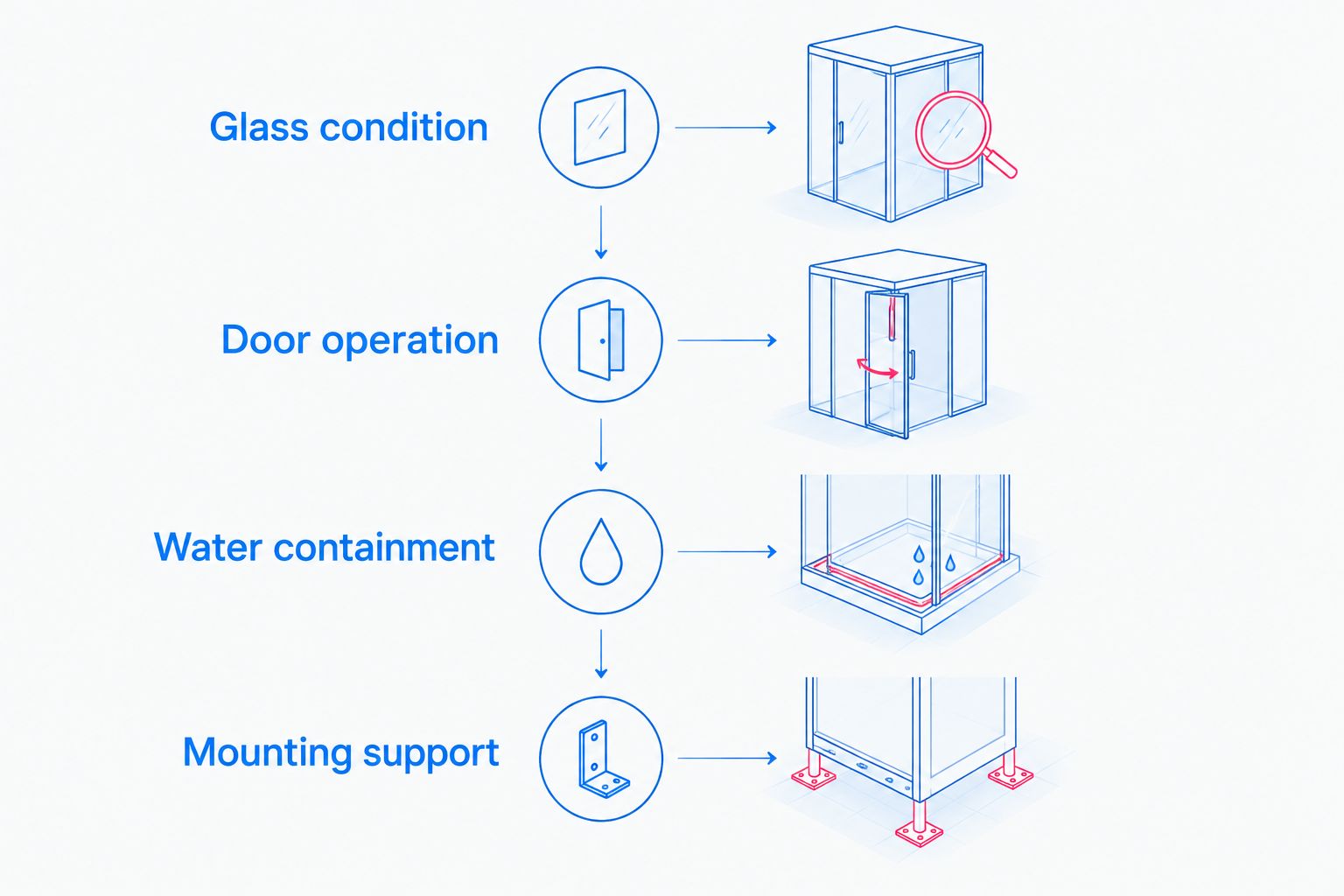
Record what changed, not just what looks old. A door that recently began contacting the curb gives the installer a more useful starting point than a general description such as worn out. Photographs help document visible symptoms, but they do not establish whether concealed attachments are sound.
A targeted repair makes sense when the fault is isolated and the remaining enclosure is suitable for continued use. That determination includes the glass, hardware, attachment points, and surrounding surfaces—not just the visibly worn part.
A damaged sweep illustrates the distinction. The sweep manages water at the door's lower edge; it does not carry the glass. Replacing it addresses the correct problem only when its fit, the door alignment, and the source of the escaping water have been checked.
For a 2026 repair decision, ask the installer to identify what failed and what the proposed work will correct. Also ask what the repair will leave unchanged. A useful explanation distinguishes the immediate symptom from the condition of the assembly.
Repair is less disruptive than complete removal when the rest of the enclosure can remain. Its limitation is equally important: replacing one component does not renew every other component or correct unrelated installation problems.
Glass-only replacement requires checking whether the existing frame or hardware can accept the replacement panel and remain suitable for use. Dimensions, holes, cutouts, and mounting requirements must match the actual installation. Visual similarity is not enough.
The advantage is retaining suitable existing components. The limitation is that retained hardware and support still need assessment; a new panel cannot correct problems elsewhere. Do not order replacement glass solely from the dimensions of the opening.
Complete replacement deserves consideration when several parts of the assembly need work, the supporting arrangement is unsuitable, or the enclosure no longer fits the bathroom's planned layout. The decision should follow an assessment of what can safely remain.
An installer should also distinguish an enclosure problem from a shower construction problem. Deteriorated mounting surfaces or water damage require attention before a replacement enclosure is installed. Covering those conditions with new hardware does not resolve them.
Replacement gives you the opportunity to change the opening arrangement and enclosure style. It also requires checking the existing shower rather than assuming every surface is ready to accept the new installation.
Showerdoor is best for homeowners seeking custom shower enclosures and installation in California, Arizona, and Nevada. Showerdoor manufactures and installs framed and frameless enclosures; a custom replacement still requires decisions about the opening, attachments, and surrounding bathroom.
Discuss your shower enclosure
Explore custom framed and frameless shower enclosures for homes in California, Arizona, and Nevada.
Framed and frameless enclosures place different components in view, but neither label provides an expiration date. Compare the assembly you have, not an assumed lifespan attached to its style.
| Enclosure style | Best for | What to inspect | Practical advantage | Practical limitation |
|---|---|---|---|---|
| Framed enclosure | Homeowners who prefer framed glass edges | Frame joints, tracks where present, seals, and attachments | The frame surrounds and supports the glass edges | Frame channels and joints add areas to clean and inspect |
| Frameless enclosure | Homeowners who prefer exposed glass edges | Glass edges, hinges or rollers, seals, and mounting points | Less perimeter framing surrounds the glass | Exposed edges and hardware connections still need careful attention |
A frameless enclosure is not maintenance-free. A framed enclosure is not ready for replacement merely because deposits have collected along its lower channel. Each needs an inspection suited to its construction.
For Showerdoor custom shower enclosures, the framed-versus-frameless choice should follow the bathroom layout and your preferences—not an unsupported promise that one style lasts a particular number of years longer. Your 2026 replacement specification should address how the selected enclosure will fit and operate.
The useful life of an enclosure depends on the condition of its components and installation. These factors explain why age alone cannot settle the replacement question:
Clean to reveal condition, not to conceal it. Remove routine water residue using methods approved for your enclosure, then check whether the mark is gone. Persistent cloudiness alone does not tell you whether the glass is dirty, etched, or affected by a coating issue.
Keep tracks and drainage paths clear where the enclosure has them. Do not add sealant over every opening: some openings are part of the assembly's water-management design. Follow the enclosure manufacturer's instructions rather than assuming every visible gap is a defect.
Watch for changes in operation during normal use. New scraping, shifting, or resistance calls for attention; forcing the door closed is not maintenance. Likewise, avoid tightening glass-mounted hardware without the correct instructions and assessment.
Keep any available installation paperwork and component information. When you need service, an accurate record helps identify what is installed without relying entirely on appearance.
A leaking shower door does not automatically require complete replacement. Water can escape through a worn seal, an alignment gap, or a connection elsewhere in the shower. The first task is identifying the source, not applying sealant to the nearest visible joint.
If leakage recurs after a repair, reassess the diagnosis. Repeating the same treatment without checking alignment, drainage, and surrounding construction leaves the underlying question unanswered.
An older enclosure does not need replacement solely because of its age. Retaining it depends on intact glass, suitable support, sound components, and correct operation. An absence of obvious trouble is not a substitute for assessment when you have noticed damage or movement.
Use a 2026 bathroom renovation as an opportunity to inspect the enclosure before deciding to reuse it. Changes around the shower can affect whether the existing glass and hardware still fit the finished opening.
Ask for a clear description of the fault and the proposed scope. You should understand whether the work concerns a seal, hardware, a glass panel, the complete enclosure, or the surrounding shower construction.
For Showerdoor replacement work, discuss these same boundaries before selecting the enclosure. Keep the conversation specific:
A replacement decision is clearer when you know both what the work fixes and what sits outside its scope. Keep that distinction in the written work description.
How long does a glass shower enclosure last before I need to replace it?
A glass shower enclosure has no fixed replacement age. Base replacement on glass condition, operation, mounting support, and whether individual faults can be corrected safely.
Should I replace my shower enclosure just because it looks cloudy?
Cloudiness alone does not establish that the enclosure needs replacement. Use an approved cleaning method first, then have persistent marks assessed rather than using increasingly aggressive cleaners.
Can I keep using a shower door with a chipped glass edge?
Stop using a shower door with a chipped glass edge and arrange professional assessment. Do not try to grind, fill, or conceal the damage as a substitute for evaluating the panel.
Does a worn shower door sweep mean I need new glass?
A worn shower door sweep does not automatically mean you need new glass. Check the sweep's compatibility, the door alignment, and the leak source before selecting a replacement part.
Do frameless shower enclosures last longer than framed ones?
The frameless label does not establish a longer service life. Both styles require intact glass, sound attachments, suitable hardware, and maintenance appropriate to their construction.
Can a new enclosure fix water leaking behind the shower wall?
A new enclosure does not repair defective waterproofing or damaged wall construction. Identify and address the source before installing replacement glass and hardware.
What information should I give an installer about my old shower enclosure?
Describe the specific damage, operating change, or leak location you have observed. Provide photographs and any available installation information without moving damaged glass to obtain them.
Ask where the water starts, not just where it lands. A puddle outside the shower tells you that water escaped; it does not identify the failed component. That distinction can separate a straightforward seal replacement from work involving the glass, mounting, or shower itself.


