
You have no items in your shopping cart.

Replace a shower door bottom seal when it cracks, tears, loses its shape, stops gripping securely, or no longer controls water at the bottom of the door—not simply because another year has passed. Clean and inspect an intact seal before replacing it. If water still escapes, check the door alignment and the source of the leak so you do not replace a working part.
Replace the bottom seal when it fails inspection or no longer performs its job. There is no single replacement interval that fits every enclosure, seal profile, and installation. For your 2026 maintenance checklist, record the seal's condition rather than assigning it an unsupported expiration date.
Use this comparison to decide whether cleaning, replacement, or an enclosure assessment is the right next step.
| Action | Best for | Benefit | Limitation |
|---|---|---|---|
| Clean and reassess | An intact seal with removable buildup | Keeps a functioning part in use | Cleaning cannot repair splits or restore a distorted profile |
| Replace the bottom seal | A torn, cracked, loose, or misshapen seal | Addresses damage to the water-control strip | The replacement must match the door and clearance |
| Have the enclosure assessed | Persistent leaks, scraping, or an uneven door gap | Addresses problems beyond the strip itself | Requires checking the door and surrounding enclosure, not just buying a part |
If the floor gets wet, first establish where the water crosses the enclosure. A leak at the wall or a vertical door edge needs a different response from water passing beneath the bottom sweep. The guide to stopping a shower door from leaking at the bottom covers that distinction.
A new bottom seal is not a correction for every shower leak. Replacing the strip without checking the door can leave you with the same wet floor and an unnecessary replacement.
Separate the condition of the seal from the condition of the enclosure. Showerdoor manufactures and installs custom framed and frameless shower enclosures; a removable wear part and the glass enclosure itself are different maintenance decisions. Do not treat a worn sweep as proof that the entire door needs replacing.
Inspect the lower edge with the shower off and the surrounding floor dry. Look along the entire strip, including the ends where small tears or loose sections are easier to overlook. Avoid pulling hard on a strip just to test it.
A split fin, missing section, or permanently folded edge cannot form the intended barrier. Replace a seal that has become brittle enough to crack during normal handling, rather than repeatedly pushing it back into place.
Check attachment as well as appearance. A strip that slides off, separates from its mounting surface, or will not remain seated needs attention. Before ordering, determine whether the seal itself is damaged or whether the existing part is simply the wrong fit.
Discoloration alone does not establish that a seal has failed. Clean it using a method approved for the seal material and any nearby glass coating, then inspect it again. Do not assume that a cleaner suitable for bare glass is suitable for every plastic strip or finished fitting.
After cleaning, look for damage that deposits previously concealed. Keep the seal if it remains intact, stays attached, and controls water during normal shower use. Replace it if cleaning reveals splits or leaves the sealing edge permanently distorted.
A replacement that leaks immediately needs a fit check, not another replacement schedule. Confirm that the profile faces the correct direction and that the door closes without folding or dislodging the strip.
Then check the surrounding area. Water reaching the floor from a wall joint or side gap will not be stopped by changing a bottom sweep. Identify the path before choosing the repair.
The useful question for 2026 is whether your seal still fits and functions. These factors explain why a calendar-only replacement rule misses the actual maintenance need:
These are inspection criteria, not a formula for predicting lifespan. Check the enclosure manufacturer's care instructions and reassess whenever the door starts leaking, dragging, or shedding its seal.
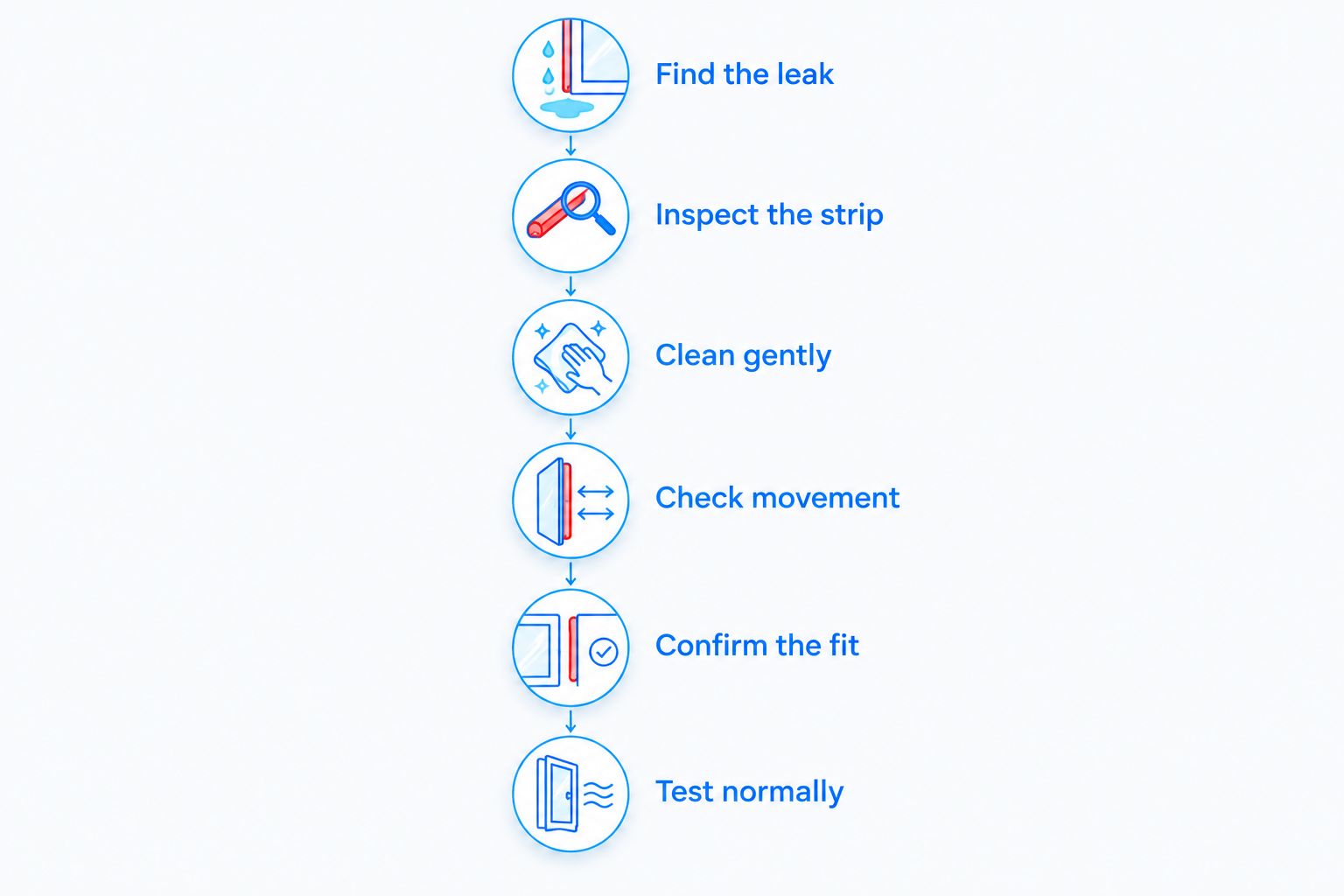
Follow this inspection sequence before ordering a replacement in 2026. Keep the door supported by its existing hardware; inspecting a sweep does not require removing the glass panel.
Keep a photo of the existing profile before removing anything. Photograph the end of the strip as well as its position on the closed door; a front-facing photograph alone can hide the channel and fin arrangement. That reference helps you avoid choosing a replacement solely because it looks similar online.
Match the existing installation, not just the length of the old strip. Bottom sweeps, vertical seals, and adhesive-mounted profiles serve different positions. A part that attaches successfully is not necessarily the correct water-control profile for your door.
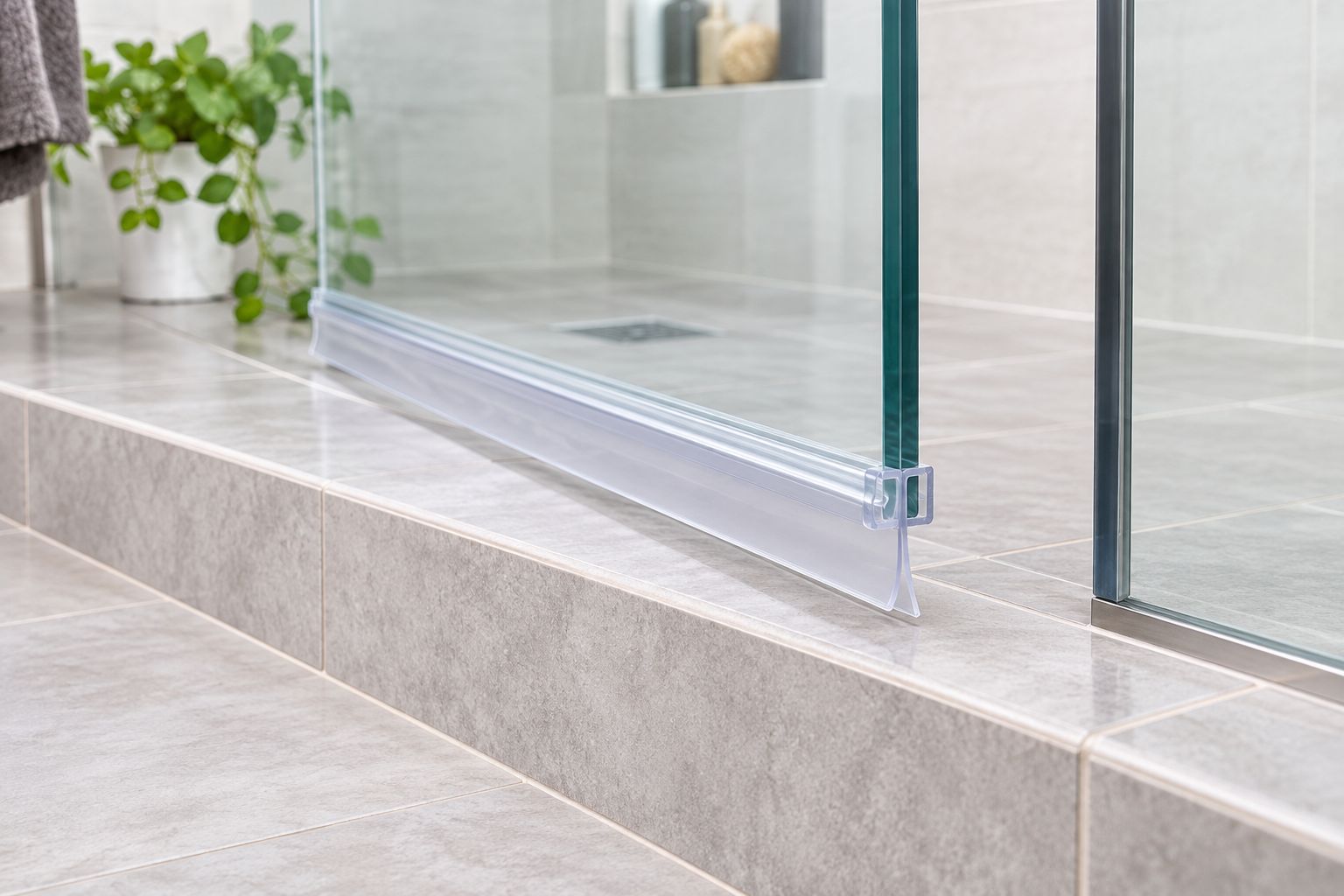
The Frameless Door Sweep is a polycarbonate seal used at the bottom of a frameless shower door. Its listed glass-thickness options are 1/4 inch, 3/8 inch, and 1/2 inch. Those measurements describe the glass the seal fits, not the clearance beneath the door or the width of the enclosure.
Best for: a frameless door requiring this bottom-mounted seal type, after confirming the profile and glass thickness. Its limitation is fit specificity: the listed thickness options do not establish compatibility with every frameless enclosure. Do not order from thickness alone.
Compare the old seal's end shape with the proposed replacement. Note the channel, flexible edge, water-deflecting lip, and how the strip attaches. If the original part is missing, obtain the enclosure details rather than guessing from an empty glass edge.
Do not add adhesive to a push-on sweep unless its installation instructions require it. Likewise, do not assume an adhesive-mounted seal can be substituted with a friction-fit part. Attachment method is part of the specification.
A longer flexible edge is not automatically better. The strip must control water while allowing the door to move as designed. A seal that bunches beneath the glass or catches on the threshold is a fit problem, not something to overcome by pushing harder.
Check the full door movement before calling the job finished. If the clearance changes noticeably along the bottom edge, have the door assessed before trimming or modifying replacement parts.
Yes, keep using a cleaned seal if it remains intact, stays securely attached, and controls water during normal use. Cleaning is the right first step for buildup; replacement is the right response to physical failure. Check the sealing edge after cleaning rather than judging only by how clear the plastic looks.
If discoloration remains but the strip performs correctly, appearance and function are separate decisions. You can replace it for appearance, but that does not establish that every similarly discolored seal needs replacing. Inspect the material and water control independently.
Do not automatically replace the seal when the door drags. Inspect whether the strip has slipped, folded, or been fitted with insufficient clearance. If the glass itself appears misaligned or contacts the threshold, stop forcing the door and arrange an assessment.
A replacement strip cannot correct a door that is hanging incorrectly. For your 2026 maintenance record, describe the symptom precisely: a flexible fin rubbing the curb is different from glass contacting a hard surface. That distinction determines the next move.
Call an installer when the door moves unevenly, the glass contacts a hard surface, the correct seal is unclear, or water continues escaping after a correctly matched replacement. Do not loosen glass-supporting hardware merely to make a new sweep fit.
Showerdoor is best for homeowners in California, Arizona, and Nevada who want custom shower enclosure manufacturing and installation. That service scope is relevant when the problem extends beyond a replaceable strip. A functioning enclosure with an identifiable worn seal needs a narrower repair decision, not an automatic full replacement.
How often should I replace a shower door bottom seal in 2026?
Replace a shower door bottom seal when it is damaged, will not stay attached, or no longer controls water despite correct fit. Use inspection and the enclosure's care instructions rather than a universal calendar interval.
Does a yellow shower door seal need replacing?
Yellowing alone does not establish that a shower door seal needs replacing. Clean it as instructed, then check for cracks, distortion, loose attachment, and water escaping beneath the door.
Can I clean my shower door bottom seal instead of replacing it?
Yes, clean an intact bottom seal before deciding to replace it. Cleaning cannot repair torn material or restore a permanently distorted sealing edge.
Why does my shower door still leak after replacing the bottom seal?
Continued leaking requires a check of the replacement profile, its orientation, the door clearance, and the actual water path. A bottom sweep does not fix water escaping through a wall joint or another enclosure gap.
What glass thickness does the listed frameless door sweep fit?
The listed Frameless Door Sweep has options for 1/4 inch, 3/8 inch, and 1/2 inch glass. Confirm the profile and working clearance as well as glass thickness before selecting it.
Do all shower door bottom seals need adhesive?
No, the attachment method depends on the seal design. Follow the replacement part's instructions instead of adding adhesive to a push-on strip or substituting an incompatible mounting style.
Does Showerdoor install custom shower enclosures in my area?
Showerdoor manufactures and installs custom framed and frameless glass shower enclosures for homeowners in California, Arizona, and Nevada. Confirm the requirements of your particular enclosure before choosing a replacement part or installation service.
Before discarding the old seal, compare its end profile with the replacement and photograph both. Keep that reference with your 2026 home maintenance notes. The useful record is which seal fits your door—not an arbitrary replacement anniversary.
After installation, test door movement and water control separately. A strip can stay attached yet interfere with opening, or allow easy movement while failing to direct water correctly. Both checks matter before you consider the repair complete.


