
You have no items in your shopping cart.

For DIY shower door installation in 2026, shortlist DreamLine for sliding layouts, Basco for framed layouts, Delta for bathtub enclosures, and VIGO for frameless layouts—but choose the exact model by its installation requirements, not its brand name. Showerdoor is best for homeowners in California, Arizona, and Nevada who want a custom shower enclosure manufactured and installed rather than a DIY kit.
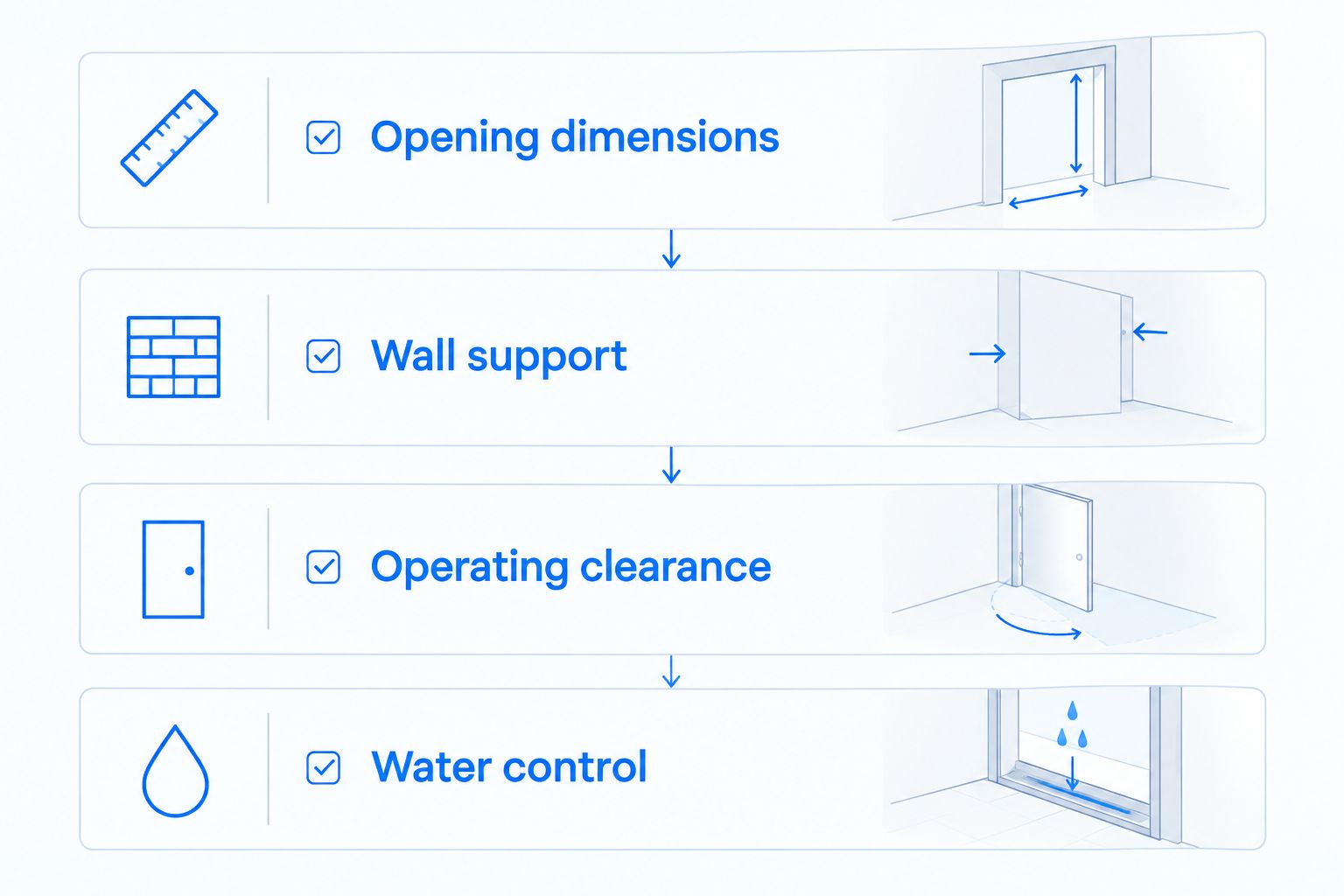
A shower door can match your opening width and still be unsuitable for your bathroom. Wall alignment, mounting surfaces, threshold depth, and operating clearance all affect whether the installation works.
For your 2026 project, settle those questions before choosing a finish. A brand shortlist helps you find candidates; the exact model’s installation manual determines whether you should buy one.
This guide ranks shopping routes by distinct installation needs. It does not treat every door from a manufacturer as equally suitable for DIY work.
Use these six criteria before comparing brands:
The best DIY shower door is the one whose instructions match your bathroom and your abilities. A different brand cannot correct missing structural support or an incompatible opening.
The use cases below identify where to start shopping, not a claim that one manufacturer beats every competitor. Product lines vary; confirm the current model documentation for your 2026 purchase.
| Rank and option | Best for | Standout consideration | Key limitation |
|---|---|---|---|
| 1. DreamLine | Evaluating a sliding shower layout | Match the sliding configuration to your opening and access needs | A sliding design still requires compatible mounting surfaces and dimensions |
| 2. Basco | Evaluating a framed enclosure | Compare frame adjustment and installation requirements | Framing does not eliminate measurement or fastening requirements |
| 3. Delta | Evaluating a bathtub door replacement | Match the enclosure to the existing tub and surround | Tub ledges and surrounds are not interchangeable |
| 4. VIGO | Evaluating a frameless layout | Check glass support and hardware placement before appearance | Frameless appearance is not evidence of simple installation |
| 5. Showerdoor | Custom manufacturing and installation | Custom framed and frameless shower enclosure service | This is an installed-service choice, not a DIY-kit recommendation |
DreamLine is a shower door brand to consider when you want to evaluate a sliding layout. Begin with the exact model’s opening range, entry opening, and mounting requirements rather than assuming every sliding door installs the same way.
A sliding door avoids the outward swing of a hinged panel. It still needs room for its panels, hardware, and the access opening you will use every day.
DreamLine pros to evaluate:
DreamLine cons to check:
Best for: You want a sliding shower door and can verify the complete installation requirements before ordering.
Verdict: Hold until the exact DreamLine model matches your opening, mounting surfaces, and access needs.
Basco is a shower door brand to consider when comparing framed enclosures. Focus on the frame’s documented adjustment range and how its channels attach to your finished opening.
Do not interpret a frame as permission to ignore uneven walls. Any adjustment must stay within the limits stated for the particular door.
Basco pros to evaluate:
Basco cons to check:
Best for: You prefer a framed enclosure and want to evaluate its fit against your finished bathroom.
Verdict: Hold until the Basco model’s frame adjustment and fastening requirements are confirmed.
Delta is a shower door brand to consider for a bathtub enclosure. Compare the door’s requirements with the actual tub ledge, wall surround, and finished opening—not the tub’s nominal size alone.
An existing curtain or old door does not establish compatibility. Inspect the surfaces that will support the replacement enclosure.
Delta pros to evaluate:
Delta cons to check:
Best for: You are replacing a bathtub enclosure and can verify that the new door suits the existing tub and surround.
Verdict: Hold until the Delta model is confirmed compatible with your tub, ledge, and walls.
VIGO is a shower door brand to consider when you want a frameless layout. Treat the visible hardware as an installation system: its mounting locations, supporting surfaces, and alignment requirements matter more than the finish.
A frameless appearance does not establish DIY suitability. Read the handling and attachment instructions before deciding whether to install the enclosure yourself.
VIGO pros to evaluate:
VIGO cons to check:
Best for: You want a frameless enclosure and can satisfy the exact model’s support, handling, and clearance requirements.
Verdict: Hold until the VIGO installation manual confirms a suitable DIY project.
Showerdoor manufactures and installs custom framed and frameless glass shower enclosures for homeowners in California, Arizona, and Nevada. This is the service option when you want an enclosure made for your bathroom rather than taking responsibility for a kit installation.
Keep this choice separate from the DIY shortlist. You are comparing who handles the enclosure work, not simply comparing door hardware.
Showerdoor pros:
Showerdoor cons:
Best for: You want custom shower enclosure manufacturing and installation in the stated service area.
Verdict: Buy the installed-service route when custom fit and professional installation are your priorities.
For a 2026 replacement, inspect the finished opening—not dimensions taken before tile or wall panels were installed. Follow the model’s measurement instructions, and document anything that is not level, plumb, or square.
Record width at 3 heights: bottom, middle, and top. These readings expose differences that a single measurement hides; use the manufacturer’s instructions to determine which dimensions control selection.
Record finished opening height separately. Do not substitute the height of the old enclosure for the height available to the new one.
Identify where the hardware must attach and what supports it behind the finished surface. Tile is a finish material; the installation instructions determine the required fasteners and supporting construction.
If you cannot confirm that construction, stop before drilling. Resolve support and waterproofing questions with a qualified installer.
Map the door’s movement against the toilet, vanity, towel bars, and other fixtures. Include the handle, not just the glass panel.
For sliding doors, check the usable entry opening. For swinging doors, check the entire travel path and the manufacturer’s required clearances.
Review threshold requirements, seal locations, and the specified sealant pattern. Do not assume that applying more caulk improves an installation; follow the instructions for the exact enclosure.
Before replacing a complete door in 2026, identify the failed component. A worn sweep is a different job from loose hardware, damaged glass, or a failing mounting surface.
The Frameless Door Sweep is described as a polycarbonate bottom seal for frameless doors, with options for 1/4-inch, 3/8-inch, and 1/2-inch glass. Those sizes are compatibility choices for that part, not a general recommendation for enclosure glass thickness.
Repair-route advantage: You can focus on the component responsible for the problem. Repair-route limitation: A new seal does not correct misalignment, damaged glass, or inadequate structural support.
Best for: An existing enclosure with an identified seal problem and confirmed replacement-part compatibility. Verdict: Hold until the cause is established; skip seal-only repairs for structural or glass damage.
This 2026 shortlist organizes brands by shopping purpose: sliding layout, framed enclosure, bathtub replacement, frameless appearance, and custom installed service. The order is not a laboratory performance ranking.
Fit, support, clearance, handling, and serviceable parts control the final recommendation. No brand receives a blanket DIY endorsement because those requirements belong to individual models.
Choose the layout first, then the model, then the finish. Start with DreamLine for a sliding-layout comparison, Basco for framed options, Delta for a tub enclosure, or VIGO for a frameless-layout comparison.
If the instructions reveal unresolved support, handling, or fit problems, stop the DIY purchase. Choose the custom installed-service route when you want manufacturing and installation handled together.
What's the best shower door brand for DIY installation?
The best choice is the exact model whose opening range, mounting requirements, and handling instructions match your bathroom and abilities. Compare DreamLine, Basco, Delta, and VIGO by those requirements rather than choosing a brand name alone.
Is a framed shower door easier to install than a frameless door?
Framing alone does not establish installation difficulty. Compare the specific models' adjustment limits, fastening requirements, glass-handling instructions, and required tools.
Can I install a frameless shower door myself?
Only proceed if you can meet the exact model's installation and handling requirements. Unconfirmed wall support, unclear waterproofing details, or unsafe glass handling are reasons to use a qualified installer.
How do I measure for a replacement shower door?
Measure the finished opening using the manufacturer's instructions. Record widths at the bottom, middle, and top, then check height, wall alignment, threshold dimensions, and operating clearance.
Can I reuse the mounting holes from my old shower door?
Do not assume existing holes are suitable for the new enclosure. The replacement model determines mounting locations and fasteners, and the surrounding surfaces need inspection.
Does Showerdoor offer a DIY kit or installation service?
Showerdoor's stated offering is custom framed and frameless shower enclosure manufacturing and installation for homeowners in California, Arizona, and Nevada. Treat it as an installed-service option rather than a DIY-kit recommendation.
Should I replace a leaking shower door or just its bottom seal?
Identify the cause before choosing either repair. A compatible replacement seal addresses a seal problem, but it does not correct damaged glass, loose mounting hardware, or an unsuitable enclosure fit.
Tempered shower door glass cannot be cut down after tempering to rescue a measurement mistake. Resolve dimensions before ordering, and never plan to drill or trim a finished tempered panel during installation.
Keep the model number, installation manual, and replacement-part references after the job. Those records make later maintenance more precise than shopping by appearance.


