
You have no items in your shopping cart.

Custom shower door installation lead time must cover final measurement, design approval, fabrication, and installation scheduling; get a project-specific completion date before committing to your bathroom deadline. The installation appointment is only part of that schedule, and any required sealant curing adds time before you can use the shower. For a 2026 remodel, discuss the enclosure early, then confirm when the finished opening will be ready for measurement.
A bathroom completion date is useful only when everyone agrees on what complete means. Glass installed, sealant ready for water, and a shower ready for everyday use are different milestones.
Showerdoor manufactures and installs custom framed and frameless glass shower enclosures for homeowners in California, Arizona, and Nevada. Showerdoor is an option for homeowners in those states seeking custom shower enclosure manufacturing and installation from the same business. Ask for a schedule tied to your actual opening and chosen enclosure, rather than treating a general estimate as a confirmed appointment.
Allow for the full sequence, and have the installer assign dates to each stage. An early conversation helps you plan; final measurement and an approved design establish what the manufacturer needs to build. Neither should be confused with a confirmed installation date.
For your 2026 project schedule, separate the following milestones. Ask which are provisional, which are confirmed, and what must happen before the next stage starts.
| Milestone | What it establishes | What it does not establish |
|---|---|---|
| Initial consultation | Project scope, enclosure preferences, and site questions | Final glass dimensions or a guaranteed completion date |
| Final measurement | Dimensions and conditions of the finished opening | Permission to change the opening without review |
| Design approval | The enclosure configuration you authorize | Completion of fabrication |
| Production confirmation | The manufacturing status of the approved enclosure | A confirmed installation appointment unless stated |
| Installation confirmation | When the installation visit is scheduled | Immediate permission to expose new sealant to water |
| First-use instructions | When and how you can begin using the shower | A substitute for the sealant manufacturer's instructions |
An early estimate is best for coordinating the remodel, but it remains dependent on unresolved work. A confirmed installation appointment is best for arranging access, but you still need separate first-use instructions. Use each date for its intended purpose.
This sequence keeps a planning date from becoming an accidental promise. Use the tile-to-shower-door installation workflow to coordinate the transition between finishing the opening and fitting the enclosure.
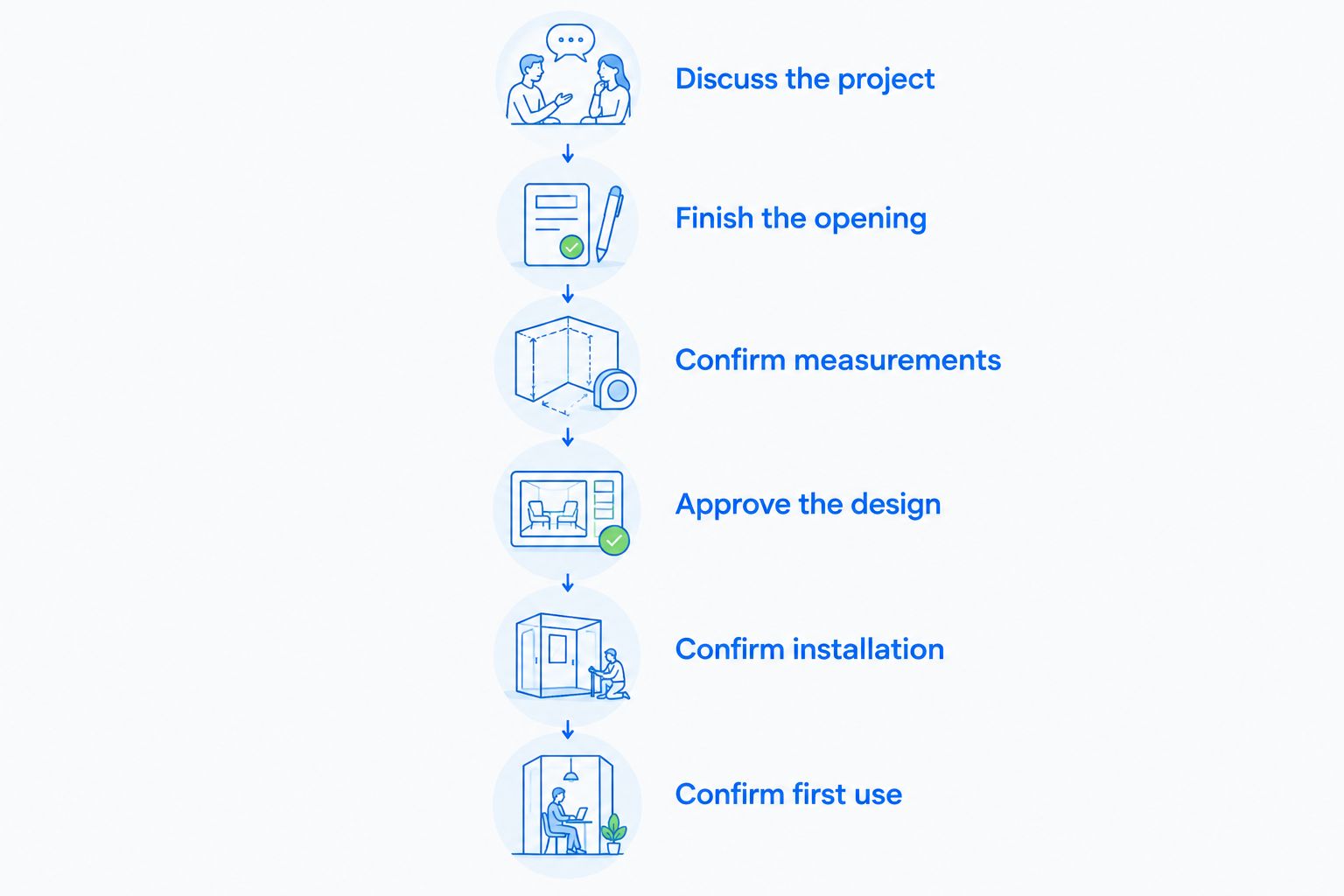
Contact an installer while you can still resolve layout questions without changing finished work. You do not need to wait until the bathroom is complete to discuss the enclosure. You do need to distinguish that early discussion from the final measurement used for fabrication.
Bring your proposed layout, photographs of the opening, and a description of the work still underway. Explain whether the project replaces an existing enclosure or forms part of a larger bathroom remodel. Those details give the scheduling conversation a clear starting point.
For a 2026 renovation, give the installer your desired first-use date—not just the day you hope to see glass installed. That lets you discuss the complete sequence without overlooking the period after installation.
Ask these questions during the initial conversation:
Do not interpret an early consultation as a reserved production slot or installation appointment. Ask explicitly what has been scheduled and what remains provisional.
The installer should define the required condition of the opening before taking fabrication measurements. Tile, wall finishes, the curb or threshold, and adjoining surfaces determine the space the enclosure must fit. Do not authorize glass dimensions from an opening that is still changing.
Coordinate this handoff with the person completing the bathroom. A surface that looks finished is not necessarily ready for the next trade; follow the applicable product instructions and the installer's site requirements.
Before the measurement visit, confirm:
If a contractor changes the opening after measurement, notify the enclosure installer before proceeding. Ask whether the approved dimensions remain valid. A small-looking change is not a reason to assume the glass will still fit.
This is also the point to resolve disagreements about responsibility. Identify who confirms site readiness and who authorizes fabrication so neither task falls between trades.
A custom enclosure schedule depends on the approved project and the steps needed to complete it. Ask which dependency controls your next milestone, rather than asking only whether the entire job can move faster.
For a 2026 deadline, record each dependency beside the person responsible for resolving it. A dated task with an owner is more useful than a general request to finish sooner.
Resolve decisions before approval and protect the measured opening afterward. These actions remove uncertainty without asking anyone to skip measurement, fabrication checks, or curing instructions.
Record the agreed enclosure configuration and selected details together. When you request a change, ask for an updated approval rather than relying on a separate message that leaves the original order ambiguous.
Share that approved information with the contractor coordinating the bathroom. The installation team and remodeling team should not be working from different assumptions about where the door or fixed glass will sit.
Tell the installer when the opening is actually ready, not when another trade hopes to finish. If the expected readiness date changes, communicate the change before the measurement or installation visit.
Clear updates let everyone reassess the next step. They do not replace confirmation that an appointment has been changed.
Ask how the crew needs to reach the bathroom and what must be cleared. Discuss stairs, entry arrangements, parking restrictions, and any building-access requirements that apply to your home.
Keep the work area available for the agreed appointment. Avoid booking another trade into the same space without first checking with the installer.
Use a short written summary after an important scheduling conversation. Include the next milestone, its date or status, and the action required from you.
For your 2026 project, label dates as requested, provisional, or confirmed. That simple distinction prevents a desired completion date from being repeated as an agreed commitment.
Lead time includes installation only when the quoted schedule explicitly says it does. Ask whether the stated interval ends when manufacturing finishes, when the enclosure is ready to schedule, or when installation is complete. Those endpoints are not interchangeable.
Also confirm the starting point. An interval measured from final approval cannot be applied to the date of your first inquiry without changing its meaning.
You can discuss the project before tile is finished, but the installer must decide when the opening is ready for final measurement. Preliminary dimensions support planning; they should not be treated as fabrication dimensions unless the installer approves that approach. Tell the installer exactly what work remains.
Use the shower only when the installer's instructions and the applicable sealant curing requirements permit it. Ask for the first-use instructions before the visit ends. Do not substitute a general online waiting period for instructions covering the materials actually used.
How far ahead should I book a custom shower door installation?
Discuss the enclosure early enough to coordinate finished-opening measurement, design approval, fabrication, and installation. Get a project-specific schedule before treating your bathroom completion date as confirmed.
When does custom shower door installation lead time start?
The starting point depends on the schedule you agree with the installer. Ask whether it begins at consultation, final measurement, order approval, or production authorization, and have that starting point recorded.
Does choosing a frameless shower door mean a longer wait?
Do not assume a frameless enclosure has a longer lead time solely because it is frameless. Request the schedule for your approved configuration and ask which stage determines the completion date.
Can I change my shower door design after final measurement?
Ask the installer to review any design change before proceeding. A change to the configuration or opening needs to be checked against the approved measurements, fabrication status, and schedule.
Will replacing an existing enclosure avoid final measurement?
Do not assume the old enclosure's dimensions replace final measurement. Ask the installer what needs to be inspected and measured, particularly if removal or repair work changes the opening.
What should I ask Showerdoor about scheduling?
Ask Showerdoor when your opening must be ready, what starts the quoted lead time, and when installation becomes confirmed. Also request the instructions that determine when you can first use the completed shower.
Is the installation date the same as the bathroom completion date?
The installation date is not automatically the bathroom completion date. Allow for applicable curing instructions and any remaining work before declaring the shower ready for use.
Put the first-use date—not just the installation date—on your bathroom schedule. That is the milestone your household actually depends on. Before closing out your 2026 project plan, confirm who supplies that date and which instructions determine it.


